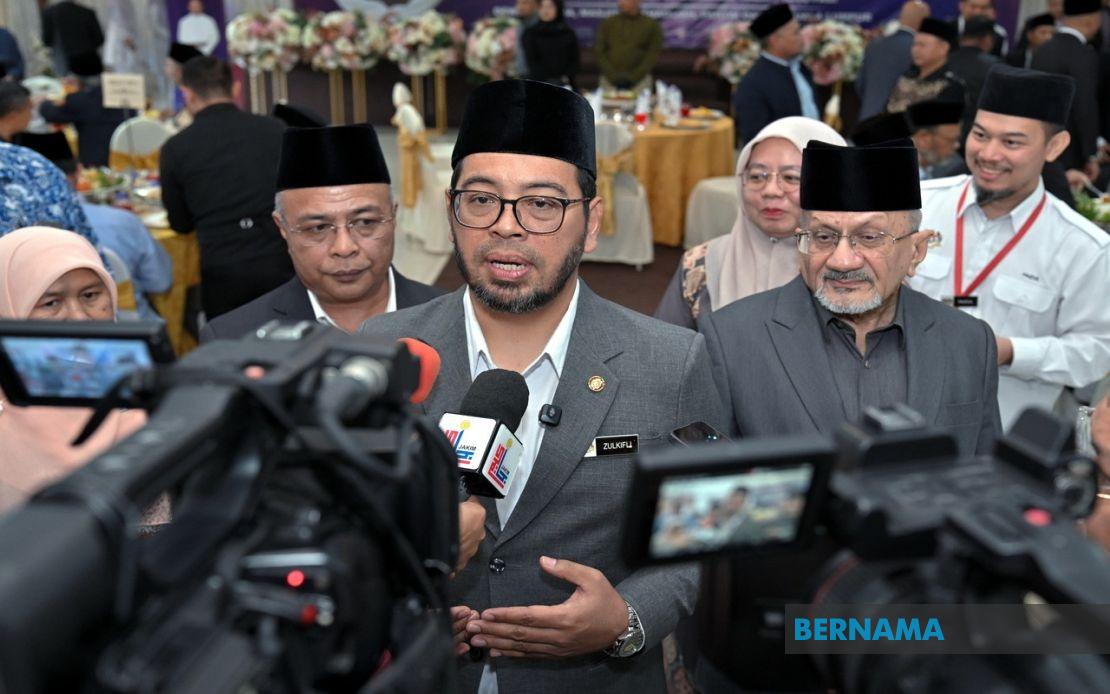
Construction of the Masjid Warisan mosque, which will be situated prominently in front of the Tun Razak Exchange (TRX) tower in Kuala Lumpur's financial district, will move forward as originally planned, according to Minister in the Prime Minister's Department (Religious Affairs) Dr Zulkifli Hasan. The project represents a long-standing commitment by the federal government to expand religious infrastructure in the capital's most prestigious commercial development, and the minister's confirmation signals a decisive resolve to see the initiative through to completion despite recent controversy surrounding its implementation.
Dr Zulkifli emphasised that the decision to proceed reflects a deliberate policy objective to reinforce the role of mosques as institutions fostering social cohesion and community wellbeing. Rather than viewing religious facilities and modern commercial developments as incompatible, the government sees the Masjid Warisan as an opportunity to integrate spiritual spaces into the nation's most ambitious urban renewal projects. The minister's framing of mosques as repositories of tranquillity underscores a broader vision in which Islamic infrastructure serves not merely devotional purposes but contributes meaningfully to the social fabric of contemporary Malaysian cities.
The announcement comes amid pressure from certain quarters advocating for the project's abandonment, with critics contending that the mosque's construction could generate social discord and fuel public dissatisfaction. These concerns, though not elaborated in official statements, appear rooted in sensitivities surrounding religious visibility in a predominantly commercial precinct and perhaps broader anxieties about the pace of religious development in major urban centres. Nevertheless, the minister's unequivocal endorsement suggests the government views these objections as insufficient grounds for abandoning an initiative framed as integral to its religious and social policy agenda.
For individuals harbouring reservations about the project, Dr Zulkifli directed them to the Federal Territories Islamic Religious Council (MAIWP) for additional context and clarification. This approach positions the MAIWP as the appropriate institutional channel for addressing public concerns through dialogue rather than capitulation, essentially inviting stakeholders to seek reassurance through established administrative structures rather than through policy reversal. The move reflects an implicit confidence that transparent engagement with MAIWP representatives will assuage legitimate concerns about the mosque's integration into TRX's urban landscape.
The minister drew comparative context by observing that prominent mosques have long constituted integral elements of major cities globally, with the Islamic call to prayer serving as an ambient feature of urban life in diverse metropolitan environments. This international precedent implicitly positions the Masjid Warisan not as an anomalous insertion into a secular commercial district but as a natural and customary urban feature found throughout cosmopolitan centres worldwide. By framing the project through a cosmopolitan lens, Dr Zulkifli subtly rebutted the notion that religious facilities represent incongruities within finance-oriented urban settings.
Beyond the Masjid Warisan discussion, Dr Zulkifli's presence at Masjid Al-Khadijah in Kampung Pantai Dalam served another significant administrative function. The minister formalised appointment letters for members of the Federal Territories Mosque and Friday prayer surau committee for the 2026-2029 term, symbolically reinforcing the institutional machinery overseeing religious administration across the capital. This ceremonial component of his engagement underscored the interconnected nature of grassroots mosque management and higher-level policy implementation.
The appointment process itself reflected considerable governmental commitment to institutional integrity and transparency. Across the Federal Territories' religious infrastructure, a total of 3,010 nominations were submitted for the 2026-2029 committee positions, distributed across 91 mosques and 124 Friday prayer surau facilities. From this extensive pool, 2,914 candidates ultimately secured selection following a rigorous integrity vetting process administered jointly by the Royal Malaysia Police, the Malaysian Anti-Corruption Commission, and the Insolvency Department. This multi-agency screening protocol demonstrates the seriousness with which federal authorities approach governance of religious institutions, ensuring that mosque leadership operates under exacting probity standards.
The scale of candidate processing—examining over 3,000 nominations and retaining nearly 2,914—suggests that the disqualification rate, while not negligible, remained relatively modest. This pattern implies that while the integrity vetting process functioned as a genuine filter, it did not operate as a systematic mechanism for excluding individuals based on arbitrary or political criteria. The involvement of law enforcement and anti-corruption authorities lends credibility to the screening's independence from religious or political patronage networks, theoretically ensuring that mosque committees reflect merit and integrity rather than factional alignment.
For Malaysian readers following religious policy developments, the Masjid Warisan announcement carries implications extending beyond the immediate project. It demonstrates the government's determination to integrate religious infrastructure into modern urban development initiatives despite resistance from certain segments, signalling a particular vision of Malaysia as a country where religious expression and commercial modernity coexist harmoniously. The decision also illustrates how religious affairs ministers employ comparative international examples and institutional channels to build consensus for controversial initiatives, effectively delegitimising opposition by reframing it as provincial rather than cosmopolitan.
The broader context suggests that Malaysia's approach to mosque development in premium commercial locations will likely influence similar projects regionally, particularly in Southeast Asian cities aspiring to comparable financial sophistication. If the Masjid Warisan succeeds as both a functional religious facility and an architecturally harmonious addition to TRX, it could establish a template for integrating Islamic institutions into upscale urban precincts throughout the region, challenging conventional assumptions about zoning and land use hierarchy. Conversely, should the project encounter implementation difficulties or community backlash, it may reinforce prevailing cautionary approaches to situating religious facilities in secular commercial districts.
The emphasis on transparency and multi-agency vetting in mosque committee appointments simultaneously addresses a persistent governance challenge across religious institutions globally—ensuring accountability and preventing institutional capture by factional interests. By systematising the appointments process and subjecting candidates to external scrutiny, Malaysian federal authorities appear to be working incrementally toward professionalising mosque administration, potentially reducing informal patronage networks that have historically characterised some religious institution governance in Southeast Asia.

