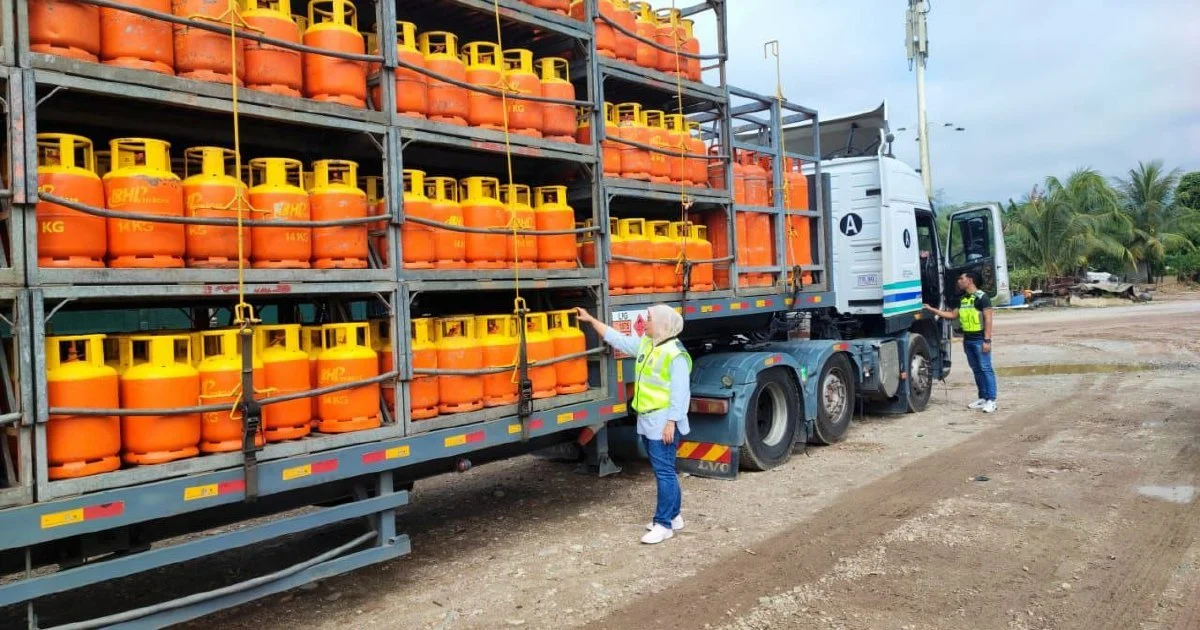
Enforcement officers acting on intelligence reports raided a fenced storage facility in Bentong, uncovering a significant stash of liquefied petroleum gas (LPG) cylinders worth RM405,000 that were being held on a commercial trailer. The discovery marks another major seizure in the ongoing crackdown against illicit fuel operations throughout the region, reflecting the scale at which unauthorised LPG distribution networks continue to operate despite increased regulatory scrutiny.
The operation in Bentong, a town straddling the Pahang-Selangor border known as a transit hub for commercial goods, points to the persistent vulnerability of fuel supply chains to illegal diversion. Enforcement agencies have intensified operations across this corridor following multiple intelligence reports suggesting organised diversion of controlled fuel products destined for legitimate commercial and domestic markets. The RM405,000 valuation reflects the black market premium that operators earn through unauthorised distribution channels, where oversight and safety standards are frequently compromised.
LPG cylinders represent a high-demand commodity in Malaysia's informal economy, particularly in smaller towns and rural communities where supply constraints and pricing pressures create opportunities for illicit traders. The concentration of such a large quantity at a single location suggests this was likely a consolidation point for distribution across multiple points of sale, rather than stock intended for immediate local consumption. This operational structure indicates a degree of coordination and planning characteristic of organised fuel smuggling networks that operate with some sophistication.
The seizure underscores broader challenges facing regulatory authorities in managing fuel distribution across Malaysia's extensive supply chain. Unlike petrol and diesel, which are subject to standardised pricing mechanisms and intensive monitoring at major distribution points, LPG operates through a more diffuse network involving direct-to-consumer sales, small retailers, and numerous middlemen. This fragmentation creates structural gaps through which diversions occur, and enforcement agencies face significant resource constraints in tracking unlicenced operators and informal distribution networks.
From a safety perspective, the operation highlights genuine public hazards associated with unregulated LPG handling and storage. Commercial cylinders stored improperly or handled by untrained personnel pose fire and explosion risks to surrounding communities. The fenced facility where these cylinders were discovered provided no guarantee of compliance with storage safety protocols, ventilation standards, or emergency procedures required for legitimate LPG operations. Such illegally maintained storage areas frequently lack proper documentation, insurance, and emergency response arrangements, creating preventable risks for nearby residents.
For Malaysian consumers, the existence of these diversion networks ultimately influences LPG pricing and availability in the formal market. When significant quantities are redirected through illicit channels, legitimate retailers and consumers face constrained supply during peak demand periods, while black market operators pocket profit margins that legitimate businesses cannot sustain. This creates perverse incentives for further diversion and discourages investment in formal distribution infrastructure, particularly in underserved areas where demand is sufficient to support illicit operations.
The Bentong location carries particular significance given the town's position as a commercial crossroads. The district's geography makes it convenient for operators moving diverted fuel products between supply sources and various consumer markets throughout the central and northern regions. Previous enforcement operations in Bentong have repeatedly uncovered similar caches of diverted fuel products, suggesting the location functions as a recurring distribution hub rather than an isolated incident site.
Enforcement authorities have indicated that investigations into the ownership and operation of the fenced facility remain ongoing. Determining the intended distribution network and identifying supply sources upstream represents the next critical phase of the investigation, as disrupting the entire chain from diversion point through to final retail outlets proves far more effective than seizing individual caches. Intelligence suggesting systematic involvement of specific operators or syndicates would enable authorities to target organisational structures rather than merely impounding commodities.
Regional implications extend beyond Bentong and Pahang. The volume seized suggests networks operating across state boundaries, potentially connecting Klang Valley markets with Peninsular distribution points. Coordination between Pahang and Selangor enforcement agencies, alongside federal authorities overseeing petroleum product management, remains essential for addressing the interstate nature of these operations. Without integrated intelligence sharing and coordinated enforcement strategies, operators continue shifting activities across jurisdictional boundaries to evade detection.
The discovery also reflects broader energy security concerns in Southeast Asia, where fuel theft and diversion remain persistent challenges affecting government revenues and market stability. As energy demand grows across the region and price differentials between formal and informal markets widen, opportunities for organised fuel smuggling operations expand correspondingly. Malaysia's experience mirrors challenges faced throughout the region, where capacity-building in regulatory enforcement and supply chain transparency represents an ongoing necessity.
Moving forward, authorities may need to revisit existing LPG distribution regulatory frameworks to incorporate better tracking mechanisms, perhaps including serialisation or digital documentation requirements at each transfer point. Developing intelligence capabilities to identify organisational patterns and financial flows supporting these operations would enable prosecution of network operators rather than street-level traders alone. Meanwhile, continued public awareness campaigns about the dangers of purchasing fuel from unlicensed suppliers remain vital for reducing consumer demand that sustains these illicit networks.

