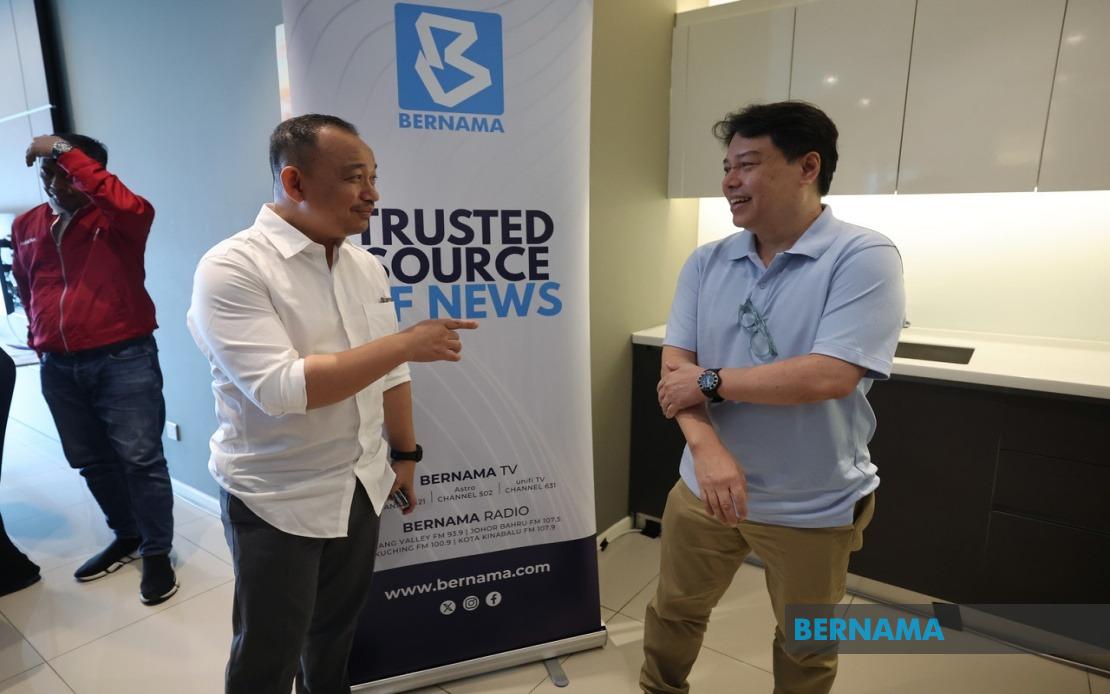
Dr Maszlee Malik, the Pakatan Harapan contender for the Puteri Wangsa state assembly seat in Johor, responded to an online challenge by taking a Perodua Myvi on a test drive through Tebrau and Ulu Tiram on June 29. The exercise was designed to give the former education minister direct exposure to the infrastructure complaints that have dominated social media conversations among local voters. The route traced a path beginning at Petron Kampung Melayu, traversing through Pandan and Kangkar Tebrau before reaching Ulu Tiram and returning towards the city centre.
The journey proved enlightening for Maszlee, who compared the experience of navigating the deteriorated road surfaces to sailing a traditional wooden vessel. The uneven pavement, with its pronounced dips and rises, created a jarring sensation that would be familiar to many Malaysian motorists struggling with similar conditions in their own constituencies. By physically undertaking the drive rather than simply hearing complaints, the candidate demonstrated a willingness to validate resident grievances through personal experience—a gesture that carries political weight during campaign season when constituents often feel their concerns are dismissed by distant officials.
Traffic congestion presented itself as a secondary but equally significant challenge along the route. Peak-hour driving revealed the genuine gridlock that commuters endure, particularly in residential areas such as Taman Daya and Taman Pelangi Indah. Maszlee's firsthand observation of vehicles queuing during congested periods provided context for understanding how poor road infrastructure compounds movement efficiency. The Myvi, chosen for its everyman appeal and durability, became a symbolic vehicle for this exercise—it is the car that ordinary Malaysians rely upon daily, making the candidate's choice both practical and politically astute.
During subsequent remarks at Bernama's operations room, Maszlee articulated a diagnosis of Johor's infrastructure challenges that extends beyond simple neglect. Rapid residential development across the constituency has outpaced the capacity of existing road networks to accommodate increased traffic volume. Areas surrounding Tebrau have experienced significant population growth, yet the transport arteries serving these communities have remained static or degraded further. This planning mismatch—where expansion in housing outstrips expansion in mobility infrastructure—mirrors challenges facing other major Malaysian states where rapid urbanization has overwhelmed civic planning frameworks.
The former Simpang Renggam Member of Parliament emphasized that remedying these structural problems demands coordination across multiple government agencies. The Public Works Department (JKR) would need to prioritize resurfacing and reconstruction efforts, while urban planners would require authority to mandate infrastructure upgrades before approving new residential developments. Such inter-agency collaboration remains notoriously difficult within Malaysia's layered governance structure, where federal, state, and local authorities often operate in silos. Maszlee's acknowledgment of this complexity—stemming from his experience at ministerial level—suggests awareness that campaign promises must contend with bureaucratic realities.
For Malaysian voters, particularly those in Johor where infrastructure maintenance has been a persistent grievance, Maszlee's approach signals a departure from the dismissal of everyday concerns that characterizes much political discourse. Rather than relegating road conditions to minor local matters, he positioned them as substantive policy issues deserving of serious analysis and resourced solutions. This framing acknowledges that quality-of-life infrastructure directly affects economic productivity, safety, and social cohesion—concerns that resonate across demographic groups.
The Puteri Wangsa constituency itself presents a competitive electoral battleground. With 128,723 registered voters, including 128,525 ordinary voters and 198 police personnel and spouses, the seat will be contested by five candidates in the Johor state election. Maszlee faces competition from Rashifa Aljunied representing MUDA, Teow Chia Ling of Barisan Nasional, Nicholas Paul Vincent from Parti Bersama Malaysia, and independent candidate Wang Wee Siong. This five-way split suggests no clear frontrunner and indicates that victory may depend on mobilizing specific voter blocs around targeted issues—infrastructure quality being among the most tangible and immediate concerns for residents.
Maszlee's campaign strategy appears to center on demonstrating responsiveness to constituent feedback. By accepting the Myvi challenge rather than dismissing it as frivolous social media engagement, he signaled that even unconventional forms of voter communication warrant serious consideration. This approach may appeal to younger voters and those active on digital platforms, demographics that have demonstrated increasing skepticism toward traditional political messaging. The visual narrative of a former federal minister subjecting himself to the same road conditions as ordinary commuters carries symbolic power in Malaysian political culture.
The timing of this exercise during the Johor state election campaign period—with polling scheduled for July 11 and early voting on July 7—suggests Maszlee recognizes that infrastructure issues will likely determine voter turnout in affected areas. Residents who have endured years of potholed roads and congestion view their ballot papers as instruments to demand accountability. By documenting his personal experience with these conditions, Maszlee positioned himself as a candidate who understands the lived reality of his constituents rather than governing from theoretical frameworks or urban planning documents.
The road conditions in areas like Tebrau and Ulu Tiram reflect broader infrastructure maintenance challenges across Malaysia's urban centers. Municipal authorities frequently struggle with funding constraints and competing budget priorities, leaving road repairs perpetually deferred. For residents in these constituencies, such deterioration translates into vehicle damage, increased commuting time, and diminished quality of life. When political candidates acknowledge these issues through direct engagement rather than abstract policy statements, they validate the cumulative frustration that voters have experienced with governmental indifference.
Looking forward, the outcome in Puteri Wangsa will partly reflect voter judgment on which candidate demonstrated genuine commitment to addressing infrastructure concerns. Maszlee's Myvi test drive represents one approach to building electoral credibility on this issue. Whether such gestures translate into actual policy implementation would depend not only on his election but on his capacity to marshal inter-agency cooperation and secure budgetary allocations—challenges that transcend individual candidate ambitions and involve the broader machinery of state governance. For Malaysian voters evaluating candidates in their respective constituencies, Maszlee's willingness to experience voter concerns firsthand offers at least a starting point for assessing his political commitment.

