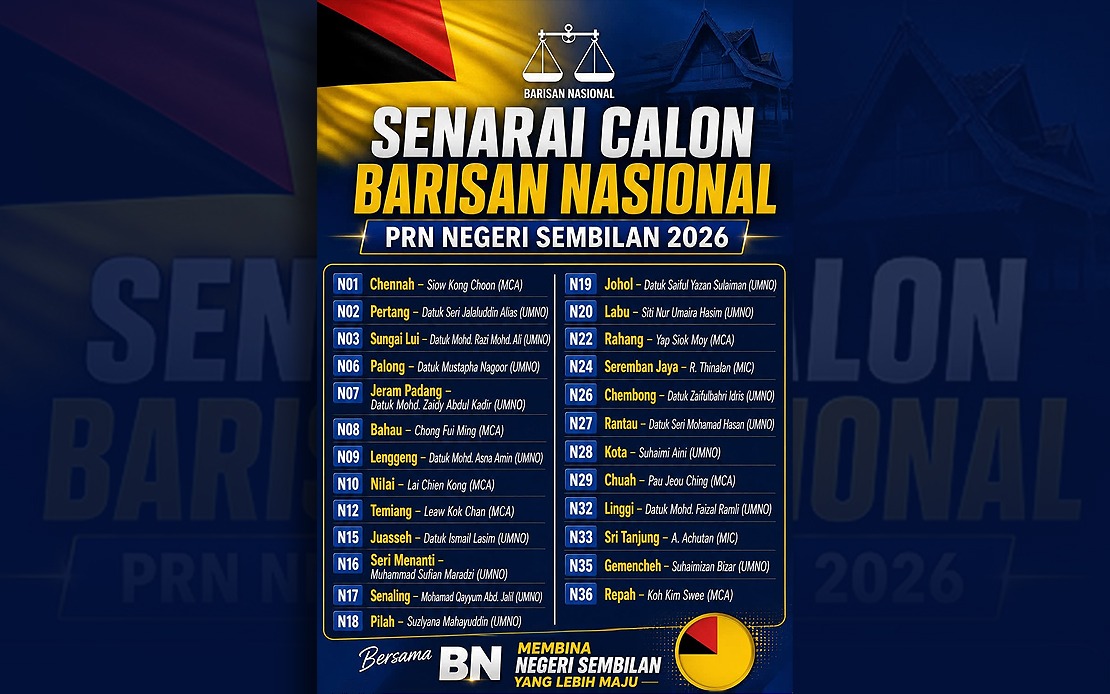
Barisan Nasional has finalized seat allocations for the 16th Negeri Sembilan state election, with coalition chairman Datuk Seri Dr Ahmad Zahid Hamidi announcing that the MCA will contest seven State Legislative Assembly seats while the MIC will stand in four constituencies. The division of seats reflects BN's strategy to optimize its chances across the state's assembly constituencies by deploying component parties where they are most competitive.
Ahmad Zahid, who simultaneously serves as Deputy Prime Minister, explained that the seat distribution methodology centres on assessing the competitive strength and victory potential of individual candidates within their respective constituencies. The coalition leadership conducted evaluations of prospective contestants, weighing factors such as ground support, local constituency dynamics, and historical electoral performance. This measured approach to candidate placement aims to maximize BN's representation in the state assembly following the August 1 polling day.
The BN chairman disclosed that he had personally met with all prospective candidates, requiring each to sign formal undertakings and pledge their allegiance to his leadership as the coalition's chairman. Such procedural steps are standard practice within BN during state-level contests, by-elections, and general elections, serving to formalize party unity and candidate commitment to coalition objectives. The gathering of candidates at Wisma UMNO Negeri Sembilan underscored the importance BN places on coordinated candidate selection and party discipline ahead of the campaign period.
Ahmad Zahid was scheduled to unveil the comprehensive list of BN candidates at a formal ceremony at Stadium Tuanku Abdul Rahman Paroi on the same evening, providing the electorate with complete information about the coalition's contenders. The announcement event represents a significant moment in the campaign calendar, allowing media, supporters, and voters to assess the caliber and profile of candidates selected by the coalition's leadership across all participating component parties.
The Election Commission has structured the electoral timeline with precision, setting July 18 as nomination day when candidates must officially register their candidacy. Early voting has been scheduled for July 28, enabling certain categories of voters including election personnel and those absent on polling day to cast their ballots in advance. The main polling day is set for August 1, when the majority of registered voters in Negeri Sembilan will determine the composition of their state assembly.
Context from the previous state election reveals the competitive landscape that BN now confronts. In the 15th Negeri Sembilan state election, BN secured 14 seats, falling short of the majority needed for government formation. Pakatan Harapan emerged as the dominant force with 17 seats, thereby claiming the right to form the state government. Perikatan Nasional captured five seats, fragmenting the opposition vote but also reflecting the polarization of Negeri Sembilan's electorate across three major political blocs.
The opposition's control of the state assembly has created substantial pressure on BN to recover ground lost in 2022. The allocation of seats to the MCA and MIC signals that BN strategists believe these component parties can make gains in specific constituencies, potentially reversing the coalition's fortunes. The inclusion of minority-based parties in the contest reflects BN's traditional multi-ethnic composition and its historical reliance on the MCA and MIC to represent non-Malay communities and secure votes from Chinese and Indian Malaysian voters respectively.
For the MCA, contesting seven seats provides a significant platform to demonstrate its continued relevance within Malaysian politics at a time when the party has faced internal challenges and electoral headwinds. The assignment of seats represents confidence by BN leadership that the MCA can contribute meaningfully to the coalition's recovery in Negeri Sembilan. Similarly, the MIC's allocation of four seats offers the party an opportunity to mobilize its support base among Indian Malaysian voters and contribute to coalition efforts in constituencies where Indian voters form a substantial portion of the electorate.
The strategic importance of Negeri Sembilan for the broader Malaysian political landscape cannot be understated. As a state election preceding any potential general election, the results will provide crucial signals about voter sentiment regarding the current federal government and the opposition's popularity. A strong BN performance would bolster confidence in the coalition's ability to govern, while conversely, a poor showing would strengthen narratives about declining public support for the incumbent federal administration.
The seat allocation process undertaken by Ahmad Zahid demonstrates the internal bargaining dynamics within BN, where component parties negotiate for representation proportionate to their perceived electoral contributions and historical standing within the coalition. The distribution between MCA and MIC, alongside implicit allocations to UMNO, reflects ongoing calculations about which parties possess competitive advantages in specific constituencies. These calculations carry implications for coalition stability and party morale heading into what could be a challenging campaign.
For Malaysian voters in Negeri Sembilan, the election represents an opportunity to assess whether they wish to maintain Pakatan Harapan's government or return BN to power. The coalition's strategy of deploying different component parties in different constituencies suggests a sophisticated understanding of local electoral dynamics and voter preferences. Whether this strategy translates into seat gains remains to be determined once campaigning commences and voters make their preferences known during the nomination period and through to polling day.

