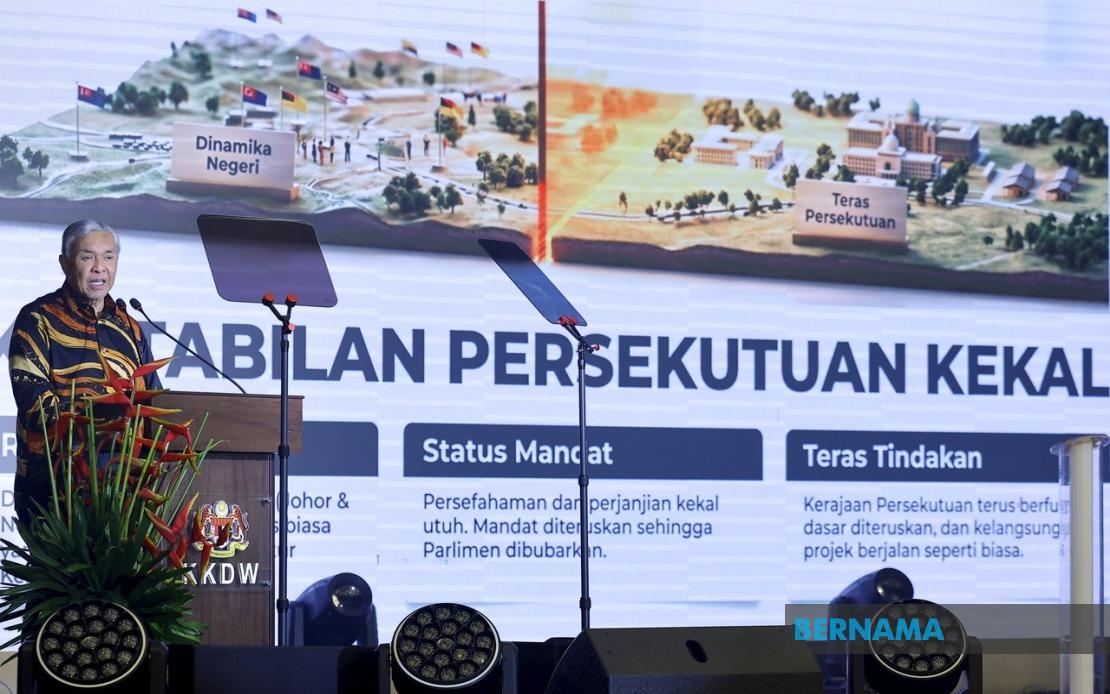
Barisan Nasional's Melaka chapter is positioning itself for a dominant performance in the forthcoming 16th state election, with party leadership committing to contest and win all 21 state assembly seats currently held by the coalition. BN chairman Datuk Seri Dr Ahmad Zahid Hamidi outlined the ambitious target while addressing reporters at the Rural and Regional Development Ministry's monthly assembly in Putrajaya on August 6, confirming that Melaka Chief Minister Datuk Seri Ab Rauf Yusoh has expressed unwavering determination to defend the coalition's entire existing portfolio.
The aggressive defence strategy reflects confidence in Melaka's political landscape, where BN maintains a commanding presence. Yusoh, who simultaneously chairs the state BN apparatus, has framed the retention of all 21 seats as a priority objective, sending a clear signal to party members and voters about the coalition's electoral ambitions in the state. This unified messaging from both the state and federal BN hierarchy suggests internal alignment on campaign strategy and candidate selection going forward.
Yet Ahmad Zahid's statements also introduced a note of flexibility into BN's posture, indicating that the coalition remains receptive to discussions with potential partners ahead of the election. This openness reflects the increasingly complex coalition dynamics within Malaysian politics, where BN has historically benefited from strategic alignments with other groups to maximise electoral outcomes. The possibility of negotiated arrangements suggests that BN leadership recognises the value of maintaining diplomatic channels with other political entities, even while pursuing an ambitious seat target.
The chief minister's receptiveness to dialogue carries particular significance given Malaysia's recent political volatility and the fragmentation visible in state-level politics. By signalling openness while maintaining the 21-seat target, BN appears to be hedging its approach—projecting confidence to the base while preserving room to manoeuvre if electoral mathematics or strategic considerations warrant adjustments. Such flexibility has become standard practice in Malaysian politics, where pre-election agreements between coalitions can significantly reshape outcomes.
Crucially, Ahmad Zahid emphasised that any final arrangements would require approval from BN's central leadership rather than being determined at the state level. This hierarchical decision-making structure underscores the coalition's centralised governance model and ensures that agreements with external parties align with broader national strategic objectives. The requirement for federal-level endorsement suggests that BN views the Melaka election within a larger political context, potentially considering how outcomes and alliances might influence other electoral contests or legislative dynamics.
Melaka holds strategic importance within the Malaysian political system, serving as a symbolic stronghold for BN and a barometer of the coalition's health following years of electoral turbulence at the national level. The state's voting patterns have historically reflected broader trends in Malaysian politics, making a strong BN performance in Melaka valuable beyond the state's own 21 seats. Victory there would provide momentum for BN ahead of other state elections and reinforce the coalition's narrative of political recovery.
The timing of Ahmad Zahid's announcement, delivered during a routine ministry assembly, indicates that BN is already intensifying its political ground game and messaging. By publicly articulating the 21-seat target, party leadership establishes clear expectations for campaign performance and signals to potential partners that BN enters negotiations from a position of institutional confidence. This approach is designed to attract coalition partners who perceive BN as a formidable electoral force.
From a regional perspective, Melaka's election carries implications for Southeast Asian coalition politics more broadly. Malaysia's experience with multi-party negotiations and coalition-building offers lessons relevant to other democracies in the region grappling with similar fragmented political landscapes. How BN balances its 21-seat ambition with potential coalition discussions will illustrate contemporary approaches to maximising electoral advantage while maintaining political flexibility.
For Malaysian voters and political observers, the BN position represents both a statement of electoral ambition and an acknowledgment of contemporary political realities. The coalition's unwillingness to completely foreclose coalition partnerships reflects understanding that Malaysian politics no longer operates on clear two-bloc lines. Instead, successful electoral performance increasingly depends on strategic partnerships calibrated to specific state contexts and voter preferences.
As Melaka moves toward its 16th state election, the coming months will determine whether BN can translate this publicly stated confidence into actual electoral support. The state's electorate will ultimately decide whether the coalition's 21-seat target remains aspirational or becomes achievable. Meanwhile, the internal BN dynamics and potential coalition negotiations will shape not only the campaign strategy but also the political landscape following election day, with implications extending well beyond Melaka's borders.

