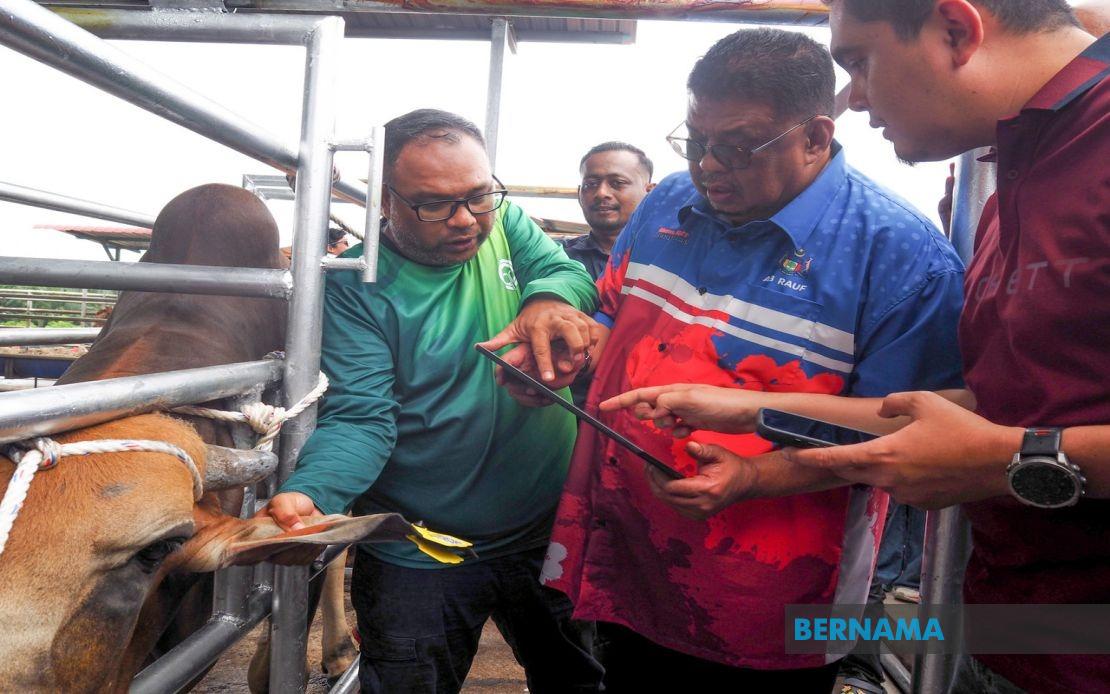
Melaka's state government has rolled out an innovative digital solution to one of its pressing agricultural challenges: a Livestock QR Tag system designed to revolutionise how the state manages and monitors its farm animals. The initiative, developed in partnership with the Melaka Veterinary Services Department, emerged from Chief Minister Datuk Seri Ab Rauf Yusoh's vision to integrate technology into livestock administration as part of a broader digitalisation strategy aimed at making Melaka a smarter, more livable state.
At its core, the system addresses a real problem that has worsened over recent years. Since 2023, Melaka has recorded 835 traffic accidents involving livestock and fielded over 50 complaints concerning stray animals roaming the streets. These incidents not only disrupt public order but create genuine hazards for motorists and pedestrians. By attaching QR-coded tags to individual animals, authorities can instantly access critical ownership data—breeder name, premises identification, and farm location—simply by scanning the code with a smartphone. This capability transforms what was once a time-consuming investigation into an immediate identification process.
The technical execution is straightforward yet effective. Each registered livestock receives a permanent tag containing a unique QR code that remains with the animal throughout its life, even if sold or transferred to a new owner. The breeder's information is stored in the eVetPermit Malaysia system, which can be updated to reflect changes in ownership without requiring a new tag. This design eliminates the administrative friction that often accompanies livestock transfers and ensures ownership records remain current and traceable.
The rollout has gained early traction. By early June this year, approximately 2,000 livestock had been fitted with QR tags, yet this represents only a fraction of Melaka's registered farming population. The state government aims to expand coverage across the entire estimated population of over 32,000 registered cows and buffaloes. The phased approach allows authorities to refine implementation while building breeder participation gradually, reducing the risk of adoption fatigue or system bottlenecks that plague rapid tech deployments in agriculture.
Breeders themselves have responded positively to the initiative, viewing the system as a tool that protects their commercial interests and enhances the standing of Melaka's livestock sector. This support is crucial; without farmer buy-in, even well-designed systems fail. The state government has sweetened participation by absorbing the installation cost of RM6.50 per tag until the end of 2024, allowing breeders to register animals with the Melaka Veterinary Services Department and receive tags free of charge. After this promotional period, new installations and replacements will cost breeders RM5 per head starting in 2027, establishing a sustainable cost-recovery model.
Beyond immediate identification benefits, the QR Tag system creates infrastructure for broader livestock management functions. Disease surveillance becomes more efficient when authorities can trace animal movements and contacts through ownership records. Enforcement against unlawful or negligent animal husbandry improves when responsibility can be attributed swiftly. The system also produces data—which animals are registered, where they are located, movement patterns—that state agricultural planners can use to optimize herd health programs, vaccination campaigns, and biosecurity protocols. Over time, this data layer transforms livestock administration from reactive complaint-handling into proactive management.
The initiative reflects a wider regional trend toward agricultural digitisation, though Melaka's approach is notably practical rather than aspirational. Unlike some smart farming projects that remain confined to demonstration zones, this system plugs directly into an existing regulatory framework (the eVetPermit Malaysia system) and solves an immediate public safety problem. Southeast Asian states grappling with rapid urbanisation and land-use conflicts between rural and urban areas will likely watch Melaka's results closely. As cities expand into agricultural hinterlands, stray livestock incidents become more frequent and more costly; a replicable digital solution holds appeal.
Mahathir Mustafa, chief assistant secretary of the Local Government Unit within the Chief Minister's Department, has framed the QR Tag initiative as emblematic of Melaka's commitment to technology-enabled governance. He emphasises that close collaboration between the Local Government Unit, Veterinary Services Department, and municipal authorities (Petubuhan Bandaraya Terpilih) is essential to implementation success. This institutional alignment matters; livestock management requires coordination across multiple agencies, and fragmented efforts typically produce fragmented results. Melaka's centralised coordination through the Chief Minister's office signals genuine governmental priority.
The system also addresses a subtle but important shift in breeder responsibility. When an animal's identity is instantly traceable, ownership becomes undeniable, and breach of care standards becomes indefensible. This psychological and administrative effect—the knowledge that one's animals can be located and connected to one's name within seconds—incentivises better husbandry practices. Negligent breeders cannot hide behind anonymity or vague ownership chains; accountability becomes immediate and personal.
Looking ahead, Melaka's government has signalled ambition to extend technological integration across other economic sectors, with agriculture serving as a proof-of-concept. The livestock QR Tag system is relatively modest in scope and cost, making it an ideal test case for scaling digital management tools. If the system successfully reduces stray animal incidents, accelerates owner identification, and enhances disease monitoring, it will build internal case studies and public confidence for more ambitious digitalisation projects.
For Malaysian livestock breeders beyond Melaka, the system offers a template worth studying. Other states facing similar stray animal challenges—Selangor, Johor, and Perak, with their larger cattle populations—could adapt Melaka's model, particularly given the existence of the national eVetPermit Malaysia platform that can host registration data across state lines. A regionally standardised QR Tag system would amplify benefits, enabling movement tracking across borders and facilitating coordinated disease response across Malaysian livestock populations.
The human element also matters. The government's decision to subsidise tag costs signals that livestock welfare and public safety are public goods worthy of public investment, not burdens to be shifted entirely to farmers. This approach encourages compliance and demonstrates that smart governance need not mean austerity. The RM6.50-per-head cost, absorbed by the state treasury until year-end, is modest relative to the potential savings from prevented accidents and reduced complaint processing.
Melaka's Livestock QR Tag system ultimately represents pragmatic digital governance: a focused solution to a defined problem, built on existing infrastructure, funded sustainably, and designed with stakeholder input. As Southeast Asian governments seek to balance agricultural development with rapid urbanisation, such practical applications of technology—as opposed to grand but unrealistic smart city schemes—offer a useful roadmap for policymakers across the region.

