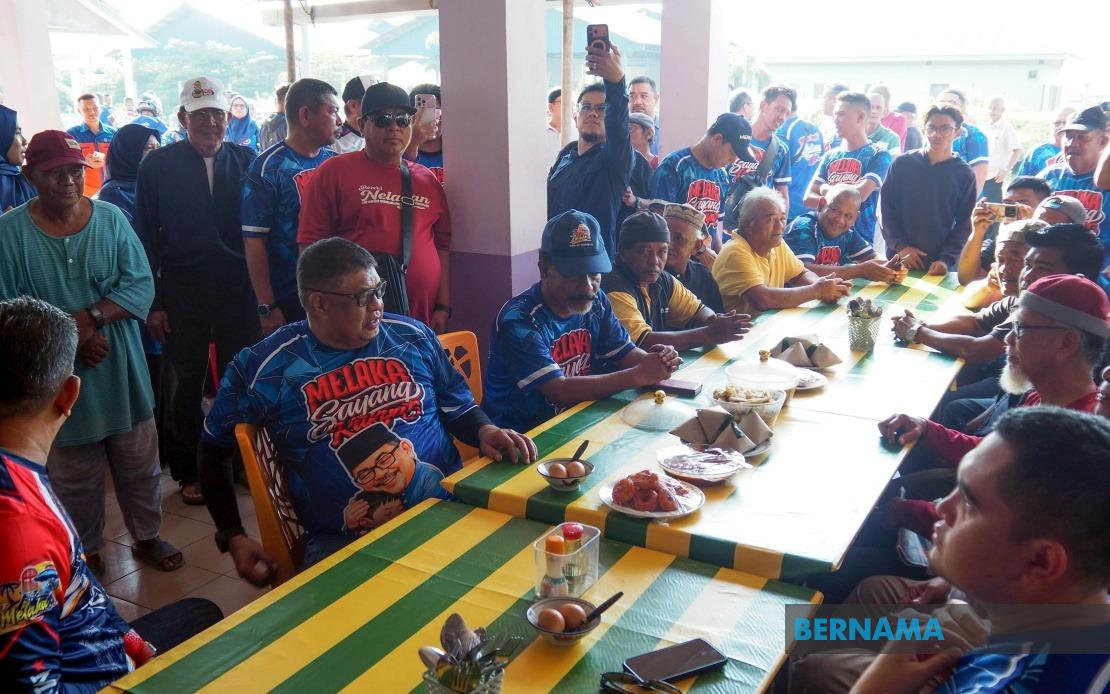
Melaka is rolling out a substantial welfare programme aimed at transforming the economic prospects and occupational safety of its fishing community, with Chief Minister Datuk Seri Ab Rauf Yusoh unveiling PERKESO coverage and fish finder technology for all registered fishermen during a grassroots engagement tour in the Merlimau constituency. The initiatives, presented during the fifth stop of the Chief Minister's 'Jelajah Ketua Menteri Sayang Rakyat' community tour, signal a strategic shift toward modernising a sector long dependent on traditional methods and represent an effort to directly address vulnerabilities facing Malaysia's coastal workforce.
The Chief Minister emphasised the government's commitment to engaging fishermen at ground level rather than governing from state offices, travelling with members of the State Executive Council to understand community concerns firsthand. This hands-on approach yielded concrete outcomes: during the Kuala Sempang Jetty gathering, 107 registered fishermen received RM200 each under the 'Bantuan Jaring Nelayan' scheme, channelling RM21,400 directly into the community. The government simultaneously distributed 360 kilogrammes of fish valued at RM3,600 to residents, allocating approximately 1.5 kg per person as part of broader efforts to support both producers and consumers.
The introduction of fish finder technology addresses a critical operational challenge that has constrained productivity in Malaysia's artisanal fishing sector. These electronic devices enable fishermen to locate concentrations of fish with precision, eliminating reliance on experience-based estimation that often proves inefficient and time-consuming. For fishermen like Amirul Shah Fuad Shah, a 35-year-old operator from Kuala Merlimau with over two decades of experience, the technology represents transformative potential. Amirul noted that fish finders typically cost between RM1,000 and RM2,000 when purchased privately, making government provision of this equipment particularly valuable for small-scale operators with limited capital.
The efficiency gains from fish finder adoption carry significant implications for household incomes throughout Melaka's fishing communities. By reducing the time spent searching for productive fishing grounds and enabling targeted net placement, these devices promise to increase daily catch volumes and reduce fuel costs associated with prolonged searching. For elderly fishermen and those entirely dependent on maritime livelihoods, such productivity improvements are not marginal enhancements but critical to sustaining viable incomes. The technology also aligns with broader regional efforts to modernise traditional fishing while maintaining small-scale, family-based operations that remain central to Malaysian coastal economies.
PERKESO coverage extension represents equally significant progress in occupational protections for a workforce chronically exposed to maritime hazards. Fishing ranks among Malaysia's most dangerous occupations, with workers facing risks of drowning, equipment injuries, and prolonged exposure to harsh weather conditions. Yet many fishermen historically operated outside formal social security systems, leaving families vulnerable to catastrophic income loss following workplace accidents or death. By extending mandatory PERKESO protection to all registered fishermen, Melaka addresses a critical social protection gap that has long exposed this community to uninsurable risks.
Kampung Sempang Fishermen's Association chairman Md Khalil Md Jadi, 67, characterised the PERKESO initiative as meaningful recognition of fishing's occupational hazards and acknowledged the sector's demographic realities. Many fishermen in Malaysia are advancing in age yet continue maritime work due to limited alternative livelihood options and modest savings. Without adequate social protection, an incapacitating injury or premature death creates acute hardship for dependent families. The extension of PERKESO thus provides both immediate reassurance and long-term security for an aging workforce with few exit options.
The dual-pronged approach—combining productivity enhancement through technology with enhanced social safety nets—reflects evolving policy thinking around informal sector development in Southeast Asia. Rather than attempting to eliminate traditional fishing through industrial consolidation or discouraging participation, Melaka's strategy invests in upgrading existing operations while protecting practitioners. This contrasts with approaches that view artisanal fishing as superseded and prioritise only industrial-scale alternatives. For Malaysia's coastal states, where fishing remains culturally significant and supports dispersed populations with limited alternative employment, such inclusive upgrading strategies carry particular relevance.
The initiative also carries implications for regional fisheries management and sustainability. Fish finders improve catch efficiency, but efficiency alone does not guarantee resource sustainability. The technology could paradoxically accelerate overfishing if deployed without accompanying stock management measures. Melaka's government must therefore pair productivity improvements with robust monitoring of catch volumes and species composition to prevent localised depletion. Coordination with federal fisheries authorities and neighbouring states will be essential to ensure that technological gains do not undermine long-term resource availability.
From a Malaysian policy perspective, Melaka's programme offers a replicable model for other coastal states managing comparable fishing communities. Peninsular Malaysia hosts substantial fishing populations in Perak, Selangor, Johor, and other maritime constituencies, many facing similar challenges of aging demographics, productivity stagnation, and inadequate social protection. If Melaka's approach proves effective in demonstrating measurable income and safety improvements, it could prompt comparable interventions elsewhere. The relatively modest financial commitment—approximately RM24,000 in direct cash assistance plus equipment costs—makes replication feasible even for states with constrained budgets.
The fishermen's positive reception reflects long-standing grievances about policy neglect and appreciation for targeted support. Amirul and Md Khalil both emphasised gratitude for government responsiveness, indicating that the Chief Minister's ground engagement strategy succeeded in generating community goodwill. However, sustained impact depends on follow-through: ensuring fish finders receive proper maintenance support, verifying that PERKESO coverage is genuinely activated and remains current, and monitoring whether income improvements materialise in actual catch data and family budgets. Symbolic gestures must translate into durable benefits.
Looking forward, Melaka's fisheries welfare expansion should include complementary investments in training for fish finder operation and maintenance, since many traditional fishermen may lack technical familiarity with electronic equipment. Partnerships with electronics retailers or vocational training centres could bridge this gap. Additionally, the state might consider extending support to processing and marketing infrastructure, helping fishermen capture greater value from improved catches rather than selling exclusively to middlemen at thin margins. Such layered interventions would compound the productivity gains from technology introduction.

