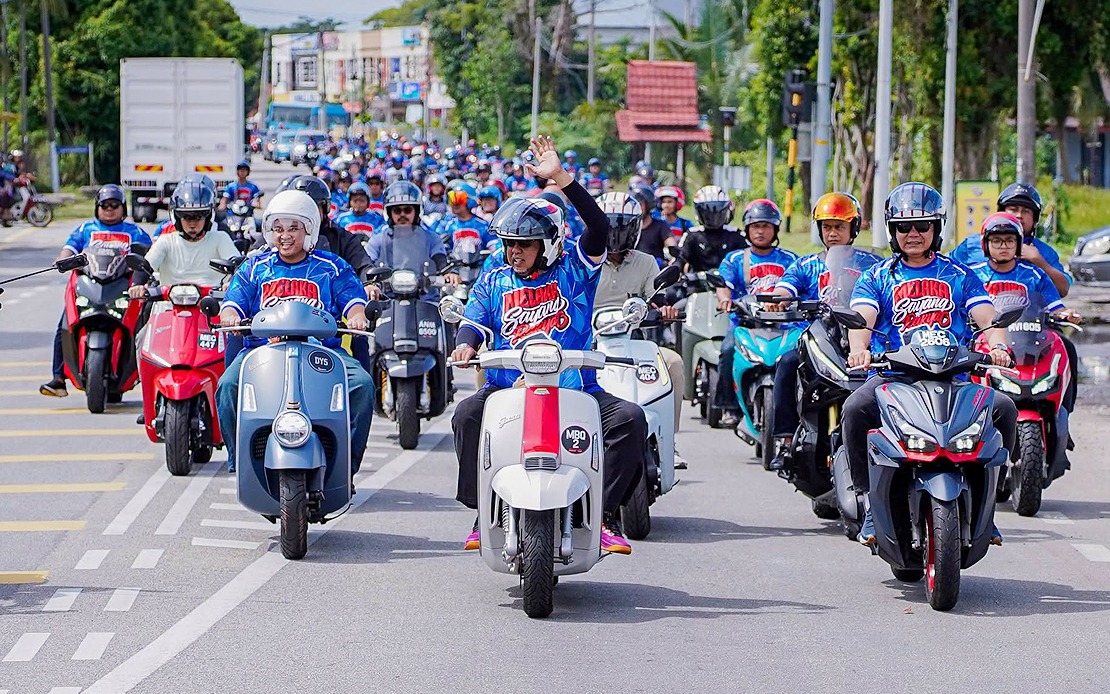
Melaka Chief Minister Datuk Seri Ab Rauf Yusoh has unveiled an expansion of the state government's grassroots engagement platform, with a comprehensive two-phase rollout that will blanket the Pantai Kundor and Paya Rumput state constituencies. The initiative, known as WRUR and branded as Kampung Kita in this iteration, reflects a strategic commitment to direct community interaction as a mechanism for identifying and addressing constituent grievances at the parliamentary level.
The programme will deploy more than 200 separate activities across multiple policy domains, ranging from welfare assistance and community infrastructure to education, youth development, and small business support. Rather than presenting itself as a seasonal campaign, Ab Rauf positioned WRUR as an institutionalised component of Melaka's governance model, emphasising that the state has pursued similar engagement efforts consistently over the preceding 24 months. This framing suggests a deliberate shift toward embedded community listening mechanisms rather than episodic political activation.
The cumulative impact of previous WRUR phases has proven substantial in quantitative terms. Across 23 implementation cycles, the platform has accumulated over 4,000 formal complaints from constituents, with nearly 70 per cent achieving resolution. This resolution rate indicates either effective administrative follow-through or, alternatively, the resolution of lower-complexity issues while more structural problems languish—a distinction worth examining in future evaluations. The data point signals that state governments increasingly view complaint resolution metrics as performance indicators, a development that carries implications for administrative accountability across Malaysia's federal system.
Within the Tangga Batu parliamentary constituency specifically, WRUR has previous operational history. Earlier phases targeting the Sungai Udang and Kelebang state constituencies yielded 359 documented complaints, with 328 subsequently closed and 31 remaining under active review. The 91 per cent closure rate in this narrower context exceeds the overall programme average, suggesting either spatial variation in issue complexity or differential administrative capacity by topic area. The persistence of 31 unresolved cases indicates that certain problem categories—potentially involving inter-agency coordination, technical feasibility, or resource constraints—require extended timelines.
The current phase distributed assistance totalling RM150,000 across multiple beneficiary categories, disaggregated in ways that reveal targeted priorities. Fisheries represented the largest allocation, with RM22,000 distributed among 220 fishing households, suggesting both the economic importance of this sector in coastal Melaka constituencies and government intent to address vulnerability within the community. Small maritime incidents received dedicated support: RM1,500 was earmarked for five boat owners affected by sinking incidents, a category suggesting recent localised disasters or chronic infrastructure deficiencies in fishing harbour facilities. Small and medium enterprises received RM14,000 in equipment support benefiting ten operators, indicating a microeconomic development strand within the programme.
Beyond direct cash transfers, the WRUR initiative encompasses institutional support. Religious education facilities, houses of worship, student bodies, and homeowners experiencing housing distress all received contributions, reflecting a holistic approach to community welfare spanning economic, spiritual, and residential dimensions. This breadth suggests that the programme operates as a coordination mechanism across multiple Melaka state departments and possibly federal agencies, though the exact institutional architecture remains opaque from publicly available information.
Infrastructural investment forms the programme's most capital-intensive component. The Department of Irrigation and Drainage has mobilised RM50,000 for cleaning and maintenance operations at Sungai Seberang Gajah, with completion targeted for the following week. This intervention responds directly to recent flash flooding that damaged 73 residential structures in Pantai Kundor, demonstrating that WRUR integrates reactive disaster response with proactive asset management. The timing is politically significant: rapid response to environmental disasters strengthens constituent perceptions of state responsiveness and creates visible evidence of government action.
Downstream from immediate maintenance work, the Department of Irrigation and Drainage has initiated procurement processes for RM100,000 in improvement works at Sungai Lereh, suggesting systematic asset evaluation and multi-year capital programming. More ambitiously, the Public Works Department has pursued federal approval for a RM16 million infrastructure upgrade addressing the crossing culvert structure on Jalan Tangga Batu-Tanjung Minyak. This project scale indicates collaboration between state and federal entities, with Melaka requiring federal fiscal cooperation for substantial transportation infrastructure modifications.
The fiscal mobilisation underlying WRUR deserves scrutiny. Direct assistance of RM150,000 plus infrastructure commitments totalling RM166,000 represent meaningful state expenditure for a single parliamentary constituency. Extrapolated across multiple constituencies and implementation phases, annual grassroots programme spending reaches significant magnitudes. For Malaysian readers evaluating fiscal responsibility and policy priorities, these allocations warrant comparison against education, healthcare, and economic development budgets to assess resource distribution across competing state functions.
The expansion to Tangga Batu carries implications beyond local administration. This parliamentary seat has experienced competitive electoral dynamics, and WRUR's expansion timing may reflect both genuine governance philosophy and electoral calendar awareness. The programme's emphasis on complaint resolution creates objective metrics against which state performance can be measured—a development that potentially shifts electoral discourse from rhetorical claims to documented administrative outcomes. For voters assessing state government effectiveness, complaint resolution rates and infrastructure completion timelines offer empirical evaluation criteria.
Melaka's model of institutionalised grassroots engagement through WRUR represents one approach to bridging the distance between state bureaucracy and constituent needs. By combining complaint aggregation with visible resource distribution and infrastructure investment, the initiative demonstrates how state governments can operationalise responsiveness. Whether this model proves replicable across different state contexts depends on administrative capacity, fiscal resources, and political commitment—factors that vary substantially across Malaysia's 13 federal states and three federal territories.

