Melaka's small and medium-sized enterprise sector has received a substantial financial injection, with the Ministry of Entrepreneur Development and Cooperatives approving nearly RM100 million in capital for over 4,300 local entrepreneurs as of the end of May. The approval underscores the ministry's strategic focus on deepening access to financing for microenterprises, small and medium enterprises across Malaysia's various states, with Melaka emerging as a significant beneficiary of these efforts.
Minister Steven Sim articulated the ministry's philosophical approach to business financing during remarks accompanying the initiative, positioning capital allocation as a tool for broader economic circulation rather than merely supporting individual enterprises. His framing reflects a trickle-down economics perspective, wherein money channelled to business owners eventually benefits employees, suppliers and the wider community as funds continue moving through the economy. This reasoning has become increasingly central to government entrepreneurship policy as officials seek to justify direct subsidisation and concessional lending programmes to businesses rather than alternative fiscal interventions.
The scale of Melaka's allocation becomes clearer when positioned within the national context. During the first five months of this year, the ministry has approved RM5 billion in total financing, benefiting nearly 180,000 entrepreneurs nationwide. Melaka's near-RM100 million therefore represents roughly two per cent of the national disbursement, a proportion exceeding the state's share of Malaysia's population and suggesting either particularly strong application rates or targeted ministry concentration in the historically strategic southern state.
Sim's three-day working visit to Melaka, spanning June 19 to 21, coincided with the Hebatkan Perniagaan Malaysia Carnival, an engagement platform designed to foster direct dialogue between ministry officials and business operators. Such roadshow formats have become standard practice across Malaysian government agencies, allowing ministers to demonstrate commitment to grassroots entrepreneurship while gathering anecdotal feedback on policy implementation challenges. The carnival concept itself signals the ministry's desire to reframe business development as a celebratory, community-oriented endeavour rather than purely bureaucratic administration.
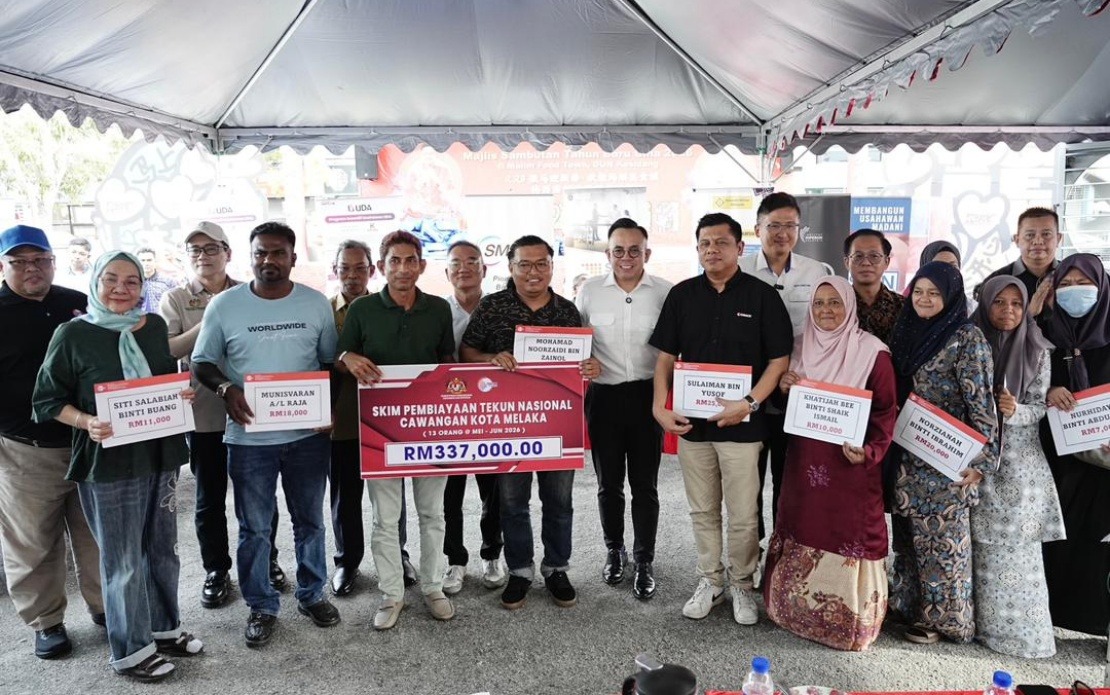
Among the visit's concrete deliverables was a financing presentation ceremony at Malim Food Town, where Minister Sim distributed nearly RM1 million across 18 entrepreneurs through TEKUN Nasional and SME Corp Malaysia. The recipients operated in diverse sectors including food and beverages, wholesale trade, professional services, construction contracting, retail, e-commerce, automotive and miscellaneous services. This sectoral diversity reflects both the breadth of MSME activity in Melaka and the government's intention to support business growth across economic segments rather than targeting specific industries.
The inclusion of online businesses among recipient categories demonstrates acknowledgment of digital commerce's rising importance in Malaysian entrepreneurship. Particularly in the post-pandemic environment, many traditional traders have pivoted toward e-commerce channels or hybrid models. The ministry's willingness to finance digital entrepreneurs signals receptivity to evolving business models, though the relatively small proportion of online businesses among the 18 recipients may suggest that e-commerce operators either face higher internal funding capacity or lower application rates to traditional government schemes.
The PowerUp10K initiative represents the ministry's most ambitious recent financing commitment, targeting RM15 billion in MSME capital allocation throughout this year. The initiative's naming convention suggests aspirational growth targets for participating businesses, with ten thousand possibly representing a target number of enterprise beneficiaries or a reference to ten thousand ringgit baseline financing per recipient. Achieving RM15 billion across the full year would represent a significant acceleration from the RM5 billion disbursed in the first five months, implying either substantial back-loaded spending in subsequent periods or adjustments to approval velocity and average loan sizes.
Minister Sim's broader comments regarding Malaysia's multicultural composition warrant analytical attention, as they frame diversity explicitly as an economic asset rather than a social characteristic. His assertion that Malaysia's racial, linguistic and cultural heterogeneity enhances both foreign investor appeal and local business expansion capacity reflects a particular political-economic perspective. Whether such diversity genuinely translates into tangible business advantages or functions primarily as rhetorical framing remains contested among economists, though the ministry's public messaging clearly positions it as a competitive advantage.
For Malaysian entrepreneurs, particularly those in competitive sectors where access to affordable capital remains constrained, government financing programmes provide critical alternatives to conventional banking channels. Commercial banks typically impose stringent collateral requirements and credit history standards that exclude many emerging entrepreneurs. By contrast, KUSKOP-backed schemes generally operate on concessional terms with more flexible eligibility criteria, effectively subsidising business formation and expansion through public resources. This creates both opportunity and risk, as subsidised financing can stimulate entrepreneurial activity but may also channel resources toward ventures with marginal viability.
Melaka's specific position within the national MSME ecosystem reflects its status as a state with substantial tourism-dependent commerce alongside traditional manufacturing and agricultural sectors. Food enterprises represented a notable portion of Ministry Sim's financing presentations, likely reflecting both Melaka's culinary tourism profile and the state's concentration of food processing and catering businesses. Understanding sectoral composition of MSME financing remains important for assessing whether capital allocation aligns with genuine market opportunities or reflects bureaucratic convenience in approving familiar business categories.
The ministry's public framing of these financing initiatives emphasises job creation and economic circulation, messaging likely designed to build broader public support for the programmes and justify government expenditure to taxpayers. However, the actual employment impact of MSME financing remains difficult to quantify without comprehensive monitoring data. Many entrepreneurs receiving capital may be proprietors rather than employers, meaning direct job creation effects per financing dollar may prove modest despite genuine business expansion occurring.
Looking forward, the sustainability of these financing programmes depends partly on repayment performance and default rates among recipients. Government-supported schemes sometimes struggle with loan recovery, particularly when political pressure inhibits enforcement actions against defaulting borrowers. Melaka's success as a financing demonstration case may be tested not merely by initial capital distribution but by whether recipients successfully establish viable enterprises capable of repaying obligations. This outcome depends on business management quality, market conditions, and macroeconomic stability—factors largely outside the ministry's direct control despite financing programme design.
The ministry's continued expansion of MSME financing reflects broader Malaysian policy commitment to private sector-led growth and entrepreneurship-centred development. Whether such capital allocation proves the most efficient use of public resources compared to alternative investments in infrastructure, education or technology remains a legitimate policy debate. Nevertheless, for the 4,300 Melaka entrepreneurs now accessing capital previously unavailable through conventional channels, the financing approval represents a tangible economic opportunity capable of transforming business trajectories and creating genuine local economic activity.

