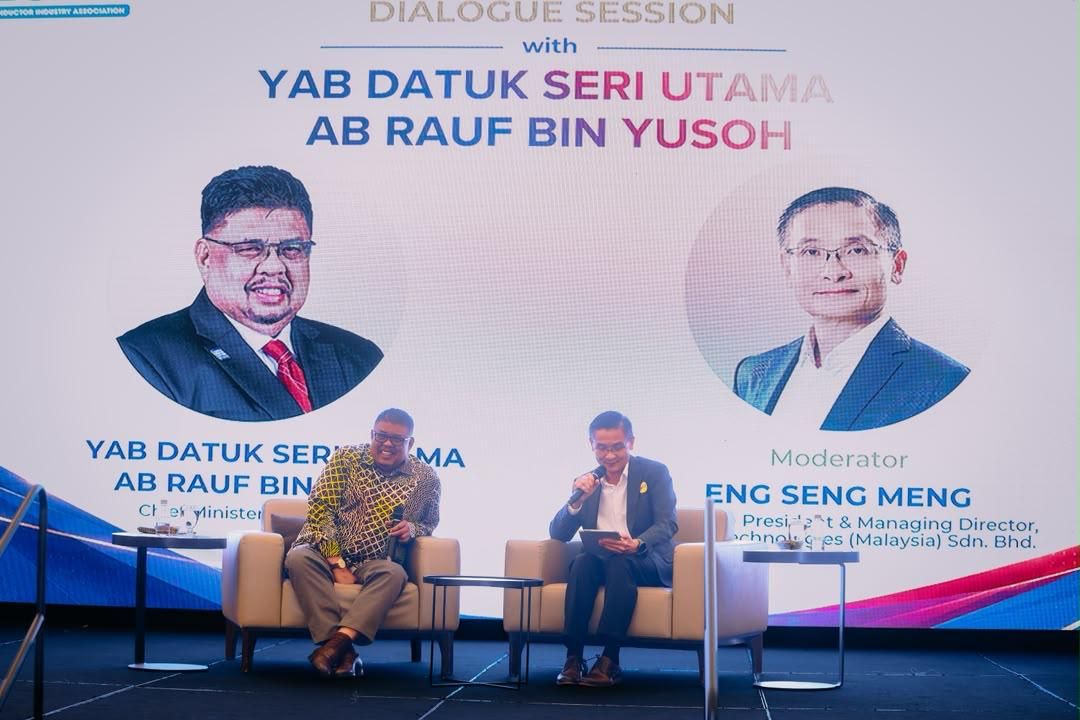
Melaka's semiconductor sector has evolved from a fledgling operation into a RM17.6 billion economic engine for the state, according to Chief Minister Datuk Seri Ab Rauf Yusoh. Speaking during an industry dialogue at a Melaka hotel on Thursday, he attributed the sector's transformation to more than five decades of continuous investment and development, tracing its origins to a pivotal decision by an international manufacturer to establish operations in the state during the early 1970s.
The journey began modestly, with the pioneer company initially operating from modest premises at an Umno building on Jalan Tuah before relocating to Batu Berendam following the creation of Melaka's first Free Industrial Zone in 1976. What commenced with a handful of workers has since matured into a globally competitive manufacturing hub, fundamentally reshaping the state's economic landscape and employment prospects. This progression reflects not merely the success of a single enterprise but rather Melaka's broader transformation into a technology and advanced manufacturing destination of regional significance.
Manufacturing now represents 36.1 percent of the state's gross domestic product, with more than 400 companies operating across 18 industrial sectors. The semiconductor and electrical and electronics subsectors remain particularly dominant, underpinning the broader industrial ecosystem and generating substantial value throughout the supply chain. This concentration of manufacturing activity has created a self-reinforcing cycle in which suppliers, service providers, and supporting industries cluster around the core semiconductor manufacturers, amplifying the sector's economic multiplier effects.
The industry's expansion has generated employment opportunities extending well beyond factory floors. The semiconductor ecosystem supports multinational corporations, local suppliers, and small and medium enterprises whilst providing livelihoods for thousands of workers and their dependents across the region. This employment diversity spans skilled technical positions in manufacturing and quality assurance through to supporting roles in logistics, maintenance, and administrative functions. The sector's maturation has enabled wage progression and career development pathways for workers who entered the industry decades ago, creating a stable economic foundation for multiple generations of Melaka residents.
Three principal factors sustain Melaka's competitive advantage in attracting and retaining semiconductor investments. The state's geographical position, nestled between Kuala Lumpur, Johor, and Singapore, provides manufacturers convenient access to major shipping ports, airports, and supplier networks whilst maintaining considerably lower operational and land costs than rival jurisdictions in the region. This locational advantage proves particularly valuable for semiconductor manufacturers requiring swift supply chain responsiveness and proximity to the broader Southeast Asian market. Additionally, Melaka possesses more than 2,600 hectares of available industrial land, offering companies flexibility to expand as production demands escalate.
Talent development emerges as the second critical pillar underpinning the sector's sustainability. The state operates 61 technical and vocational education institutions producing graduates aligned with semiconductor manufacturer requirements. This institutional infrastructure represents a deliberate investment in workforce readiness, distinguishing Melaka from competing locations and reducing employer recruitment costs. The alignment between educational curricula and industry demands reflects sustained collaboration between educational providers and manufacturers, ensuring training programmes remain current as manufacturing technologies evolve.
Confidence from multinational investors constitutes the third supporting element. Corporations from the United States, Germany, China, Japan, and elsewhere have sustained and expanded operations in Melaka for more than fifty years, signalling their assessment of the state's stability and business environment. This institutional investor confidence proves self-perpetuating; the presence of established manufacturers attracts complementary suppliers and service providers, reinforcing the ecosystem's attractiveness to prospective investors. The state's achievement of RM14.68 billion in investments across 312 projects during 2025 represents the highest investment value in twenty-two years, demonstrating continued investor commitment during a period of significant global semiconductor market uncertainty.
However, Ab Rauf acknowledged that Melaka confronts a critical juncture in semiconductor sector development. Decisions regarding manufacturing investments, research facilities, and supply chain positioning made in the coming years will likely determine technology geography for the subsequent decade or two. The semiconductor industry exhibits distinctive characteristics wherein location decisions carry prolonged strategic consequences; once manufacturers establish operations in competing jurisdictions, reversing that decision becomes economically prohibitive. This temporal urgency creates pressure for policymakers to implement investments and reforms swiftly, as delays risk losing market share to jurisdictions offering faster decision-making and deployment capacity.
The risks of inaction extend beyond foregone new investments. Existing manufacturers contemplating expansion projects may redirect planned capacity increases to alternative locations, whilst local supplier networks and small enterprises risk exclusion from burgeoning global semiconductor supply chains. The workforce implications prove particularly acute; if manufacturing expansion slows, the pipeline of employment opportunities for vocational graduates narrows, undermining the sector's utility as a source of stable middle-class employment. For Southeast Asia more broadly, Melaka's trajectory matters considerably; the state's continued strength as a semiconductor hub influences regional technology capability and economic competitiveness.
In response to these strategic pressures, Melaka has articulated the Semiconductor Strategy 2035, designed to consolidate competitive advantages whilst capturing emerging opportunities in advanced manufacturing segments. The strategy encompasses infrastructure investment, regulatory streamlining, and targeted incentive programmes designed to attract high-value manufacturing activities. Beyond formal policy mechanisms, Ab Rauf emphasised the state government's commitment to operational responsiveness, including expedited approvals, swift resolution of investor concerns, and sustained engagement throughout project lifecycle. This hands-on governmental approach recognises that investor decision-making incorporates not merely quantitative factors such as tax rates and land costs but qualitative assessment of regulatory predictability and government partnership quality.
Melaka's proposition to semiconductor investors encompasses multiple reinforcing dimensions. Strategic connectivity to major markets and suppliers combines with proven workforce development capabilities, stable political environment, and committed government support. The state's five-decade track record provides evidence of sustained sectoral commitment rather than ephemeral policy enthusiasm. For Malaysian policymakers, Melaka's semiconductor sector experience offers instructive lessons regarding the requirements for maintaining advanced manufacturing competitiveness in an increasingly globalised economy; success demands simultaneous attention to physical infrastructure, talent development, regulatory environment, and investor partnership. As global semiconductor supply chains reconfigure in response to geopolitical tensions and technological change, Melaka's positioning as a proven, capable alternative location gains strategic significance extending beyond the state's boundaries.

