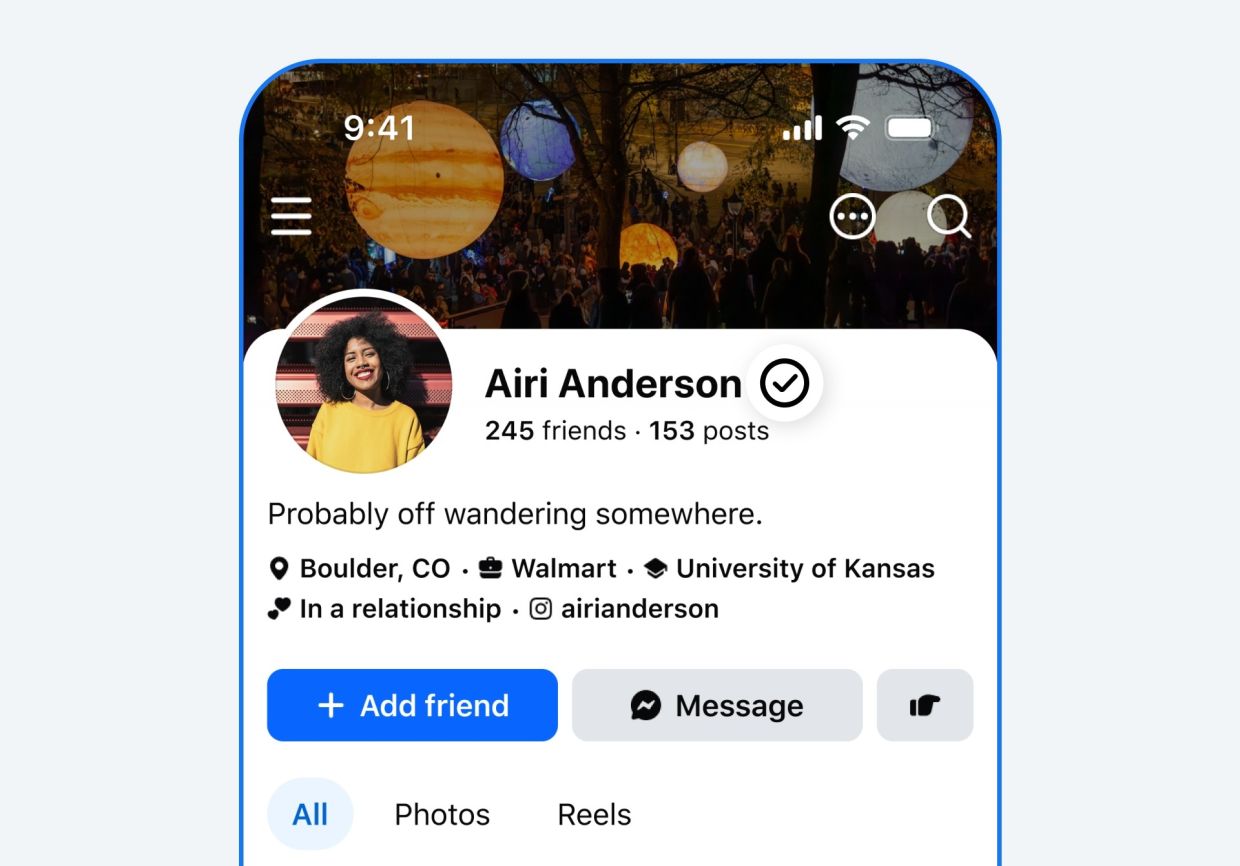
Meta is introducing a complimentary verification system for Facebook users in selected regions beginning July 27, enabling account holders to demonstrate their legitimacy through a brief video selfie. The initiative represents a significant shift in how the social media giant approaches user authentication and trust-building, particularly as artificial intelligence makes it increasingly simple to fabricate convincing digital identities. Eligible users will receive notifications directly on their Facebook profiles or within related services including Marketplace, Groups, and Dating, with rollouts scheduled across the coming months.
The verification process operates with deliberate simplicity and speed. When prompted, users record a short video of themselves, which Meta then compares against photographs already present on their profile. The company estimates this verification check takes only minutes to complete. Once approved, users receive a badge that appears across Facebook's ecosystem, with additional visibility on Feed posts arriving in subsequent phases. A particularly attractive feature for privacy-conscious users: Meta automatically deletes the video selfie and associated facial data within 30 days after verification, though users retain their badges indefinitely.
This free verification badge fundamentally differs from Meta Verified, the company's existing paid subscription tier that offers various premium features. By offering the basic verification at no cost, Meta is positioning authenticity confirmation as a foundational service rather than a luxury add-on. The timing aligns with recent statements from Meta founder and chief executive Mark Zuckerberg, who announced the previous day that the company was "betting on people" in response to AI-driven proliferation of fake profiles and fabricated content. Tom Alison, head of Facebook, similarly emphasised that the badge reinforces the platform's commitment to fostering "real connections between real people."
The stakes are particularly high on Marketplace, where Meta's e-commerce platform handles staggering transaction volumes. The company reports 430 million item listings and 44 million vehicle listings globally each month, while one in three young American adults on Facebook visit Marketplace daily. However, Meta explicitly clarifies that the verification badge carries important limitations. It confirms only that the video selfie matches the person on the account—it does not endorse the user, verify the legitimacy of their listings, or guarantee trustworthiness. The badge cannot confirm whether a seller actually owns advertised merchandise, intends to deliver it, or might attempt payment fraud.
Eligibility criteria establish baseline standards for badge recipients. Users must be at least 18 years old, maintain an account in good standing, and demonstrate no history of scams, fraud, deceptive practices, or other inauthentic behaviour. Notably, Pages and accounts operating under Professional Mode are ineligible. If Meta cannot verify a user, that person receives no badge but may attempt verification again later without facing account restrictions or usage penalties.
The verification process notably omits government-issued identification checks, a deliberate choice that separates Facebook Verified from formal know-your-customer protocols used in regulated industries. As Andras Cser, a vice president and principal analyst at Forrester Research, observes, the product primarily addresses "a reputation and user trust problem." While badges introduce additional friction to user interactions, they simultaneously enable more confident transactions. However, Cser cautions that Facebook Verified does not satisfy jurisdiction-specific regulatory requirements that financial and other heavily regulated sectors demand.
Other platforms have already demonstrated verification's commercial appeal. LinkedIn reports that over 100 million members have adopted some form of verification, with verified members receiving up to 60 percent more profile views and 50 percent greater engagement on posts. Tinder credits its video-selfie verification system with reducing interactions with fraudulent actors by more than half in markets where it operates. Although Meta claims verification will not affect user visibility, recommendations, or algorithmic distribution on Marketplace, commercial incentives may still emerge organically—buyers might naturally prefer transacting with verified sellers, creating de facto advantages.
Meta's fraud challenge is undeniable. The Federal Trade Commission reported that in 2025 consumers lost more money to scams originating on Facebook than any other social media platform. Across all social media platforms, reported losses reached US$2.1 billion, with shopping scams representing the most frequently reported category. This reality underscores why Meta executives view verification as essential infrastructure rather than optional enhancement.
The company's return to facial recognition technology, even in this narrowed form, resurrects historical controversy. Meta discontinued its broad facial-recognition system in 2021 and committed to deleting over one billion facial templates, citing regulatory uncertainty and public concerns about privacy and surveillance. The company preserved limited applications, including identity verification and fraud prevention, rationalising these uses as serving security interests. This latest initiative exploits that preserved capability while remaining within announced boundaries.
Security experts express cautious optimism tempered by realistic concern. James E. Lee, president of the Identity Theft Resource Center, acknowledges the program "could be a good use of biometrics," but emphasises that Meta has not disclosed sufficient technical detail to assess its genuine effectiveness. Lee's assessment includes an unsettling but inevitable observation: somewhere globally, professional cybercriminals are already developing methods to bypass the system or spoof verified profiles, suggesting that this technological arms race will continue indefinitely.
For Malaysian and Southeast Asian users, the verification badge carries particular relevance given the region's rapid e-commerce growth and corresponding surge in online fraud. Marketplace adoption continues accelerating across the region, where many users conduct transactions with unfamiliar buyers. The free verification option addresses barriers that paid subscriptions might impose in markets with lower disposable incomes. However, users should maintain realistic expectations—the badge confirms only that a real person operates the account, not whether they are honest, reliable, or will complete promised transactions. Sophisticated fraud will inevitably adapt to this new verification landscape, making ongoing digital literacy and caution essential even for verified transactions.

