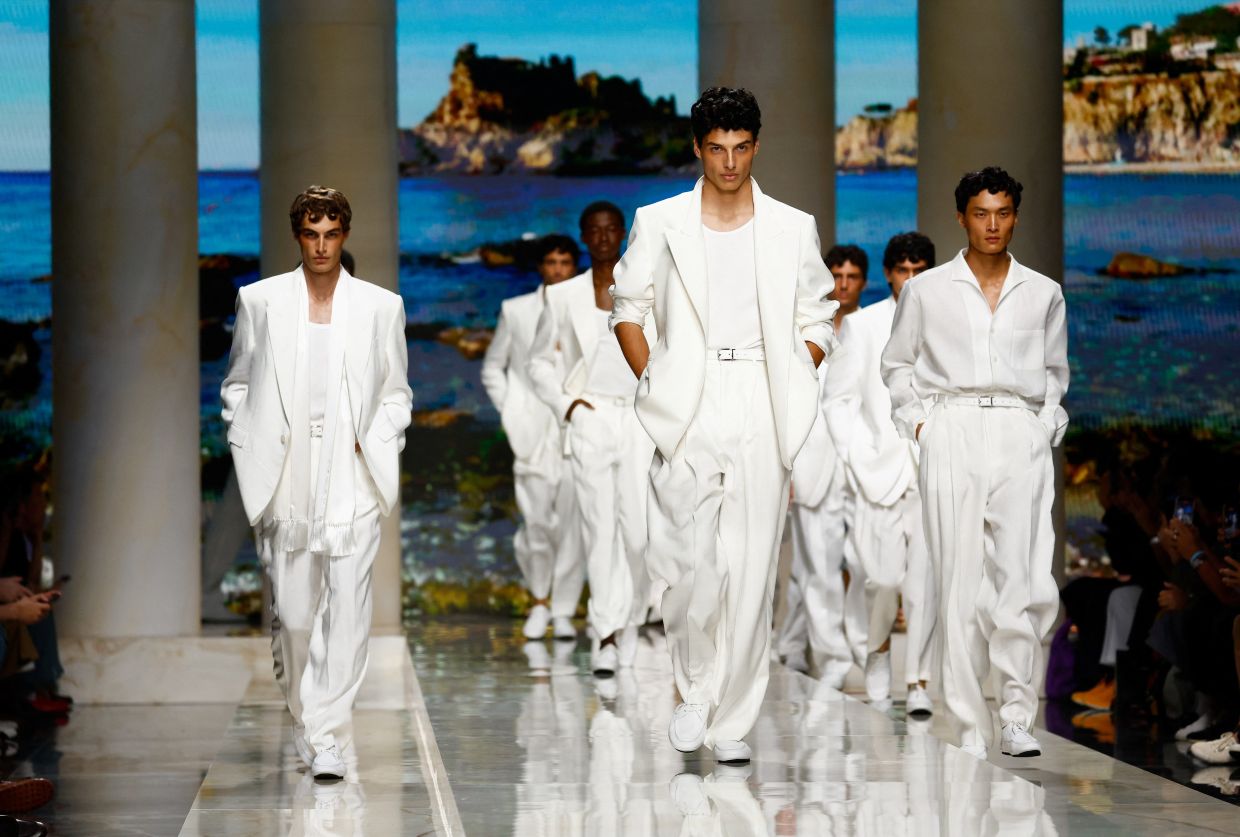
The menswear collections that closed Milan Fashion Week on June 22 revealed an industry in contemplation, with designers responding to geopolitical instability and economic uncertainty by stripping back to fundamentals. As temperatures soared during the showing season, the runway philosophy became clear: in complicated times, elegance lies in simplicity and proportion rather than excess. Co-creative directors Miuccia Prada and Raf Simons emerged as the season's intellectual anchors, demonstrating how reimagined proportions and careful fabrication choices could reinvent familiar wardrobe staples for a world that feels increasingly fragile.
The dominance of tailoring remained unchallenged across Milan's most prestigious houses, yet the execution shifted markedly toward lighter, more body-conscious silhouettes. Rather than abandoning the suit—that cornerstone of menswear formality—designers reimagined it for contemporary climates and sensibilities. The challenge facing Milan's elite became one of fundamental tension: how to maintain sartorial standards and the gravitas of structured tailoring while creating clothes that acknowledge both rising global temperatures and the psychological weight of uncertainty. This tension produced some of the season's most innovative solutions, as designers experimented with construction techniques that prioritised airflow without sacrificing elegance.
Leather presented perhaps the most unexpected trend in this context. Prada's approach proved particularly instructive, drawing inspiration from the democratic universality of denim to create leather five-pocket trousers paired with cropped, flat-pocketed jackets that functioned simultaneously as shirts. This conceptual framework—translating the vernacular language of blue jeans into luxury materials—illustrated how Milan's most sophisticated minds were thinking about accessibility and authenticity. Other designers pursued breathability through technical innovation, employing woven and perforated techniques that rendered leather more permeable without compromising its luxury associations. The paradox of heavy, traditionally warm materials appearing throughout a summer collection underscored fashion's peculiar logic: the elite may require generously air-conditioned environments, mountain retreats, or higher latitudes to wear some of these conceptually beautiful but thermally challenging pieces.
Ventilation emerged as a unifying design principle across collections, manifesting through unbuttoned dress shirts, transparent fabrics, and the strategic elimination of traditional layering. Some designers pushed further, rendering torsos visible or embracing cropped proportions that exposed the body. Dolce & Gabbana mounted perhaps the most provocative challenge to tailoring convention with microshorts that foregrounded musculature, an assertion that menswear need not default to length-based modesty. These approaches collectively signalled a generational shift away from the oversized silhouettes that dominated recent years, returning instead to a more deliberately body-conscious aesthetic. The effect was paradoxical: clothes that appeared minimal and pared-down often required considerable technical sophistication to achieve their apparent effortlessness.
Thom Browne's return to Milan for the first time since 2008, now operating under Zegna ownership, underscored how traditional American menswear sensibilities could intersect with European tailoring traditions. The designer's exploration of seersucker and pleated construction referenced summer dressing conventions while maintaining the architectural precision his brand is known for. This collection signalled that heritage and innovation need not exist in opposition, and that brands stepping outside their usual calendars could find meaningful platforms for reimagining their design languages. The season affirmed that formal menswear, despite predictions of its obsolescence, continues to evolve and adapt rather than calcify.
Yet not all of Milan embraced restraint. Philipp Plein presented crystal-encrusted denim requiring days of handwork, while Dolce & Gabbana leaned unapologetically into embellishment and beaded details evoking coral formations. These maximalist interventions offered a deliberate counterpoint to the season's dominant aesthetic, asserting that glamour, decoration, and labour-intensive luxury remain legitimate responses to uncertain times. The coexistence of reduction and maximalism across the collections suggested that Milan's menswear conversation encompasses multiple valid perspectives on how to dress in contemporary circumstances. Some designers argue that simplicity provides psychological anchor; others contend that beauty and ornamentation offer essential counterweight to global turbulence.
A lighter Milan calendar created unusual opportunities for emerging designers to gain visibility alongside established houses. Copenhagen-based Martin Quad made his Milan debut with unconventional tailoring techniques that translated regional recognition into international attention, while Domenico Orefice explored leather and richly textured weaving within a co-ed framework. Japanese designer Shinya Kozuka's inaugural Milan collection with his Shinyakozuka label emerged as one of the season's most poetically executed visions, exemplified by a bare-chested model wearing a billowing sheer teal coat over loose white trousers—an image that distilled the season's central preoccupation with airflow, proportion, and the relationship between body and fabric into a single arresting silhouette.
For Malaysian fashion enthusiasts and regional menswear consumers, Milan's Spring/Summer 2027 collections carry particular relevance. The emphasis on ventilated tailoring and breathable construction speaks directly to Southeast Asian climates, where formal dressing has long required technical solutions to tropical conditions. The season's philosophical embrace of lighter tailoring without abandoning structure offers validation for regional approaches that have always prioritised practicality within formality. Additionally, the confidence that emerged around shorter hems, exposed skin, and open construction suggests that regional preferences for less coverage-heavy formal wear align with global luxury trends, potentially democratising fashion conversations that typically centre European sensibilities.
The broader significance of Milan's menswear moment extends beyond seasonal trend forecasting. In presenting collections that acknowledge global instability without succumbing to escapism or excessive ornamentation, designers demonstrated the fashion industry's capacity to reflect and respond to contemporary anxieties. The emphasis on proportion, fabrication, and clarity of concept—rather than novelty for its own sake—suggested a maturation in menswear discourse. As geopolitical tensions persist and economic uncertainty influences consumer behaviour, these collections propose that luxury menswear's future lies in investment pieces that combine timeless silhouettes with technical innovation, elegant simplicity with sophisticated construction, and formal tradition with contemporary sensibility.

