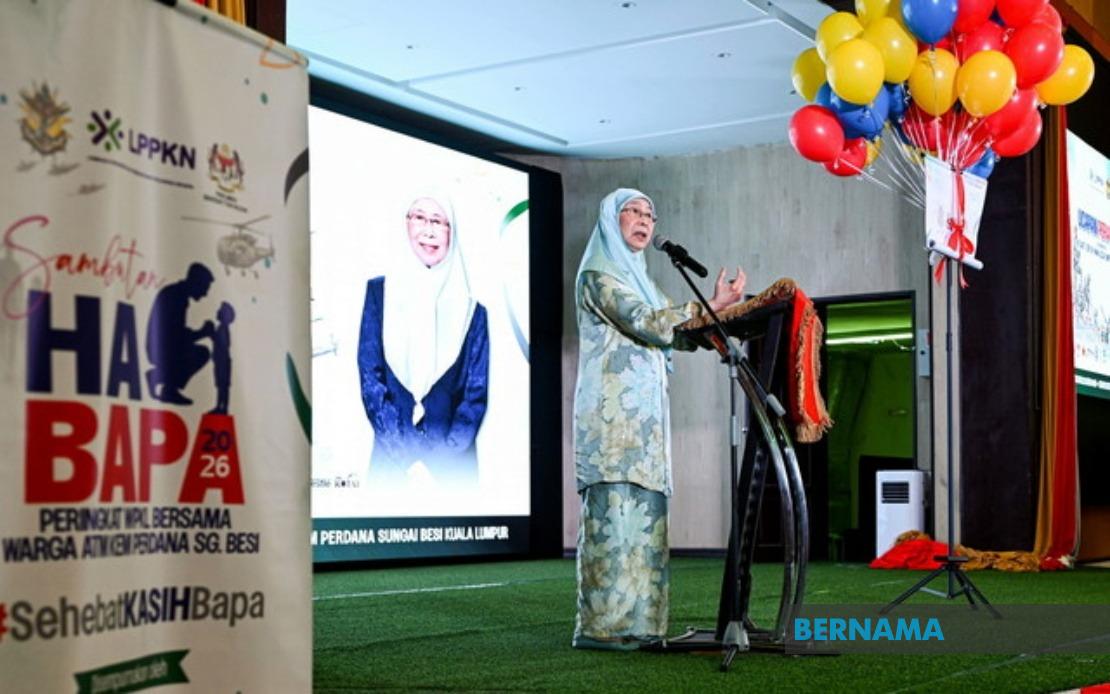
The Prime Minister's wife, Datuk Seri Dr Wan Azizah Wan Ismail, has underscored the critical importance of sustaining support systems for fathers serving in the Malaysian Armed Forces, recognizing both their contributions to national defence and the considerable personal sacrifices they make in balancing military obligations with family life. Speaking at the 2026 Federal Territory of Kuala Lumpur Father's Day Celebration, Dr Wan Azizah, the Bandar Tun Razak Member of Parliament, stressed that empowerment initiatives must remain a priority given the unique demands placed on military personnel who frequently spend extended periods away from their families while fulfilling their duty to safeguard the nation's sovereignty.
The gathering, themed 'Sehebat KASIH Bapa' (As Great as Father's Love), brought together approximately 500 participants including military fathers, their spouses, children, and representatives from various government agencies. The event was jointly organized by the National Population and Family Development Board (LPPKN) of the Federal Territory of Kuala Lumpur and the Malaysian Armed Forces (MAF), reflecting a collaborative approach to recognizing and supporting this often-overlooked demographic within the defence establishment.
Dr Wan Azizah articulated a vision in which support mechanisms work in tandem with broader family policies to enable military fathers to navigate the inherent tensions between professional commitment and parental responsibility. She emphasized that the National Family Compassion Policy (DKKN) serves as a crucial instrument in this effort, providing practical assistance that acknowledges the reality that defence personnel cannot always be physically present during significant family moments or routine household needs. By framing such policies as enablers rather than mere welfare provisions, she positioned support for military fathers as an investment in both family stability and institutional strength.
The remarks signal a broader governmental acknowledgment that strengthening families requires targeted interventions specifically designed for occupational groups facing distinctive pressures. Military service inherently demands geographic separation, irregular schedules, and exposure to physical and psychological stress—conditions that complicate traditional family dynamics. Without deliberate policy support, these circumstances can strain marriages, affect child development, and undermine the wellbeing of the service members themselves, creating a cascading effect on military readiness and morale.
A central theme in Dr Wan Azizah's address was the need to reconceptualize paternal roles within the broader framework of family leadership and institutional stability. She articulated that fathers occupy a foundational position within family structures and that elevating awareness of this role carries implications beyond individual households. By strengthening fathers' capacity to lead and nurture, societies reinforce the family as a stabilizing institution—a perspective gaining traction in development and social policy discourse across Southeast Asia.
The LPPKN has developed specific programmatic responses to this imperative. The Fatherhood Module focuses on equipping men with practical parenting skills and knowledge that transcend traditional models of masculine involvement in child-rearing. This initiative acknowledges that modern fatherhood extends beyond financial provisioning to encompass emotional availability, active participation in childrearing, and deliberate engagement in children's developmental needs. For military fathers, whose absence is periodic but predictable, such skills become even more critical—they must maximize the impact of limited time with their children and maintain relational continuity despite physical distance.
Complementing this skills-based approach is the Men Empowerment Network (MEN), a structural initiative designed to build solidarity and mutual support among men navigating shared challenges. Such peer networks have demonstrated effectiveness in changing behaviours, normalizing discussion of family roles, and creating safe spaces where men can process the emotional complexity of balancing competing demands. For military personnel, who operate within hierarchical structures that can sometimes inhibit candid discussion of personal struggles, such networks offer an alternative support architecture.
The timing and focus of this celebration carry particular relevance for Malaysia and the broader Southeast Asian region. As countries across the area grapple with modernization pressures, demographic shifts, and evolving family structures, intentional policies supporting paternal engagement become increasingly important. Research consistently demonstrates that involved fathers contribute to improved outcomes in child development, educational achievement, and long-term social cohesion. For a nation-state dependent on a professional military, ensuring the wellbeing of service members' families indirectly strengthens the institution itself by reducing stress-related attrition and supporting recruitment and retention.
Furthermore, Dr Wan Azizah's intervention reflects a gradual but significant shift in policy discourse around masculinity and family roles in Malaysia. Rather than treating fatherhood as peripheral to governance concerns, the government is increasingly recognizing men's engagement in family life as a legitimate policy domain. This represents a departure from traditional approaches that often treat family support as primarily a women's issue or focus exclusively on mothers and children. By centering fathers, particularly those in demanding professions like military service, the government acknowledges the diversity of family structures and the reality that sustainable family welfare requires engaging all members.
The gathering itself served a symbolic function beyond its immediate celebratory purpose. By bringing together military families with government representatives and acknowledgment from the Prime Minister's office, it publicly validated the non-military dimensions of military personnel's lives. Service members often navigate a cultural expectation that military identity should subsume all other identities—that professional commitment demands subordination of personal concerns. By creating space to celebrate fathers, the government tacitly affirmed that service members remain fundamentally human beings with family responsibilities that warrant recognition and support.
Moving forward, the challenge lies in translating rhetorical commitment into sustained, adequately resourced programming. Dr Wan Azizah's emphasis on continuation suggests recognition that support for military fathers requires institutionalization rather than episodic initiatives. This necessitates budget allocations, trained personnel, accessible service delivery mechanisms, and integration across multiple government agencies. The success of initiatives like the DKKN and the Men Empowerment Network will ultimately depend on how thoroughly they embed themselves within military institutional culture and how effectively they reach service members at all ranks and service branches.
For Malaysia specifically, strengthening support systems for military families carries implications beyond family welfare. A defence force composed of members who feel their families are recognized and supported by the broader society likely experiences improved morale, better mental health outcomes, and greater institutional cohesion. In an era when regional security challenges remain substantial and military readiness remains a national concern, attending to the civilian dimensions of service member wellbeing represents strategic thinking that extends defence considerations beyond purely operational or technological domains.

