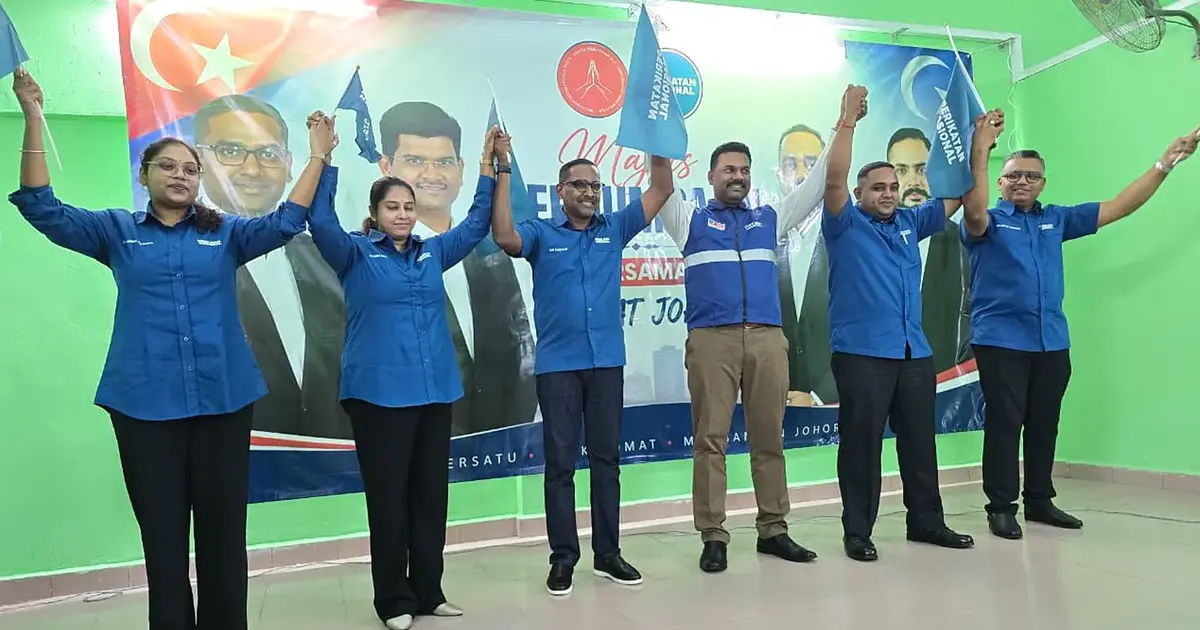
The Malaysian Indian Prosperity Party has officially entered electoral politics, contesting five parliamentary seats in Johor under the Perikatan Nasional alliance banner. Party president P Punithan characterised the move as a watershed moment for the newly-formed political vehicle, signalling the party's intention to translate grassroots mobilisation into parliamentary representation in the crucial southern state.
For Malaysia's Indian-origin population, the emergence of MIPP represents a significant shift in community political dynamics. Historically dominated by established parties such as MIC—the Malaysian Indian Congress—and competing interest groups, the Indian-Malaysian electoral bloc has remained fragmented and sometimes marginalised within broader coalition structures. MIPP's entry suggests growing appetite within segments of the community to consolidate voting power around a dedicated platform rather than scattering support across competing formations.
Johor's selection as the launching ground carries strategic weight. The state, Malaysia's second-largest by population, encompasses substantial Indian-origin constituencies, particularly in urban and semi-urban districts where service and manufacturing sectors provide employment. The five contested seats indicate MIPP leadership has identified pockets of community concentration where institutional advantages and voter familiarity could translate into competitive campaigns.
Punithan's emphasis on opportunity, education and economic empowerment outlines the party's policy positioning relative to existing alternatives. Rather than pursuing identity-centric mobilisation alone, MIPP appears to be anchoring its appeal to bread-and-butter concerns affecting Indian-Malaysians across income levels. This approach acknowledges that community voters, like their counterparts from other backgrounds, prioritise skills development, employment pathways and income security as election criteria.
The decision to align with Perikatan Nasional rather than competing coalitions reflects deliberate coalition mathematics. PN's trajectory since its 2020 formation has involved successive recalibration of membership and strategic positioning. By joining as a constituent party, MIPP gains access to PN's organisational machinery, campaign resources and brand positioning, while potentially occupying a niche within the broader alliance that might otherwise see Indian-origin candidates distributed across multiple parties without dedicated community institutional support.
Education emerges as a central policy anchor for the nascent party. This focus resonates with documented concerns within Indian-Malaysian communities regarding school access, quality, retention rates and tertiary education pathways. The community has historically advocated for preservation of vernacular schooling options alongside strengthening English-medium instruction, issues that larger mainstream parties have sometimes treated as secondary to broader policy agendas. MIPP's explicit commitment suggests these concerns will receive dedicated advocacy within PN structures.
Economic empowerment messaging acknowledges wealth disparities within Indian-Malaysian demographics. Despite notable professional and entrepreneurial success among segments, socioeconomic indicators reveal that Indian-Malaysians experience poverty and employment vulnerability at rates exceeding national averages in certain occupational categories. MIPP's platform implies targeted intervention in small business financing, skills training and sectoral targeting could distinguish its approach from competitors offering generic growth rhetoric.
The timing of MIPP's electoral debut intersects with broader coalitional flux in Malaysian politics. PN has attempted to reposition itself as a viable national alternative since its inception, though internal dynamics—involving ideological tensions between component parties—have occasionally overshadowed unified messaging. The inclusion of MIPP suggests efforts to broaden the coalition's social appeal beyond its existing Malay-Muslim and Sabah-Sarawak indigenous bases, though the five-seat allocation in Johor indicates measured expectation regarding initial parliamentary impact.
Contesting five seats simultaneously allows MIPP to generate momentum and national media visibility while maintaining realistic expectations about conversion of campaign effort into elected representatives. Winning even two or three seats would establish parliamentary foothold, generating legitimacy and resources for subsequent electoral cycles. However, the relatively modest seat count also carries risk—if MIPP fails to translate electoral presence into visible parliamentary influence, internal cohesion may suffer and activist recruitment for future campaigns could prove challenging.
For the broader Indian-Malaysian electorate, MIPP's emergence offers expanded electoral choice previously unavailable at equivalent scale. Rather than choosing between established parties or boycotting electoral participation due to perceived inadequate representation, community voters can now evaluate a platform explicitly structured around their interests. This expanded choice environment, provided voters engage seriously with manifesto comparison and candidate assessment, could strengthen democratic accountability by forcing existing parties to defend their positions on education, economic opportunity and community welfare more rigorously.
The party's success in Johor will likely determine appetite for subsequent expansion beyond the state. If MIPP establishes itself as a credible electoral force capable of competing competitively against established incumbents, the template could be replicated in other states with significant Indian-origin populations, including Selangor, Perak and Penang. Conversely, disappointing electoral performance might necessitate strategic recalibration or reconsideration of coalition partnerships.
Beyond immediate electoral calculations, MIPP's entry reflects broader patterns of political entrepreneurship in Malaysia, where emerging communities of interest increasingly seek dedicated institutional representation rather than accepting subordinate status within multi-ethnic coalitions. Whether this trajectory strengthens community political agency or further fragments coalition structures remains uncertain, but the party's explicit focus on education and economic empowerment suggests serious engagement with substantive policy terrain rather than symbolic politics alone.

