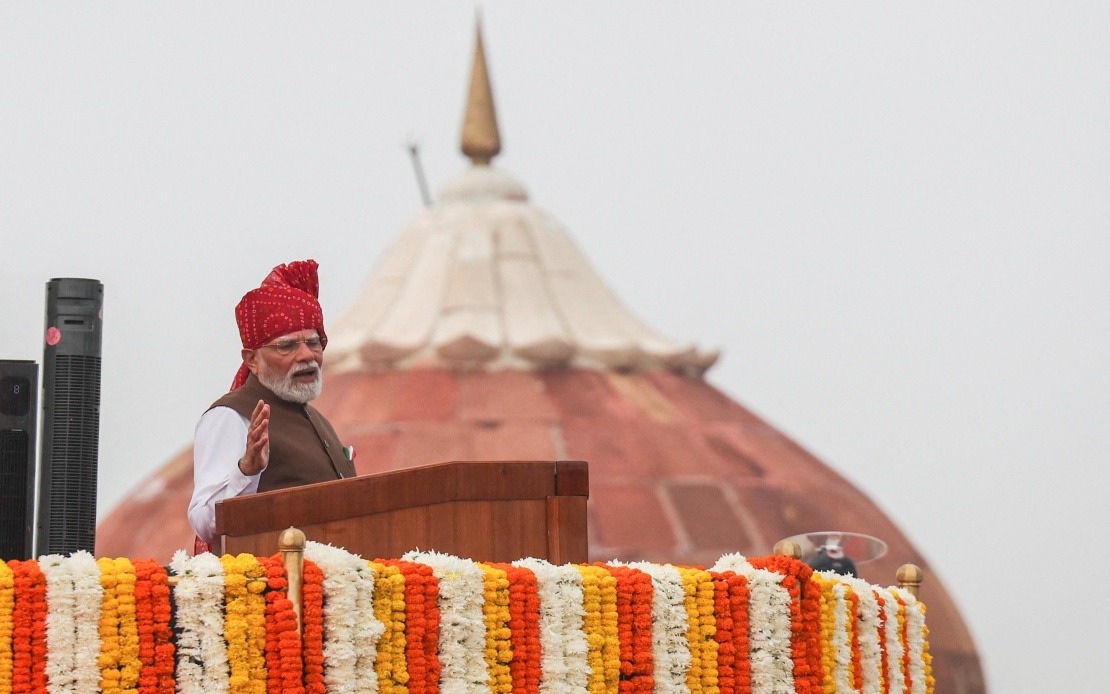
India's Prime Minister Narendra Modi has articulated an expansive vision for national self-sufficiency that extends across multiple strategic industries, positioning the country's transformation into a developed economy by 2047 as contingent upon reducing dependence on foreign imports and building indigenous technological capabilities. In his Independence Day address delivered from the Red Fort in Delhi on Saturday, Modi outlined initiatives spanning semiconductors, nuclear power, renewable energy, and military manufacturing—sectors he regards as foundational to India's economic and geopolitical ascendancy in the coming decades.
The semiconductor sector represents a cornerstone of Modi's self-reliance ambitions. India has already brought three semiconductor manufacturing plants online, with projections indicating that five to eight additional facilities will commence operations within the next seven to eight years. This expansion carries significant implications for Southeast Asia, as India's growing chip fabrication capacity could reshape regional supply chains and reduce the dominance of manufacturers concentrated in Taiwan and other established hubs. For Malaysia, which hosts substantial semiconductor production and assembly operations, India's emergence as a chipmaking nation presents both competitive pressures and potential collaboration opportunities through joint ventures and technology partnerships.
Nuclear energy occupies a central place in India's energy security calculations. The government has established an ambitious target of 100 gigawatts of nuclear capacity by 2047, representing a substantial increase from current levels. Modi emphasised that India will commission five new nuclear reactors during the current decade and highlighted a critical breakthrough: the nation has successfully mastered fast-breeder nuclear technology, a capability that dramatically enhances self-sufficiency in nuclear fuel production. This achievement addresses a historical vulnerability whereby India relied on external suppliers for nuclear materials, and the technological breakthrough promises to insulate the country from international supply disruptions while reducing costs through domestic fuel cycles.
Renewable energy has witnessed remarkable expansion under Modi's tenure, with solar capacity increasing from two gigawatts to 160 gigawatts over a twelve-year span. This trajectory underscores India's capacity to rapidly scale clean energy infrastructure and positions the nation as a potential model for developing economies pursuing decarbonisation alongside industrialisation. The solar expansion also reflects global supply chain diversification, as India now manufactures substantial quantities of solar panels domestically rather than importing them entirely, creating manufacturing employment and reducing capital outflows.
Energy exploration represents another frontier in India's self-reliance strategy. The government has allocated 850 billion rupees—approximately 8.9 billion US dollars—towards exploring offshore oil and gas reserves in zones previously considered economically unviable or technically challenging. Modi described these areas as previously "99 per cent no-go" regions, suggesting that technological advances and rising energy prices have made extraction feasible in locations that were historically bypassed. Successful development of these reserves would further strengthen India's energy independence and reduce vulnerability to geopolitical disruptions affecting global oil markets, considerations of acute concern for energy-importing nations throughout South and Southeast Asia.
Military manufacturing capabilities feature prominently in Modi's self-reliance framework. The Prime Minister called for accelerated domestic development of advanced defence systems including drones, counter-drone technology, and hypersonic weapons platforms. This emphasis reflects India's strategic competition with Pakistan and China while also serving nationalist objectives of reducing defence procurement from foreign suppliers. For regional stability calculations, India's military modernisation through domestic production carries implications for arms race dynamics throughout South Asia and the Indian Ocean region.
Beyond sector-specific initiatives, Modi invoked a cultural and economic argument for domestic consumption of locally manufactured goods. He contended that purchasing foreign products, regardless of their cost advantages or rapid availability, fails to build indigenous capabilities or test the resilience of domestic industries. This framing positions consumerism as a patriotic act and frames import substitution not merely as economic policy but as a nation-building imperative. The rhetoric carries echoes of earlier self-reliance campaigns in post-independence India, though updated for contemporary manufacturing and technology contexts.
The strategic coherence underlying these initiatives reflects a deliberate attempt to reshape India's position within global value chains. Rather than remaining a supplier of low-cost labour and raw materials, Modi's framework envisions India as a technology innovator and manufacturer capable of competing across advanced sectors. This repositioning carries substantial implications for other developing economies, particularly in Southeast Asia, which similarly aspire to move beyond basic manufacturing towards technology-intensive production.
The 2047 timeframe carries symbolic resonance as it marks the centenary of India's independence, transforming economic targets into a national destiny narrative. This temporal framing creates political momentum for long-term investments that might otherwise struggle for parliamentary approval or bureaucratic implementation. It also signals to international investors and partners that India's self-reliance drive represents enduring policy rather than cyclical political rhetoric.
For Malaysian policymakers and business observers, India's self-reliance trajectory merits close attention. Competition may intensify in sectors where Malaysia currently holds advantages, particularly semiconductors and renewable energy components. Simultaneously, India's growing manufacturing capacity creates opportunities for Malaysian companies to supply inputs, provide services, or establish joint ventures. The success of India's strategy will partly determine whether South Asia emerges as a genuine alternative production hub to East Asia, a development that could restructure regional trade patterns and investment flows across the Indian Ocean.
Modi's emphasis on domestic capabilities rather than mere market size reflects recognition that sustained development requires technological prowess and manufacturing excellence. Whether India can translate these ambitious targets into operational reality across multiple sectors simultaneously remains uncertain, requiring substantial capital investment, human capital development, and institutional capacity. Nevertheless, the articulation of such a comprehensive vision signals political commitment and resource mobilisation at the highest levels of the Indian state.

