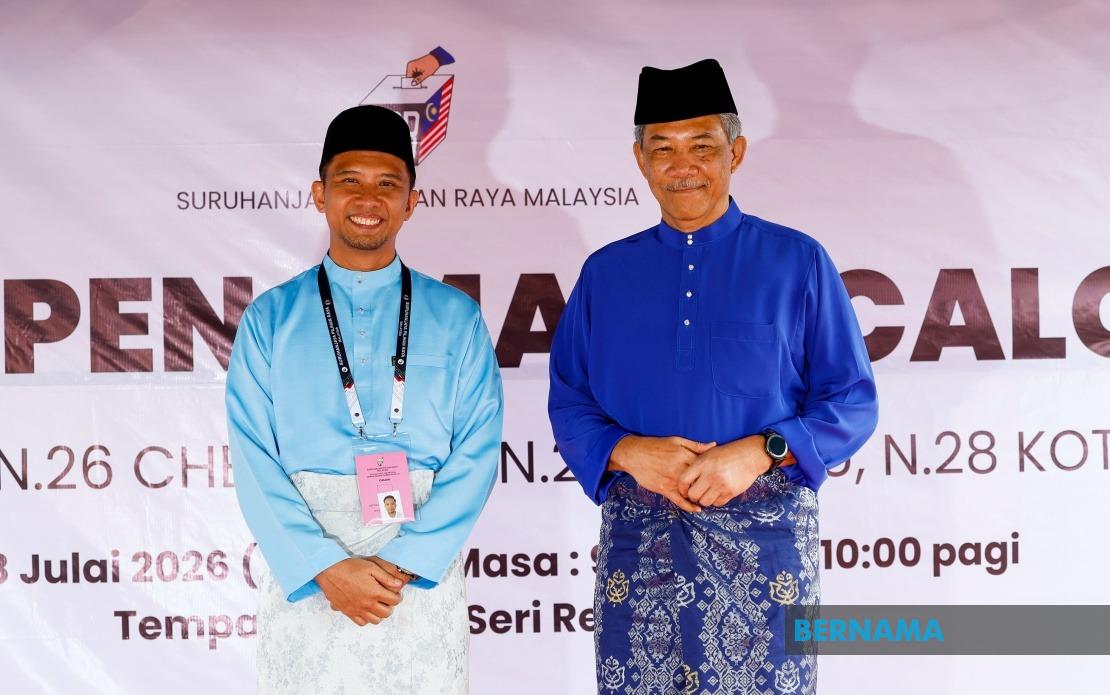
A head-to-head battle is shaping up in the Rantau state constituency for the 16th Negeri Sembilan state election, with Foreign Minister and Barisan Nasional state chairman Datuk Seri Mohamad Hasan defending his seat against Pakatan Harapan contender Dr Azizul Hakim Mahdi. The returning officer, Mohd Zamri Mohd Esa, announced the result of the nomination process at Dewan Sri Rembau on July 18, confirming that both candidates successfully filed their nomination papers and will proceed to the general election. The contest represents a significant matchup between an entrenched incumbent with nearly two decades of electoral control and a relatively young professional challenger offering an alternative vision for the constituency.
Modhamad, who simultaneously holds the position of UMNO deputy president, has maintained his grip on the Rantau state seat since 2004, demonstrating considerable political resilience through multiple election cycles. His sustained presence in the constituency reflects the strong organisational machinery he has built over the years, though this period of dominance may face its sternest test from a challenger with growing appeal among younger, more urban voters who prioritise specific policy outcomes over traditional political affiliation. The Rembau Member of Parliament subsequently addressed the media to outline Barisan Nasional's campaign strategy, emphasising the need for systematic and organised grassroots mobilisation. He noted that the formal campaign period would now commence following the completion of the nomination procedure, and he expressed confidence that diligent ground-level work would translate into electoral success for the coalition.
Dr Azizul Hakim, aged 35, positioned himself as a generational alternative to Mohamad's established political presence. The PH candidate highlighted his professional credentials as a medical doctor with a decade of clinical experience, alongside his entrepreneurial track record encompassing three private healthcare clinics located in Senawang, Puncak Alam, and Melaka. This combination of medical expertise and business acumen provides him with genuine insight into both healthcare delivery challenges and the broader economic concerns affecting ordinary Rantau residents. His campaign strategy centres on healthcare accessibility and local issue resolution, leveraging his professional background to establish credibility in areas that resonate deeply with constituency voters. The candidate argued that his hands-on experience in the healthcare sector positions him to deliver tangible improvements to medical services available to Rantau residents, a message likely to appeal to an electorate increasingly focused on bread-and-butter service delivery rather than partisan positioning.
The 2023 Negeri Sembilan state election provided a benchmark for assessing the competitive landscape. Mohamad secured a commanding 16,957 votes compared to his previous Pakatan Harapan opponent Rozmal Malakan's 6,677 votes, translating to a substantial 10,280-vote majority that appeared insurmountable on paper. However, the shift in opposition candidate from a conventional politician to a young healthcare professional with significant community engagement through private medical practice represents a qualitative change in the nature of competition. Dr Azizul's personal track record in a sector vital to community welfare may prove more persuasive to voters than traditional opposition messaging, particularly among working-age adults and families concerned about access to affordable healthcare services.
Beyond the Rantau constituency, the Negeri Sembilan electoral landscape presents varied competitive dynamics across multiple seats. The Paroi state seat is witnessing a three-way contest featuring Ahmad Shahir Mohd Shah, the Menteri Besar's press secretary standing under the Pakatan Harapan banner, competing against Perikatan Nasional candidate Kamarol Ridzuan Mohd Zin and Parti Pribumi Bersatu Malaysia contender Mohd Nazree Mohd Yunus. This fragmentation across three distinct political blocs suggests a potentially unpredictable outcome where vote-splitting dynamics could prove decisive. In Chembong, incumbent Datuk Zaifulbahri Idris representing Barisan Nasional confronts PH challenger Danish Nazran Murad in a straight contest, presenting a clearer binary choice for voters.
The Kota state seat configuration adds further complexity to the electoral picture, with Barisan Nasional's incumbent Suhaimi Aini facing competition from both Pakatan Harapan's Muhammad Allif Ibrahim and Parti Pribumi Bersatu Malaysia's Akmal Noradzmi Abdul Rahim. The emergence of Bersatu as an independent electoral force across multiple constituencies suggests that defections or reorganisations within the broader Malay-Muslim political coalition have created new fault lines in state politics. These three-cornered contests introduce unpredictability that favours neither incumbent nor challenger in conventional terms, with outcomes potentially determined by local grassroots sentiment and candidate-specific popularity rather than state-level coalition politics.
The Negeri Sembilan State Legislative Assembly comprises 36 seats in total, and the state election was triggered by the dissolution of the assembly on June 5 through constitutional procedures. The Election Commission designated July 28 as the early voting day, allowing military personnel, their spouses, and police officers to cast ballots in advance, while August 1 was set as the main polling day for the general electorate. This scheduling provides a two-week campaign window for candidates and their respective political machinery to mobilise support and communicate their messages to voters across the state.
The electoral roll encompasses 889,490 registered voters, comprising 867,151 ordinary voters and 22,339 early voters drawn from military and law enforcement personnel. This voter population represents the broadest possible cross-section of Negeri Sembilan society, from urban professionals and business owners to rural agricultural workers and manufacturing employees. The distribution of voters across rural, semi-urban, and urban constituencies creates different political dynamics, with metropolitan areas increasingly receptive to issue-focused candidates while traditional strongholds remain influenced by established political relationships and organisational networks. The scale of the franchise underscores the significance of this state election as a genuine test of contemporary Malaysian voter sentiment beyond traditional partisan calculations.
For Barisan Nasional, the Negeri Sembilan election represents a critical gauge of coalition cohesion and electoral appeal in the post-2023 environment. The coalition's performance will illuminate whether the recovery demonstrated in the 2023 federal election represents sustainable consolidation or a temporary phenomenon. Similarly, for Pakatan Harapan, success in wresting seats from Barisan Nasional would validate its positioning as a credible alternative government capable of winning in competitive battlegrounds. The emergence of Perikatan Nasional as a competitive force, particularly through Bersatu's participation, complicates the traditional binary narrative and suggests that Malaysian politics at state level is undergoing fundamental realignment. The Rantau contest, being the highest-profile individual race featuring a senior federal minister, will likely capture national attention and influence perceptions of broader political momentum heading into future electoral contests.

