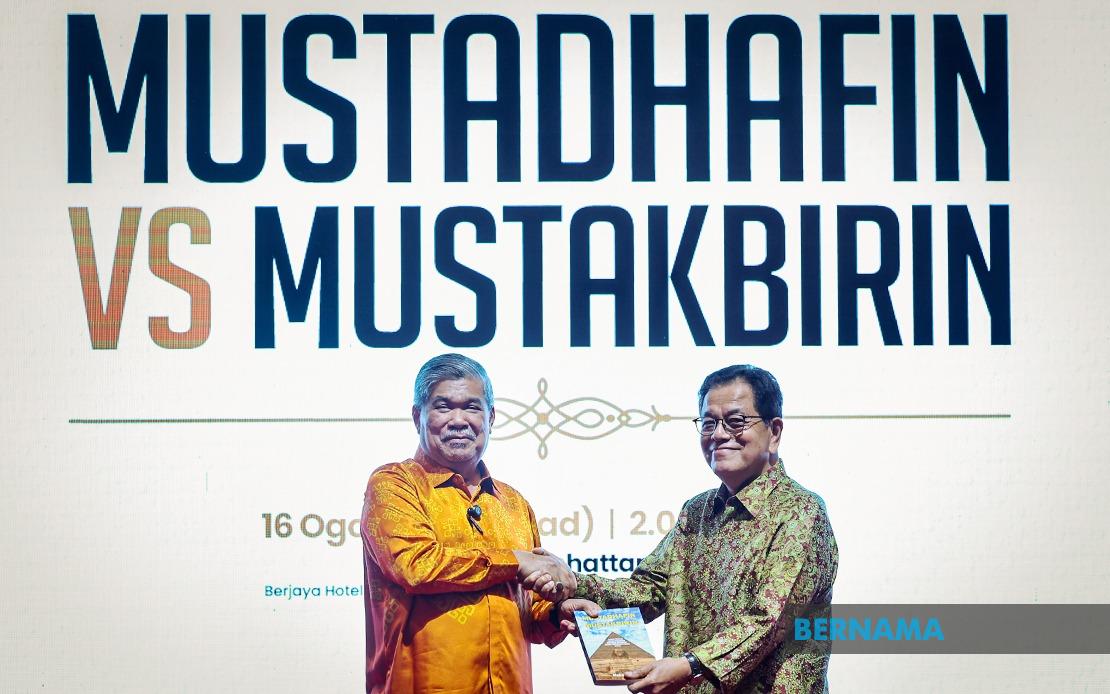
Amanah president Datuk Seri Mohamad Sabu has issued a strong call for greater critical thinking among the Malaysian public, cautioning citizens against accepting allegations at face value without subjecting them to rigorous scrutiny. Speaking after launching his book in Kuala Lumpur on August 16, the Agriculture and Food Security Minister underscored the dangers of unchecked credulity in shaping public opinion and political attitudes, particularly in an era when misinformation spreads with unprecedented speed.
The core of Mohamad Sabu's message centres on the psychological phenomenon of 'asabiyyah'—a concept rooted in Islamic and Arabic scholarship referring to group loyalty or tribalism. This tendency, he explained, manifests when individuals reflexively defend their own faction regardless of its merits while simultaneously viewing the actions and intentions of opposing groups through a distorted lens of suspicion. In the Malaysian political context, where coalition politics and factional divisions run deep, this mechanism poses a genuine threat to rational discourse and evidence-based decision-making.
Drawing a distinction between the difficulty of establishing genuine facts and the ease with which accusations proliferate, Mohamad Sabu highlighted how knowledge and verifiable information demand substantial cognitive effort to digest and evaluate. Accusations and suspicions, by contrast, require no such burden of proof. They spread with remarkable facility, particularly through social media platforms where algorithms reward sensational content and emotional engagement over nuance and accuracy. This asymmetry creates a structural advantage for those who weaponise unsubstantiated claims in political competition.
The minister specifically addressed recurring allegations directed at the Democratic Action Party, a key coalition partner. Claims that DAP harbours communist sympathies have periodically resurfaced in Malaysian political discourse, often deployed to delegitimise coalition arrangements or paint collaborating parties as unwitting accomplices to sinister ideological agendas. Mohamad Sabu's implicit challenge to such claims—asking whether the party actually embodies the ideology attributed to it—represents an invitation for the public to move beyond inherited narratives and examine evidence directly.
His approach reflects a broader philosophy evident throughout his political career. Mohamad Sabu emphasised that since his youth, he has resisted the temptation to accept information passively, instead preferring direct investigation and independent verification over reliance on circulating propaganda. This methodology, he suggested, should become the default approach for all Malaysians engaging with political claims, regardless of their source or the emotional resonance such claims might carry.
The book launch itself served as a platform for these reflections. Published and launched by National Journalism Laureate Tan Sri Johan Jaaffar, a director of Star Media Group Berhad, the volume documents Mohamad Sabu's extensive experiences in political life and his meetings with diverse stakeholders. Through these encounters, he has attempted to develop a nuanced understanding of complex issues grounded in observable reality rather than second-hand accounts or ideological presumptions. The book, he indicated, represents an invitation for readers to adopt a similarly evidence-centred epistemology.
Beyond domestic Malaysian politics, Mohamad Sabu's reflections extend to the international sphere. His book engages with significant geopolitical themes including the legacies of colonialism, the trajectory of Islamic movements globally, the Palestinian-Israeli conflict, and broader shifts in the distribution of global power. These international perspectives inform his thinking about Malaysian political challenges, suggesting that understanding parochial disputes requires awareness of larger historical and systemic contexts.
The minister's intervention arrives at a moment when Malaysian political discourse faces particular vulnerabilities to misinformation and polarised tribal narratives. The transition to unity governments and multi-party coalitions has created new pressures on traditional political identities, prompting fierce rhetorical contests over legitimacy and ideological purity. In this environment, the ability to distinguish genuine threat from manufactured grievance becomes essential for maintaining democratic stability and rational deliberation.
For Southeast Asian observers more broadly, Mohamad Sabu's warnings resonate beyond Malaysia's borders. Across the region, similar dynamics of coalition politics, social media-driven information warfare, and competing visions of national identity generate recurrent cycles of unsubstantiated allegations and counter-allegations. The challenge of building and maintaining multi-ethnic, multi-religious democracies in Southeast Asia depends substantially on the public's willingness to resist tribal loyalty and engage with competing viewpoints through evidence-based reasoning.
Moreover, the specific case of DAP and communist allegations illustrates how historical grievances can be weaponised in contemporary politics. Cold War narratives, though decades distant, retain rhetorical power in Malaysian discourse. Mohamad Sabu's implicit argument—that such historical framing must be evaluated against current reality—suggests that democratic maturity requires distinguishing between legitimate concerns about governance and ideology, and reflexive deployments of historical anxieties.
The call for critical engagement with allegations also carries implications for media institutions and civil society organisations. If the public adopts a stance of healthy scepticism toward unverified claims, then journalists, fact-checkers, and civic groups bear heightened responsibility for rigorous investigation and clear communication of verified information. Mohamad Sabu's intervention thus implicitly advocates for stronger institutional support for accountability in public discourse.
Ultimately, the minister's message reflects a conviction that democratic governance depends on epistemic responsibility—the notion that citizens bear an obligation to verify claims before accepting and acting upon them. This stance contrasts sharply with populist approaches that celebrate instinctive reactions to emotional appeals. In polarised societies, such reasoned restraint represents both a practical necessity and an ethical commitment to collective deliberation.

