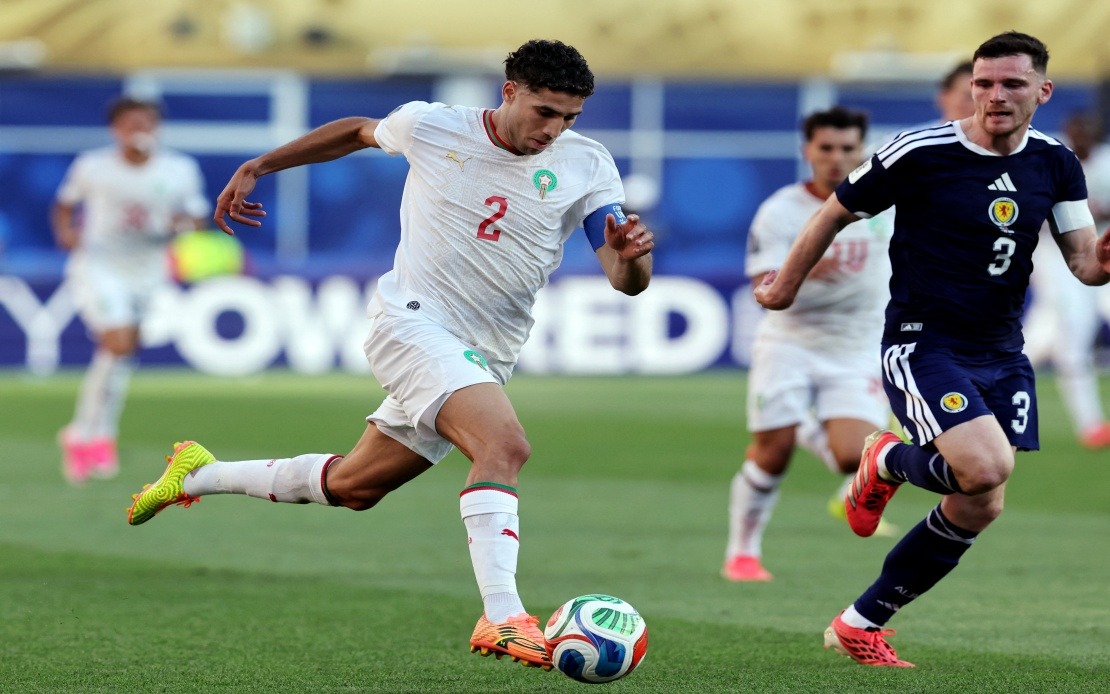
Morocco's coaching staff threw their support behind Achraf Hakimi on Friday following a turbulent match at Foxborough, Massachusetts, where the PSG defender endured sustained heckling from sections of the crowd during his nation's 1-0 victory over Scotland. The timing proved particularly sensitive, as a French court had announced just hours before kickoff that Hakimi must stand trial on rape allegations, creating an unprecedented backdrop to international football competition.
The jeers began the moment Morocco's lineup was announced, with Hakimi's name drawing audible disapproval from segments of the audience. This pattern persisted throughout the match whenever the right-back made contact with the ball, subjecting him to repeated whistles and booing that underscored the global reach of the legal proceedings. Such public displays of disdain, amplified by the World Cup platform, represented a rare intersection of sports spectacle and serious criminal allegations playing out simultaneously on the international stage.
Hakimi's legal situation stems from charges related to an alleged incident at his Paris residence in 2023 involving a 24-year-old woman. The Versailles appeal court ruled on Friday that the case would proceed to trial, following the defender's unsuccessful appeal against an earlier investigating judge's decision. The case has garnered significant attention in European media, particularly in France where PSG maintains prominent coverage across sports and national newspapers.
Morocco coach Mohamed Ouahbi chose to isolate the sporting dimension from the legal controversy, declining to engage substantively with the allegations while making clear his personal confidence in the player. His strategic approach reflected a deliberate separation between the pitch and the courtroom, suggesting the coaching staff would neither discuss nor allow the case to dominate their World Cup campaign narrative. This stance prioritised team cohesion and competitive focus over public commentary on judicial proceedings.
When asked about Hakimi's performance during the Scotland encounter, Ouahbi offered enthusiastic assessment, characterising the fullback as composed and effective in his defensive responsibilities. The coach emphasised that both he and his player remained unperturbed by the external pressures, viewing Friday's result as validation of their collective mindset. His framing suggested that maintaining psychological equilibrium, particularly for a player facing such substantial off-field challenges, represented a fundamental requirement for competing at the World Cup's elite level.
Ouahbi's comments included a pointed statement regarding Hakimi's credentials, declaring his ambition to demonstrate throughout the tournament that he represents the finest right-back currently operating in international football. Such pronounced backing from coaching staff carries particular weight in professional environments where perceived support from management can materially influence player morale and public perception. The statement functioned simultaneously as endorsement and challenge, positioning Hakimi's World Cup performance as an opportunity to prove his quality amid adversity.
The broader Morocco squad adopted a position of collective silence regarding Hakimi's circumstances. Teammates declined to comment on the rape allegations or the trial announcement, maintaining strict discipline around a topic that could otherwise fragment team messaging and distract from preparation. This unified approach reflected established protocols within professional sports organisations, where management typically restricts public statements on legal matters to authorised personnel and official channels.
For Malaysian and Southeast Asian football enthusiasts, the Hakimi situation underscores the challenges modern athletes face when personal legal crises intersect with high-profile international competitions. The case illustrates how globalised media coverage ensures that off-field controversies immediately become public spectacles, particularly when involving elite performers competing at sport's highest levels. The crowd response at Foxborough demonstrated that supporters now participate directly in moral judgements, using their voices to register disapproval of players facing allegations.
The sequence of events also raises questions about the appropriate boundaries between sporting authority and legal processes. While football authorities cannot adjudicate criminal matters falling within judicial jurisdictions, they must navigate complex situations where player participation continues alongside serious allegations. Morocco's decision to maintain Hakimi in their squad reflected confidence in presumptions of innocence, though this choice inevitably generated controversy whenever the player engaged with the ball.
Hakimi himself has maintained his innocence, utilising social media to declare that the trial opportunity would finally permit him to address the accusations directly. His statement suggested frustration with preceding procedural phases, positioning the trial announcement as a potential pathway toward clarification rather than a personal setback. This framing, combined with Ouahbi's public backing, suggested the player and his representatives viewed continued World Cup participation as preferable to removing himself from competition.
The Morocco-Scotland match result itself became somewhat secondary to the broader circumstances surrounding Hakimi's participation. However, the 1-0 victory underscored that the team could perform effectively despite the distraction and psychological pressure surrounding their captain. Whether this performance can be sustained throughout the tournament, particularly as trial proceedings advance alongside competitive fixtures, remains uncertain.
Looking forward, Morocco faces a delicate balance between maintaining team integrity and managing an unprecedented situation where international football competition occurs parallel to significant criminal proceedings. The Hakimi case will likely remain a focal point of scrutiny, with supporters and commentators continuing to register their positions through vocal reactions at matches. How different crowds respond across various venues may generate further complications for a squad attempting to focus purely on sporting excellence during football's most prestigious tournament.

