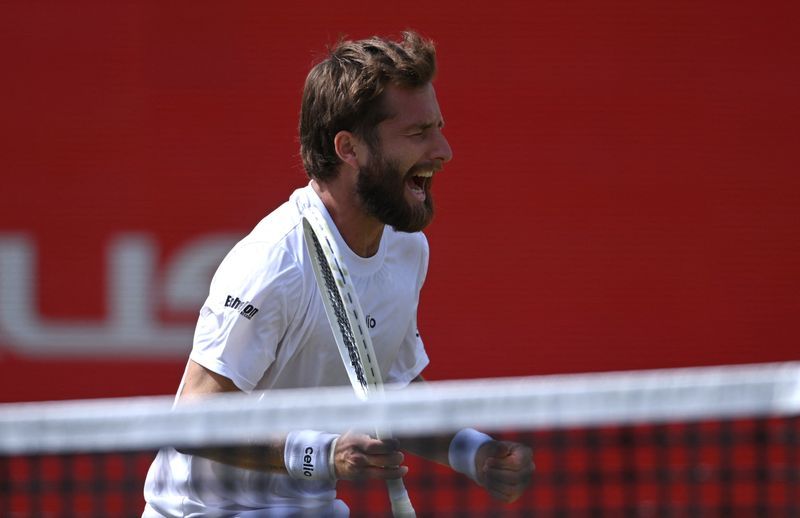
Corentin Moutet's promising run at the Queen's Club tournament has been derailed not by his opponent's racket, but by the very microphone intended to celebrate his victory. The 27-year-old French player has been stripped of nearly all his prize money from the prestigious London grass-court event after the ATP imposed a $40,000 fine for unsportsmanlike conduct stemming from an explosive post-match interview with the BBC. The penalty effectively erases the $43,000 Moutet earned for advancing to the second round, leaving him with minimal financial reward despite his opening-round success and raising fresh questions about player conduct standards in professional tennis.
The incident unfolded immediately after Moutet defeated fellow Frenchman Giovanni Mpetshi Perricard in their first-round encounter. As is customary at the Queen's Club, the broadcaster conducted an on-court interview to capture the player's immediate reactions and insights. What followed was an unexpectedly contentious exchange in which Moutet used profanities on seven separate occasions, beginning when he attempted to describe a particularly frustrating moment during the match—specifically, being aced on match point by a 142 miles-per-hour second serve. When the interviewer politely requested that he refrain from repeating the offensive language, Moutet continued undeterred, deploying the same expletive three additional times before officials terminated the segment and issued apologies to the assembled crowd and television audience.
The consequences came swiftly. The ATP, professional tennis's governing body, determined that Moutet's conduct violated its unsportsmanlike conduct regulations and levied the substantial fine. In an official statement, the governing body confirmed the disciplinary action while noting that Moutet had submitted an appeal, leaving open the possibility of a reduction or reversal of the penalty depending on the outcome of his challenge. Such appeals are not uncommon in professional tennis, though they rarely succeed when incidents have been captured on live broadcast and witnessed by thousands of spectators and millions of viewers.
Moutet's tournament experience deteriorated further when he subsequently lost his second-round match to Spain's Alejandro Davidovich Fokina, eliminating him from the competition and ending his chances of accumulating additional prize money. This defeat compounds the financial impact of his disciplinary suspension, converting what should have been a profitable week in London into a net loss when the fine is factored against his earnings. For a player ranked number 36 in the world, such monetary penalties represent a meaningful portion of income that many mid-tier professionals rely upon during the tennis calendar.
The on-court explanation for Moutet's outburst provides some context, though it hardly excuses the behaviour. Being struck by an ace on match point—the deciding point of a match—is undoubtedly frustrating, and a 142 miles-per-hour second serve represents exceptional power that would test any player's composure. Nevertheless, professional athletes are expected to manage their emotions during broadcasts, particularly in the contemporary media environment where every word is captured, preserved, and potentially circulated globally through social media platforms. Moutet's decision to repeat the offensive language after being explicitly asked not to do so demonstrated either a lack of self-awareness or a deliberate disregard for the interviewer's reasonable request.
Following the interview, Moutet attempted to minimize the incident by posting on Instagram that he had simply been joking, suggesting that the inflammatory language was meant in jest rather than representing genuine anger. This explanation failed to satisfy the ATP's disciplinary committee and offers little comfort to broadcasters who must navigate the complex balance between capturing authentic player reactions and maintaining broadcast standards acceptable to family audiences. The claim of humour after the fact, particularly following explicit reminders about appropriate conduct, rings hollow and may have even influenced the ATP's decision to impose a penalty at the upper end of the scale.
This is not Moutet's first brush with tennis discipline, and that history likely weighed heavily in the severity of the Queen's Club fine. In 2022, during the Adelaide International, Moutet was defaulted—the harshest punishment short of banning—for directing profanities at the umpire during a match against Serbia's Laslo Djere. Such defaults are extraordinarily rare in professional tennis and signal conduct so egregious that continued participation in the tournament cannot be permitted. Additionally, that same year, the French Tennis Federation itself suspended Moutet, cutting him off from federation support and resources due to persistent behavioural concerns. These interventions from his own national federation underscore that the problem extends beyond isolated incidents to a pattern requiring remedial action.
For Southeast Asian tennis audiences and players, Moutet's situation serves as a cautionary tale about the intersection of athletic talent and professional behaviour standards. The region has produced several emerging tennis talents who will inevitably face similar pressures and moments of frustration during high-stakes matches. His case demonstrates that modern professional tennis imposes strict behavioural expectations, particularly during televised moments when players represent not only themselves but their nations and the sport itself. Broadcasters across Asia, including those covering Australian Open preliminary rounds and regional tournaments, maintain similar standards, meaning that players targeting the highest levels of professional tennis must develop emotional regulation alongside technical skill.
The financial impact of Moutet's fine also illustrates how tournament structures allocate prize money and the vulnerability of mid-ranking players whose income depends heavily on advancing through multiple rounds. A $40,000 penalty represents not merely a financial setback but potentially affects his ability to afford coaching staff, travel, and training facilities that higher-ranked players can sustain despite occasional fines. This economic dimension adds depth to what might otherwise be viewed as a simple disciplinary matter, raising questions about whether massive fines adequately deter misconduct or whether they disproportionately impact players with fewer financial cushions.

