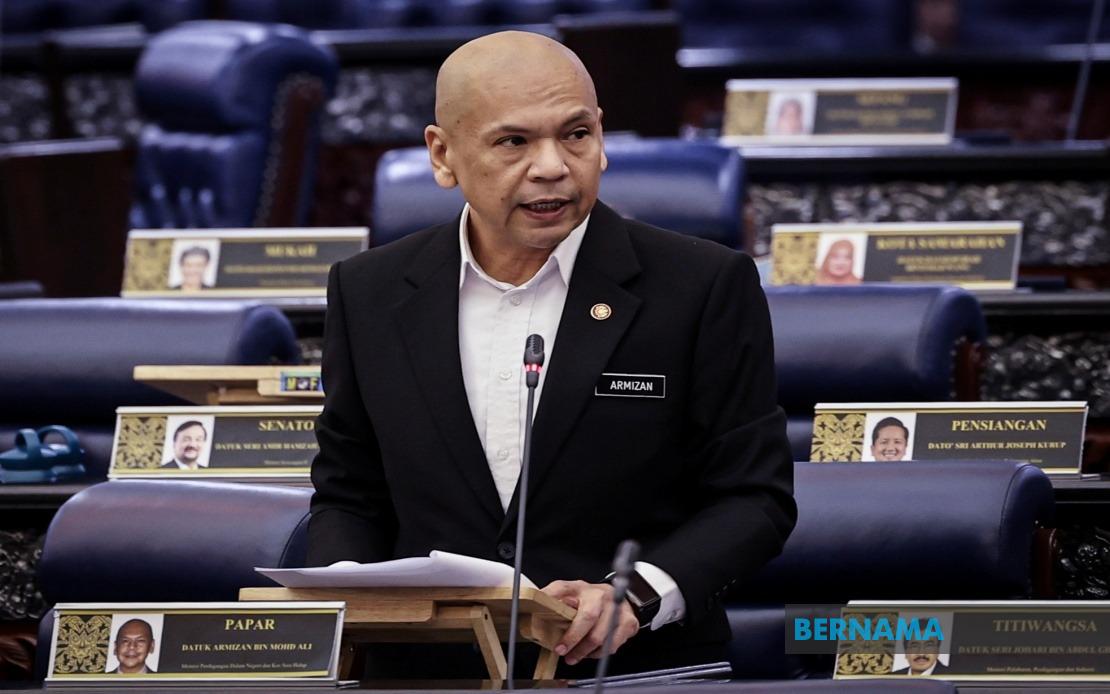
Parliamentarians have emphasised the critical importance of conducting investigations stemming from the Tabung Haji Royal Commission of Inquiry report with full transparency and independence, stressing that doing so remains essential to safeguard the welfare of depositors and uphold the principles of justice throughout Malaysian society.
Datuk Armizan Mohd Ali, the Minister of Domestic Trade and Cost of Living and Member of Parliament for Papar, raised these concerns during a special parliamentary sitting devoted to scrutinising the RCI report's findings. He stressed that investigative processes must adhere to strict professional standards, enabling authorities to draw conclusions grounded exclusively in factual evidence and applicable legal frameworks rather than partisan considerations or speculation.
The minister pointed to a troubling pattern where the Tabung Haji situation has become mired in public disputes and contradictory accusations, with various stakeholders levelling claims of defamation and slander against one another. This contentious environment has created significant public confusion, as citizens struggle to determine the credibility of competing narratives and identify the actual wrongdoers responsible for institutional failings. Armizan suggested that intervention by enforcement agencies armed with proper investigative authority could help cut through the misinformation and establish clarity based on objective evidence.
Beyond the immediate investigative phase, lawmakers have also stressed that the 25 recommendations contained within the RCI report warrant equally rigorous examination and implementation. These proposals represent a comprehensive roadmap for institutional reform and strengthened governance structures at Tabung Haji. Effective execution of these recommendations will prove instrumental in completing the institution's recovery trajectory and ensuring that similar governance lapses cannot recur in the future. As of late July, the administration had already implemented approximately three-quarters of the suggested improvements, demonstrating tangible progress toward institutional restoration.
Minister of Women, Family and Community Development Datuk Seri Nancy Shukri advanced a nuanced perspective regarding the structural arrangement of Tabung Haji's responsibilities across different government departments. She championed the current division whereby haj management remains under the Minister in the Prime Minister's Department (Religious Affairs), while financial and investment matters fall within the Finance Ministry's purview. This arrangement, she argued, represents a rational specialisation of duties based on sector expertise, reduces bureaucratic redundancy, and ensures that each functional area receives appropriate technical oversight and support.
The question of political appointments to Tabung Haji's board of directors generated considerable parliamentary discussion, with Nancy presenting a compelling framework for evaluating board composition. Rather than reflexively opposing political appointees, she contended that the genuine criterion for selection should centre on whether individual candidates possess the requisite integrity, professional qualifications, relevant experience, demonstrated expertise, and proven capability to discharge their duties effectively. The presence of political connections should not disqualify otherwise suitable candidates, provided they meet these substantive requirements.
Nancy articulated an important principle regarding the intersection of political backgrounds and institutional governance: Malaysian society must maintain fairness in acknowledging the contributions of capable individuals, even those with political affiliations, while simultaneously refusing to permit political credentials to supersede rigorous fit-and-proper evaluations. The institutional challenge lies in establishing clear, measurable criteria for board appointments, formalising transparent selection methodologies, and explicitly identifying the technical expertise areas required for each position. When these procedural safeguards function effectively, merit and suitability become the determinative factors in appointment decisions.
The special parliamentary sitting, convened specifically to examine the RCI report, represents a critical institutional mechanism for legislative scrutiny. The government's decision to make the report publicly available on July 29 reflected a commitment to transparency, allowing elected representatives and Malaysian citizens alike to assess the inquiry's findings and recommendations. This openness stands in sharp contrast to the opacity that sometimes surrounds government investigations, and it demonstrates responsiveness to public demand for accountability in matters affecting millions of depositors.
The RCI's investigation covered the fifteen-year period spanning 2014 through 2020, a interval that witnessed significant institutional turbulence and strategic challenges within Tabung Haji's operations. The inquiry identified multiple governance weaknesses and operational deficiencies that contributed to the institution's difficulties during this period. These findings, while sometimes uncomfortable for those implicated, provide essential diagnostic information necessary to implement meaningful reforms and prevent repetition of past mistakes.
The parliamentary emphasis on transparent, professional investigation carries particular significance for ordinary Malaysian depositors whose life savings remain entrusted to Tabung Haji. For many Malaysians, particularly those of modest means who have contributed to the hajj savings scheme for decades, the institution's stability and integrity remain matters of profound personal concern. Parliamentary insistence on rigorous investigation and comprehensive implementation of reform recommendations reflects a commitment to protecting these vulnerable stakeholders' interests and restoring their confidence in the institution's management.
The coordination between multiple government entities—the enforcement agencies conducting investigations, the Prime Minister's Department overseeing hajj matters, the Finance Ministry managing investments, and the parliamentary oversight mechanism—will prove crucial in translating these commitments into concrete institutional improvements. Effective cross-agency communication and sustained political will remain prerequisites for achieving genuine reform. Without such coordination, even the most well-intentioned investigations and recommendations risk becoming mere bureaucratic exercises that fail to produce meaningful change.
Moving forward, the success of any investigation and reform process will ultimately be measured by whether ordinary Malaysians regain confidence in Tabung Haji's management and whether the institution emerges stronger, more transparent, and more resilient. Parliamentary scrutiny combined with professional investigation and systematic implementation of recommendations offers a promising pathway toward these objectives, though sustained vigilance will remain necessary to ensure that political pressures do not undermine the integrity of these processes. The RCI exercise represents an opportunity to establish governance standards that other institutions might emulate, advancing broader accountability across Malaysia's regulatory landscape.

