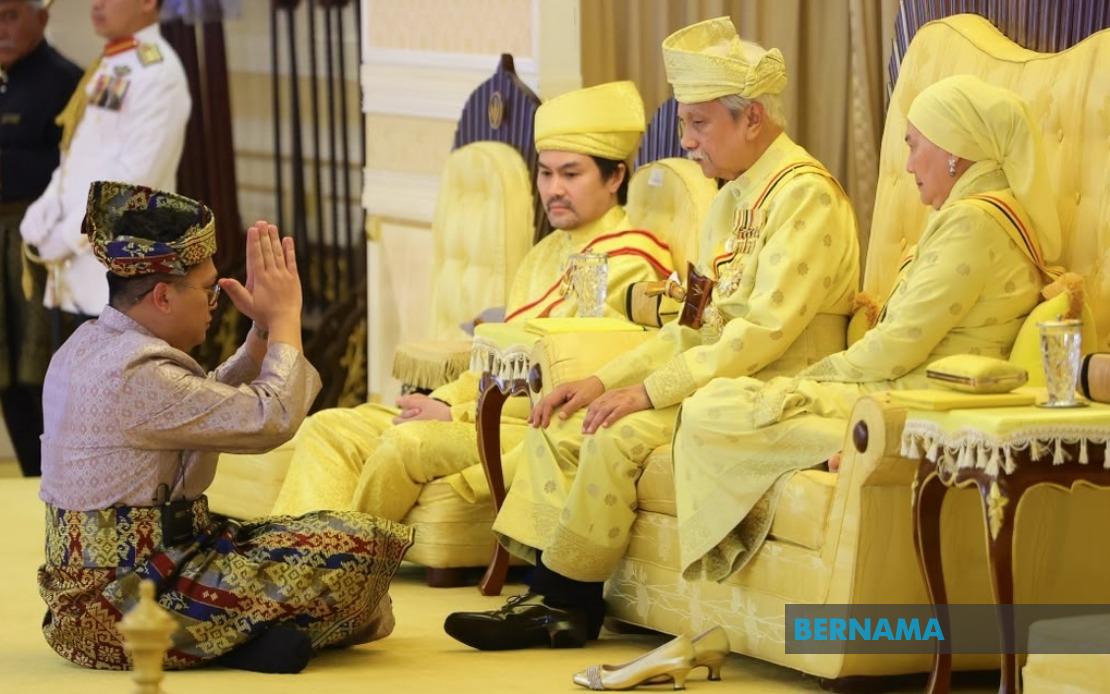
The Yang Dipertuan Besar of Negeri Sembilan, Tuanku Muhriz Tuanku Munawir, has formally installed Muhammad Faris Johari as the 11th Undang of Luak Sungei Ujong during a traditional ceremony held at Istana Besar Seri Menanti in Kuala Pilah on June 27. Through the installation, Muhammad Faris has been conferred the hereditary title Datuk Klana Petra, marking his assumption of one of the most significant customary leadership positions in the state.
The ceremonial proceedings adhered to centuries-old protocols that underpin Negeri Sembilan's distinctive system of governance. The Orang Empat Istana, the council of four senior chieftains, formally sought the Yang Dipertuan Besar's approval before the proceedings commenced, a procedural requirement that emphasises the constitutional relationship between the hereditary ruler and the territorial chiefs. Following this grant of permission, the newly appointed Undang renewed his solemn oath of allegiance to the sovereign, a ritual that binds the leadership hierarchy together through bonds of loyalty and mutual obligation.
In his address during the ceremony, Tuanku Muhriz stressed the importance of maintaining the integrity of these traditional commitments. The ruler appealed to all territorial chiefs, known collectively as the Orang Kaya, to remain steadfast in their devotion to the institution of the Yang Dipertuan Besar and to nurture relationships with the Palace characterised by respect and deference. This emphasis on institutional loyalty reflects broader concerns about preserving the symbolic and practical functions of constitutional monarchy within Malaysia's federal framework, particularly at the state level where customary authority remains deeply embedded in local governance.
The Yang Dipertuan Besar also articulated a wider vision of governance grounded in collaborative principles. He underscored that relationships founded on reciprocal respect, confidence and collective agreement serve as vital foundations for sustaining the constitutional monarchy system. These pillars also support the preservation of traditional customs and, ultimately, contribute to the durability of the state's institutions and the welfare of its population. This framing suggests a deliberate attempt to situate customary leadership within contemporary governance discourse, positioning it not as an anachronism but as a legitimate and necessary component of social cohesion.
A significant dimension of the ceremony involved the affirmation of Adat Perpatih, the indigenous system of customary law practised across Negeri Sembilan. The Undang, as territorial chief, bears particular responsibility for championing these ancestral practices, which have been transmitted across generations and form the cultural bedrock of Minangkabau communities in the state. The ruler called on both the appointed leadership and the general public to collaborate in safeguarding these values, positioning customary law not merely as historical artifact but as a living framework that continues to shape social relationships and community identity.
Muhammad Faris, who was born on October 30, 1997, brings substantial professional credentials to his hereditary position. The 28-year-old obtained a bachelor's degree in accountancy from Universiti Teknologi MARA, followed by completion of the Association of Chartered Certified Accountants professional qualification in 2022. This combination of formal tertiary education and internationally recognised accounting credentials suggests a contemporary orientation, potentially positioning him to navigate the intersection between traditional customary governance and modern administrative requirements. He is married to Sharifah Amirah Syed Ismail Ash-Shahab.
The installation of Muhammad Faris occurs within a moment of significant transition for Negeri Sembilan's customary leadership structure. The ceremony hosted by the Yang Dipertuan Besar prefaced another royal audience scheduled for later that same day, at which point the formal installation of the 22nd Undang of Luak Rembau would take place. This clustering of successive installations reflects the periodic nature of succession within the state's four territorial divisions, where leadership transitions ripple through the customary hierarchy.
The presence of senior members of the royal household at the ceremony underscored its significance within state protocol. Tunku Ampuan Besar Tuanku Aishah Rohani Tengku Besar Mahmud, alongside Tunku Besar Seri Menanti Tunku Ali Redhauddin Tuanku Muhriz and Tunku Panglima Besar Tunku Zain Al-'Abidin, witnessed the proceedings. The attendance of Menteri Besar Datuk Seri Aminuddin Harun alongside senior government departmental heads illustrated the interface between traditional hereditary authority and elected political administration within the state system.
Negeri Sembilan occupies a distinctive position within Malaysia's constitutional architecture, owing to its reliance on the Undang system of territorial governance. Unlike states with centralised sultans, Negeri Sembilan's Yang Dipertuan Besar rotates among the four territorial chiefs themselves, creating an interdependent system where each Undang maintains both local administrative authority and theoretical eligibility for the supreme position. This arrangement creates particular incentives for preserving the legitimacy and autonomy of territorial leadership roles, as each chief represents a potential future sovereign.
The formalisation of Muhammad Faris's appointment carries implications for how Negeri Sembilan negotiates the tension between preserving customary institutions and adapting to modern governance demands. As a younger leader with professional qualifications acquired through contemporary educational institutions, his appointment may signal capacity to bridge traditional authority with technical competence. The specific emphasis by the Yang Dipertuan Besar on sustaining customary practices while fostering collaborative governance relationships suggests that state leadership is actively considering how to maintain cultural and institutional continuity amid broader social and economic transformation.
The customary succession process in Sungei Ujong, formalised through royal proclamation, exemplifies how Malaysia's plural system of authority permits multiple legitimacy sources operating simultaneously. The Undang commands authority not through electoral mandate or bureaucratic appointment, but through hereditary right and ceremonial validation by the Yang Dipertuan Besar. This layering of traditional and constitutional authority continues to function as an alternative mode of governance, particularly relevant for resolving land disputes, mediating community conflicts and maintaining cultural cohesion within Minangkabau-majority regions of the state.

