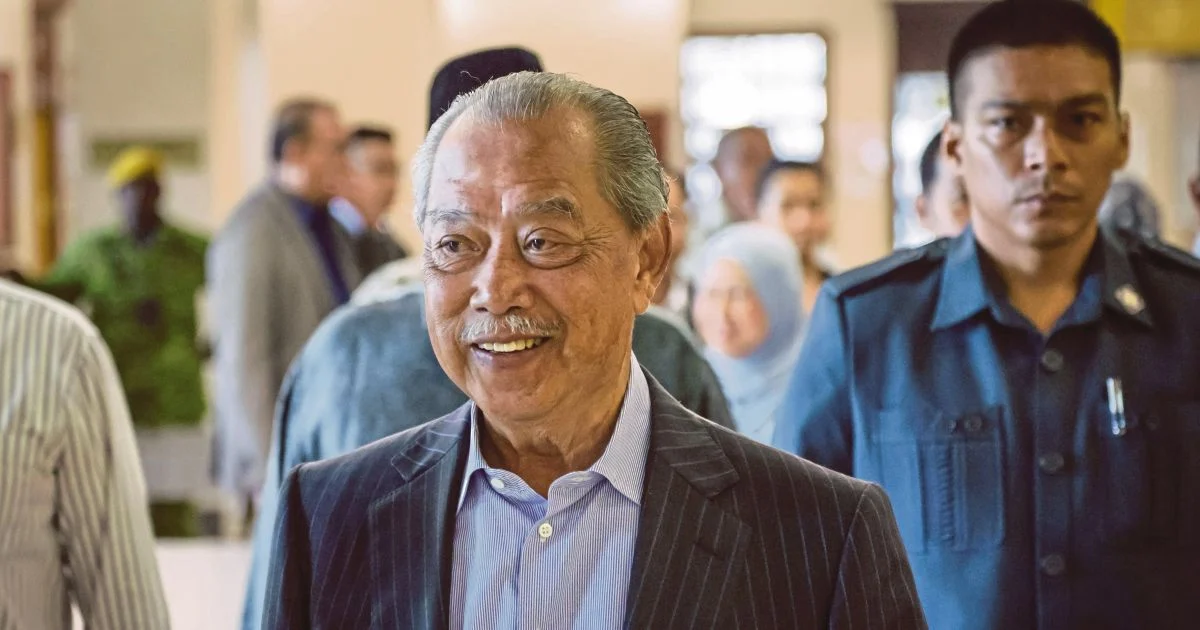
Bersatu president Tan Sri Muhyiddin Yassin has struck an optimistic note about Perikatan Nasional's electoral prospects in Johor, asserting that the opposition coalition maintains a realistic pathway to government formation despite running candidates in only 33 of the state's parliamentary constituencies. Speaking in Pagoh, the veteran politician downplayed concerns about PN's limited seat contest, suggesting instead that strategic positioning and post-election political manoeuvring could still deliver sufficient legislative support to establish a state administration.
The confidence Muhyiddin projects rests partly on the fractured nature of Malaysian state politics, where coalition-building and seat-sharing arrangements frequently determine outcomes rather than vote margins alone. In Johor, as in several Malaysian states, the complex interplay between the ruling Barisan Nasional, the opposition Pakatan Harapan, and PN itself creates multiple permutations for government formation. Muhyiddin's remarks suggest that PN strategists believe independent candidates, defections, or floor-crossings could prove decisive after polling, a pattern increasingly visible across Malaysian legislatures.
Johor represents significant political terrain for PN. The state, long a Barisan stronghold, has witnessed growing political volatility in recent years, with voters displaying less tribal loyalty to long-established coalitions. PN's 2018 federal election breakthrough and its subsequent role in various state administrations have established the coalition as a credible alternative in many constituencies. The party's limited seat contest in Johor does not necessarily reflect weakness so much as tactical calculation, with Muhyiddin and party strategists potentially conceding certain constituencies while focusing resources and organisational muscle where PN believes it holds competitive advantages.
The decision to field candidates in only 33 seats out of Johor's total requires deeper examination. Such restraint in seat-fielding typically reflects internal party assessments about resource allocation, organisational capacity, and realistic winning prospects. Rather than interpreting limited candidacies as indicative of electoral vulnerability, Muhyiddin appears to be arguing that concentrated effort in winnable constituencies, combined with favourable post-election political winds, could yet produce a governing majority. This approach acknowledges the reality that Johor elections will ultimately be determined through complex negotiations among multiple parties and independent lawmakers.
For Malaysian and Southeast Asian observers, PN's positioning in Johor exemplifies broader regional trends toward political fragmentation and coalition instability. Unlike Westminster systems with clear two-party competition, Malaysian politics at state level increasingly feature multi-cornered contests where no single grouping automatically commands legislative majorities. This creates opportunities for smaller coalitions and individual candidates to exercise outsized influence, transforming post-election bargaining into as significant a factor as actual electoral margins. Muhyiddin's optimism reflects understanding of this political arithmetic.
The broader context of Johor politics has shifted meaningfully over recent years. Barisan Nasional's historical dominance faced sustained challenge, particularly during the 2018 federal breakthrough when PN-aligned candidates gained traction in previously secure Umno-held seats. While subsequent state and federal elections have produced mixed results for PN, the coalition has demonstrated capacity to remain relevant across most Malaysian states. Johor's political landscape now includes genuinely competitive races in constituencies that might previously have been considered automatic Barisan victories.
Muhyiddin's confidence also reflects PN's experience in unexpected government formations. The coalition's role in establishing the Perikatan Nasional federal administration following the 2020 political crisis demonstrated that legislative mathematics and strategic positioning could overcome apparent electoral disadvantages. While that administration ultimately proved unstable, it validated the principle that political outcomes frequently diverge from simple seat-counting projections. Johor voters and observers should interpret Muhyiddin's statements through this lens of recent Malaysian political history.
Regional analysts tracking Malaysian politics recognise that state-level elections serve as barometers for shifting public sentiment and evolving coalition dynamics. Johor's electoral contest carries significance beyond the state itself, potentially influencing perceptions of PN's national viability and affecting Barisan Nasional's confidence going forward. A stronger-than-expected PN showing in Johor, even from a reduced seat base, could reshape calculations about coalition competitiveness across Malaysia. Conversely, poor PN performance would reinforce narratives about the coalition's structural limitations.
The sustainability of PN as a governing entity depends heavily on its capacity to translate electoral participation into legislative cooperation and stable administrations. Previous instances where opposition coalitions or alternative groupings have taken power in Malaysian states have sometimes produced fractious administrations marked by defections and political instability. Muhyiddin's confidence, while publicly articulated, presumably reflects private assessments about potential coalition partners and the reliability of floor support if PN does secure a sufficient number of seats to form government.
Looking ahead, the Johor election will test multiple hypotheses about contemporary Malaysian electoral politics. Whether limited seat-fielding by PN proves strategically sound or merely reflects constrained resources will become apparent through detailed post-election analysis. More broadly, the contest offers insights into voter behaviour in a state long considered politically pivotal, and the capacity of opposition coalitions to penetrate Barisan's traditional strongholds. Muhyiddin's public optimism, measured against actual electoral results, will provide evidence about whether his assessment of PN's prospects reflects realistic political calculation or aspirational thinking.

