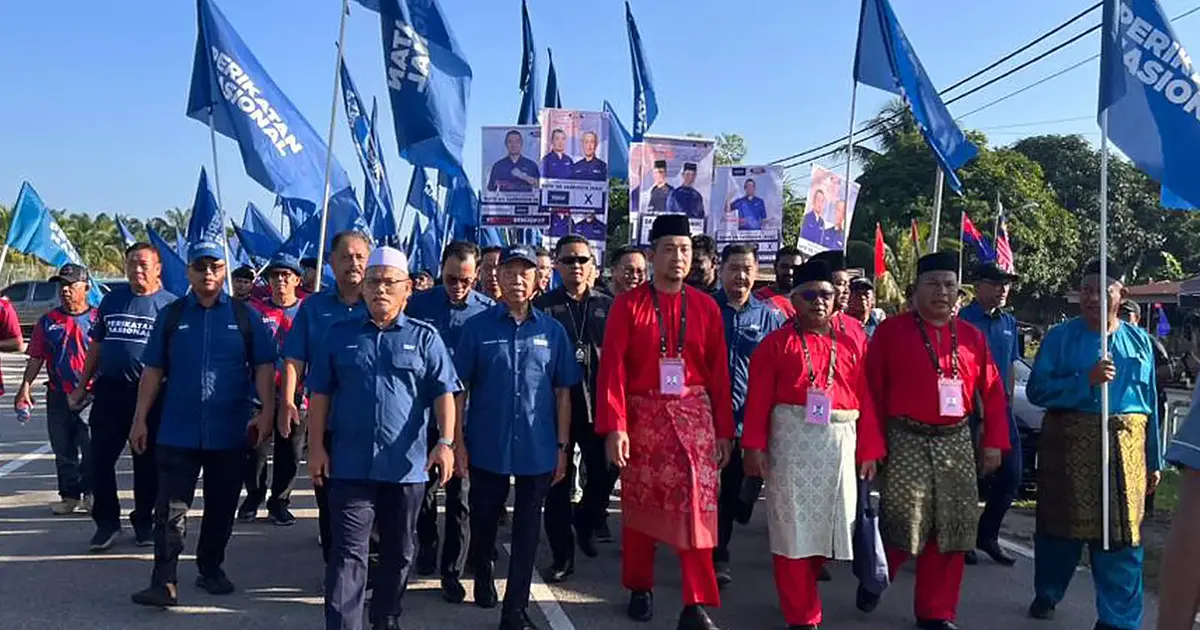
Perikatan Nasional chairman Muhyiddin Yassin threw his weight behind the coalition's Bukit Kepong campaign this week, assembling hundreds of party supporters in a demonstration of organisational muscle ahead of what promises to be a closely contested electoral engagement. The former prime minister's visible backing underscores the strategic importance Perikatan places on retaining the seat, which has emerged as a key battleground in the broader political realignment reshaping Malaysia's political landscape.
The decision to deploy Muhyiddin himself to stump for the constituency reflects mounting confidence within Perikatan's upper echelon regarding their electoral prospects. His personal involvement signals to the grassroots that leadership is taking the contest seriously, a symbolic gesture that carries weight in Malaysian politics where proximity to senior figures is often interpreted as validation of a candidate's viability. The turnout of several hundred supporters, while modest by historical standards, indicates retained organisational capacity within the coalition at the ground level.
Bersatu has nominated Dr Sahruddin Jamal to contest the seat. The two-term assemblyman brings incumbency advantage and established roots within the constituency, factors that typically prove decisive in Malaysian electoral contests where local recognition and service records substantially influence voter behaviour. His re-nomination suggests Bersatu's confidence in his political standing, particularly given the volatile environment in which sitting representatives have occasionally found themselves vulnerable to localist sentiment and competing party machinery.
The Bukit Kepong contest sits within a broader context of Perikatan's strategic repositioning. Since its formation and subsequent evolution, the coalition has sought to consolidate support in traditionally Malay-majority constituencies where Islamist politics and Bumiputera-centric appeals resonate strongly. Bukit Kepong, situated within a demographic profile matching these parameters, represents precisely the type of seat where Perikatan must perform strongly to achieve meaningful parliamentary representation gains.
Muhyiddin's campaign presence also addresses internal coalition dynamics. Perikatan comprises multiple parties with distinct organisational cultures and constituent bases, requiring periodic coordination signals from the apex to maintain momentum and prevent internal drift. The visible demonstration of support for Dr Sahruddin helps reinforce institutional discipline within the broader coalition structure, ensuring that Bersatu's effort receives tacit endorsement from other Perikatan components.
The candidate himself has built tenure across two assembly terms, accumulating the relationships and track record that constitute electoral bedrock in Malaysian politics. Voters in Bukit Kepong will evaluate his performance against service delivery metrics—infrastructure development, responsiveness to constituent complaints, and visibility within the community. These tangible dimensions of representation often outweigh broader party political messaging in determining electoral outcomes at the state assembly level.
Peikatan's emphasis on personal campaigning by senior leadership reflects awareness that electoral competition has intensified across Malaysia's political spectrum. The coalition cannot rely solely on organisational machinery or traditional support bases; active cultivation of voters through direct engagement has become essential. Muhyiddin's participation therefore serves both a morale function for existing supporters and a signal to persuadable voters that Perikatan remains an active, serious political force capable of mobilising resources and attention.
The timing of such campaign activities carries significance within Malaysia's electoral calendar. Pre-campaign periods offer opportunities for parties to gauge sentiment, refine messaging, and test organisational readiness before formal nomination and official campaign periods commence. Muhyiddin's appearance alongside Dr Sahruddin and assembled supporters thus represents forward deployment in a long electoral cycle, not merely an ad-hoc appearance.
For Malaysian observers and analysts tracking coalition dynamics, Bukit Kepong exemplifies the state-level contests through which larger political narratives develop. These constituency-level battles, multiplied across the federation, ultimately determine which coalitions achieve legislative majorities and govern state administrations. Each individual contest contributes to the broader mosaic of political competition that characterises Southeast Asia's largest Muslim-majority democracy.
The confidence demonstrated through Muhyiddin's campaign involvement must be tested against electoral reality. Malaysian voters regularly surprise political analysts with outcomes that defy elite expectations, particularly when economic grievances or local dissatisfactions override party loyalty or personality-driven politics. Dr Sahruddin and Perikatan supporters will therefore require sustained effort rather than relying on momentum from leadership appearances alone.
Moving forward, observers should monitor whether Perikatan sustains this level of active campaigning across multiple constituencies or concentrates resources selectively. The coalition's capacity to mount simultaneous campaigns across numerous constituencies will reveal much about its genuine competitive positioning heading into formal electoral contests. Bukit Kepong thus represents both a specific local engagement and a microcosm of broader coalition health and strategic capability.

