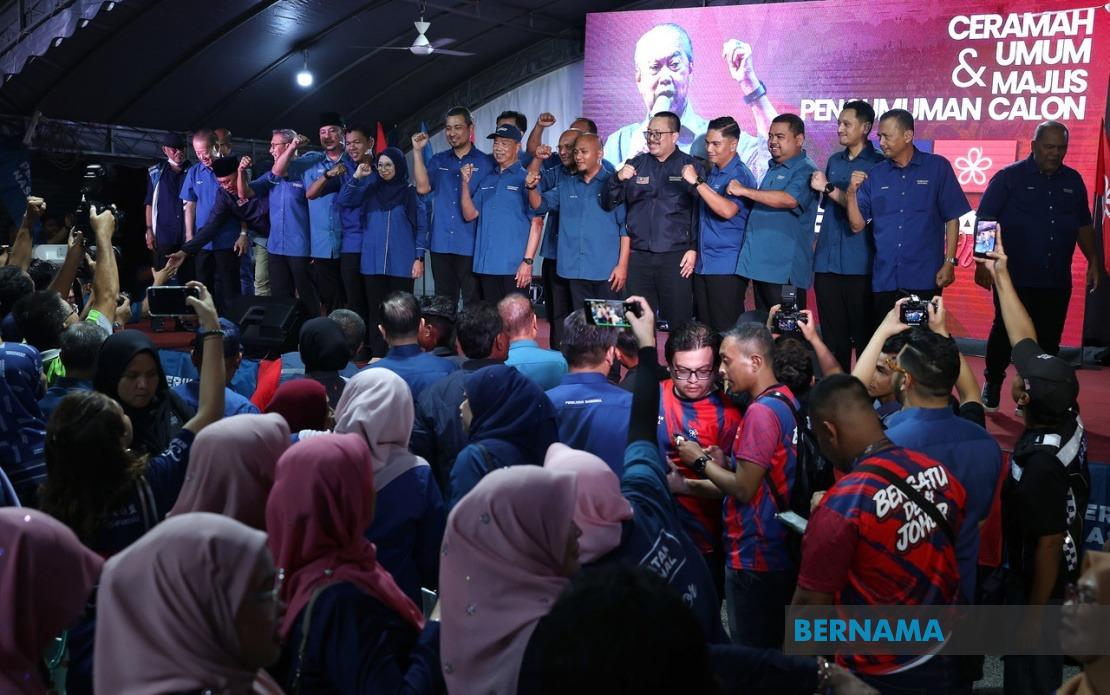
Parti Pribumi Bersatu Malaysia has fielded a full slate of 16 candidates across all state assembly seats in the upcoming Johor State Election, party president Tan Sri Muhyiddin Yassin announced at a campaign event in Muar on June 25. The declaration came during a candidates announcement and public address at the Pagoh Parliamentary Service Centre in Taman Pagoh Jaya, where Muhyiddin outlined the party's strategy for reclaiming ground in one of Malaysia's most politically consequential states.
The timing of Bersatu's candidate rollout reflects the compressed campaign schedule following the dissolution of the Johor State Assembly on June 1. The Election Commission has designated June 27 as nomination day, giving candidates and their campaign machinery less than a week to formally register their candidacies. This condensed timeframe places considerable pressure on grassroots mobilization efforts across the state, requiring parties to activate their machinery swiftly across rural and urban constituencies alike.
Bersatu's decision to contest all 16 seats signals the party's commitment to competitive engagement in Johor despite shifting political alignments within Malaysia's coalition landscape. The party, which forms part of the broader Perikatan Nasional alliance, faces the dual challenge of consolidating support among its existing base while broadening appeal to undecided voters. Johor represents crucial electoral territory for Bersatu, as performance here will significantly influence the party's bargaining position within coalition negotiations and parliamentary arithmetic.
Among the announced candidates is Mohd Idzharruddin Mohd Nasirruddin, who will contest the N8 Bukit Pasir seat. This constituency, representing a primarily Malay-Muslim demographic concentrated around the Pagoh area, has traditionally been a contentious battleground between competing Malay-based parties. The selection of candidates for such seats reflects internal party deliberations regarding candidate quality, local influence, and perceived electability in specific communities.
The July 11 polling date provides voters with approximately two weeks to assess candidate platforms and party manifestos following the formal nomination period. This timeline is considerably compressed compared to federal election campaigns, potentially limiting the depth of policy discussion and voter engagement. However, the shorter campaign cycle also means campaign expenditure pressures are more contained, which may benefit parties with leaner organizational structures and more efficient ground networks.
Bersatu's participation in this state election carries implications extending beyond Johor's borders. Performance metrics here will be closely monitored by coalition partners, opposition benchmarkers, and political analysts assessing the party's electoral viability and grassroots organizational capacity. Strong showings would reinforce Muhyiddin's leadership position within Perikatan Nasional, while disappointing results could trigger internal recalibrations regarding strategy and candidate selection methodologies.
The state election also serves as a barometer for broader political sentiments in Malaysia's southern region. Johor's demographic diversity—encompassing Malay-Muslim heartland areas, significant Chinese and Indian communities, and urban professional classes—makes electoral trends here representative of nationwide sentiment across multiple demographic groups. Parties will scrutinize voting patterns by constituency type and ethnicity to extract lessons for eventual federal elections.
Bersatu's campaign messaging will likely emphasize governance achievements during prior state administration tenures and differentiate the party's approach from competing coalitions. The party must navigate the delicate balance of emphasizing local constituency concerns while connecting these to broader national policy agendas that resonate with voters. Candidate quality and perceived accessibility to constituents become particularly important in a compressed campaign environment where there is limited time for voters to develop familiarity with less-established political figures.
The organizational logistics of coordinating 16 candidate campaigns simultaneously across a geographically dispersed state presents substantial coordination challenges. Campaign managers must allocate resources strategically, concentrating efforts in winnable constituencies while maintaining baseline visibility in more challenging battlegrounds. The quality of coordination between state-level party machinery and parliamentary zone coordinators will largely determine whether Bersatu maximizes its potential vote share.
Johor's electoral outcome will reverberate through Malaysian politics regardless of which coalition emerges victorious. The state government's composition directly influences policy implementation affecting commerce, agriculture, infrastructure development, and social services that impact millions of residents. Additionally, Johor's political complexion influences coalition bargaining dynamics during parliamentary sessions, where slim majority margins make even single state government losses strategically significant.
For Southeast Asian observers monitoring Malaysian political developments, the Johor election offers insights into coalition stability, electoral competitiveness in established political strongholds, and the evolving role of parties like Bersatu within Malaysia's fractious political ecosystem. The state's economic importance as a manufacturing and logistics hub adds economic dimensions to what might otherwise be dismissed as merely another routine state election.

