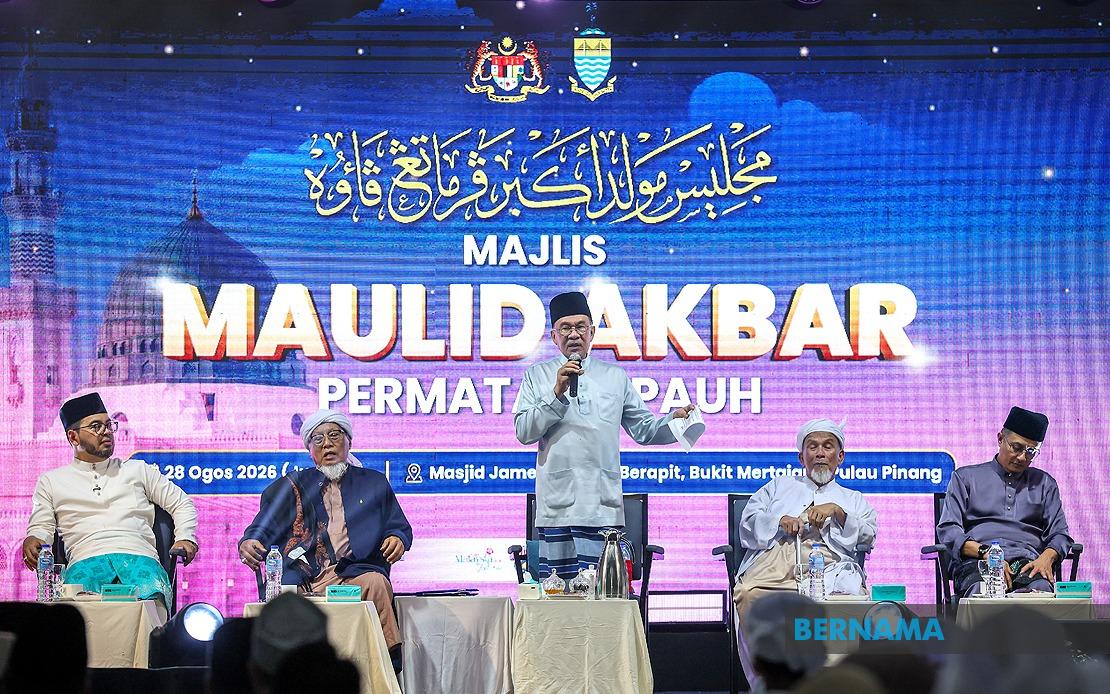
Prime Minister Datuk Seri Anwar Ibrahim has urged Malaysia's Muslim population to become living examples of virtue and ethical conduct, arguing that genuine societal respect stems not from religious identity alone but from consistent demonstration of positive values in everyday interactions. Speaking at a Maulid Akbar ceremony held alongside National Day celebrations in Bukit Mertajam, Anwar framed moral leadership as a practical imperative, suggesting that public esteem for Muslims depends fundamentally on whether individuals exhibit diligence, honour their commitments and refrain from financial impropriety.
The Prime Minister articulated a vision where Muslims function as cultural ambassadors for Islam's broader message of compassion and universal welfare. He argued that when society observes Muslims working conscientiously, maintaining ethical standards and abstaining from dishonest practices, a natural respect emerges that transcends theological debate. This framing rejects the notion that reverence should flow automatically from religious affiliation, instead tying it directly to behavioural accountability and tangible demonstration of character.
Anwar's remarks carry particular significance given Malaysia's ongoing struggles with corruption and governance challenges. By positioning Muslim communities as standards-bearers for integrity, he implicitly acknowledges that public confidence in institutions and leadership has been eroded, requiring deliberate reconstruction through exemplary individual conduct. The emphasis on rejecting wrongdoing and abuse of position reflects contemporary concerns about institutional trust that extend across Malaysian society.
Crucially, Anwar stressed that Islamic principles demand Muslims maintain balanced development across multiple dimensions of human flourishing. Rather than compartmentalising religious faith from material progress or technological advancement, he advocated for simultaneous cultivation of knowledge, spirituality, moral discipline and physical wellbeing. This holistic approach reflects Islamic theology's rejection of false dichotomies between the sacred and secular domains of life.
The Prime Minister explicitly connected this framework to Malaysia MADANI, the government's overarching development narrative. He cautioned that economic policies, growth statistics and technological achievements cannot substitute for a robust moral foundation. Without strong grounding in faith, ethics and character, Malaysia risks becoming a nation that pursues material advancement while losing its moral compass—what Anwar described using the metaphor of reaching for the sky while remaining rooted in the earth.
This formulation suggests potential tensions within Malaysia MADANI's implementation. Government officials must navigate between fostering innovation and competitiveness in global markets—demanding pragmatism, calculated risk-taking and sometimes morally ambiguous trade-offs—while simultaneously maintaining that moral principles remain development's primary pillar. Anwar's rhetoric suggests this tension is surmountable through disciplined commitment to ethical frameworks, though practical governance often reveals such ideals are considerably more difficult to operationalise.
Anwar also highlighted the role of Islamic religious scholars as institutional anchors for moral leadership. By emphasising the importance of consulting religious experts and maintaining constructive dialogue between scholars and political leaders, Anwar positioned Malaysia's religious establishment as essential infrastructure for national development. This recognition reflects broader Southeast Asian patterns where religious institutions function as repositories of ethical authority and social cohesion, particularly during periods of rapid modernisation that disrupt traditional community structures.
The Minister in the Prime Minister's Department (Religious Affairs), Dr Zulkifli Hasan, accompanied Anwar at the ceremony, underscoring government commitment to integrating religious perspectives into policy frameworks. This institutional arrangement suggests that moral and spiritual dimensions of governance are not peripheral to Malaysia MADANI but central to its conception and implementation.
For Malaysian readers, Anwar's message carries implications beyond rhetorical flourish. It articulates an implicit social contract wherein Muslims—as the nation's majority religious community—bear responsibility for demonstrating that Islam is compatible with modern governance, economic dynamism and technological progress while maintaining ethical standards. This burden of representation is asymmetrical; while all Malaysians bear responsibility for integrity, Anwar's address places particular emphasis on Muslim communities as exemplars.
The emphasis on relationships transcending religious boundaries reflects Malaysia's multicommunal context, where Muslim majority governance depends on maintaining confidence among non-Muslim citizens. By insisting that Islamic principles mandate concern for community welfare regardless of faith background, Anwar attempts to align religious obligation with inclusive national citizenship. Whether this rhetorical framework translates into policy that genuinely protects minority interests and ensures equitable resource distribution remains contested.
Anwar's invocation of knowledge and Islamic scholarship as essential components of development also gestures toward countering narratives portraying Islam as incompatible with scientific progress or modern expertise. By presenting piety and learning as complementary rather than competing values, he challenges simplistic binaries that have sometimes dominated Malaysian public discourse on religion and modernity.
Ultimately, Anwar's address represents an attempt to harness religious identity as a motivating force for institutional integrity and personal accountability. Rather than treating morality as a private virtue disconnected from public governance, he argues that Malaysia's development trajectory depends on officials, business leaders and citizens embodying ethical principles consistently and visibly. The challenge lies in ensuring that such appeals for moral leadership translate into systemic reforms that constrain corruption and improve institutional performance across government and private sectors.

