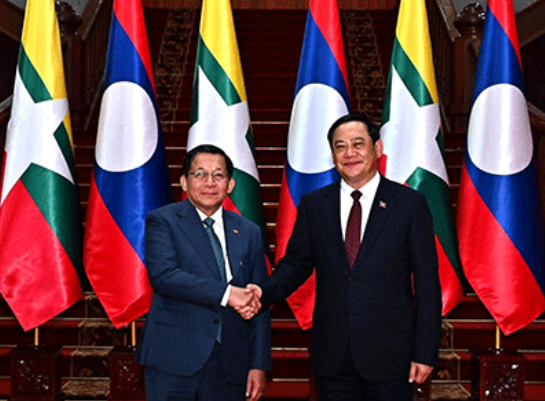
Myanmar's President Min Aung Hlaing touched down in Vientiane on July 3 for a three-day state visit to Laos, bringing with him his wife and a senior delegation in what constitutes a significant diplomatic overture between two neighbouring Southeast Asian countries. The occasion coincided with celebrations marking 70 years of formal bilateral relations—a milestone underscoring the historical depth of ties between Naypyidaw and Vientiane. President Thongloun Sisoulith and his wife Naly Sisoulith received their counterpart with full ceremonial honours at the Presidential Palace, setting the tone for a visit centred on reinvigorating cooperation and charting fresh collaborative pathways across multiple sectors of mutual concern.
The formal talks that followed revealed both governments' ambition to transcend traditional diplomatic courtesies and move into substantive partnership. During discussions between the two presidents, leaders reviewed the architecture of bilateral engagement accumulated over seven decades, reassessed existing frameworks, and deliberated on regional and global developments affecting their respective nations and Southeast Asia more broadly. President Thongloun characterised the visit as a watershed moment for the relationship, emphasising that it represented another chapter in consolidating the traditional friendship, solidarity and cooperative spirit that has defined Laos-Myanmar relations since 1954. His acknowledgement of Myanmar's recent general election and formation of a new government, coupled with expressed confidence in continued progress under Min Aung Hlaing's stewardship, signalled Laos's political backing for the current Myanmar administration.
Practical collaboration featured prominently in the leadership discussions, with both sides recording satisfaction at advances already achieved in defence and security arrangements, foreign policy alignment, commerce, investment flows, transport connectivity, energy projects, labour mobility and educational exchanges. The stated intention to deepen these partnerships reflected recognition that bilateral ties, while historically robust, retained untapped potential in contemporary settings. Both governments recognised that coordinated border management—a perennial concern for neighbouring states—warranted strengthened mechanisms, particularly involving information-sharing protocols and collaborative security operations. Additionally, they identified cooperation through multilateral structures such as the Association of Southeast Asian Nations (Asean), United Nations bodies, and the Mekong-Lancang Cooperation framework as strategic vehicles for amplifying their collective voice in regional affairs.
Prime Minister Sonexay Siphandone's separate meeting with President Min Aung Hlaing further underscored executive-level commitment to the relationship's advancement. During these discussions, the two sides formalised their intention to intensify cooperation across political channels, defence and security infrastructure, commercial and investment sectors, transport networks, energy development, labour matters, education initiatives and humanitarian assistance programmes. Notably, both governments flagged cross-border air pollution as an emerging area requiring coordinated environmental management—a practical acknowledgement of transnational challenges that transcend traditional diplomatic silos. The referenced Laos-Myanmar Joint Committee on Bilateral Cooperation and other institutional channels would serve as operational mechanisms for translating these commitments into tangible outcomes and sustained progress.
Parliamentary-level engagement added a democratic dimension to state-level diplomacy when President Min Aung Hlaing convened with Xaysomphone Phomvihane, President of the Lao National Assembly. This interaction highlighted mutual interest in strengthening legislative cooperation and ensuring parliamentary oversight of implementation mechanisms for bilateral agreements. Xaysomphone underscored that the Myanmar President's selection of Laos as his first Asean destination for official international engagement since assuming office carried symbolic weight, positioning the kingdom as a priority partner for Naypyidaw's diplomatic outreach. The two legislative leaders pledged enhanced cooperation between their respective parliaments—Laos's National Assembly and Myanmar's Union Parliament—ensuring that agreements negotiated at executive level received legislative support and sustained monitoring to guarantee practical delivery of promised benefits.
Concrete outputs from the visit included the formal signing of two significant memorandums of understanding. A tourism cooperation agreement between Laos's Ministry of Culture and Tourism and Myanmar's Ministry of Hotels, Tourism and Culture signals mutual interest in leveraging both nations' cultural heritage and archaeological attractions to boost visitor flows and generate economic benefits for tourism sectors. Concurrently, a friendship city arrangement was formalised between Vientiane and Naypyidaw, establishing institutional linkages between the two capitals and creating frameworks for municipal-level cooperation in cultural exchanges, civic initiatives and people-to-people engagement. The symbolic handover of snake antivenom serum to the Lao Ministry of Health, though less publicised than broader partnership announcements, reflected humanitarian dimensions of the relationship and practical cooperation addressing public health concerns affecting both populations.
The visit encompassed ceremonial elements reinforcing emotional and historical bonds between the nations. President Min Aung Hlaing laid wreaths at Vientiane's Unknown Soldier Monument, honouring Lao revolutionary fighters—a gesture acknowledging shared socialist historical trajectories. His participation in a traditional Baci ceremony and attendance at an elaborate state banquet hosted by President Thongloun provided settings for personal rapport-building among leadership circles and symbolic affirmation of the visit's significance. These ceremonial dimensions, while appearing ancillary to policy discussions, carry considerable weight in Southeast Asian diplomatic culture, where personal relationships and demonstrated respect for national heritage considerably influence bilateral climate and future cooperation prospects.
The planned extension to Luang Prabang during the final phase of the visit demonstrated intent to showcase Laos's cultural assets and deepen Myanmar leaders' appreciation for the host nation's heritage and contemporary development trajectory. Temple visits, exploration of cultural landmarks and tourism of the Unesco World Heritage-listed city would familiarise the Myanmar delegation with Laos's attractions while potentially catalysing future tourism and cultural cooperation initiatives. Such exposure trips during state visits frequently yield unexpected collaboration opportunities and enhance mutual understanding beyond official memoranda.
For Malaysian observers and Southeast Asian analysts, this Myanmar-Laos diplomatic engagement reflects broader regional patterns where medium-sized powers invest substantially in bilateral relationship management despite limited economic scale. The visit illustrates how historical bonds, geographic proximity and shared regional institutional membership create durable frameworks for cooperation, even when trade volumes remain modest relative to ties with larger economic powers. Laos's positioning of the visit as Myanmar's inaugural Asean destination suggests deliberate cultivation of a relationship that Naypyidaw evidently values strategically, potentially reflecting Myanmar's need to consolidate regional partnerships amid international scrutiny of domestic governance matters.
The emphasis on trade, investment and economic cooperation within the agreed partnership agenda signals recognition that political relations alone prove insufficient for sustaining long-term bilateral engagement. Both governments appeared conscious that converting diplomatic goodwill into tangible commercial benefits—whether through tourism development, infrastructure projects or labour cooperation—strengthens constituencies within each nation supporting continued partnership. The identification of specific sectors for cooperation provides measurable yardsticks against which future governments can assess relationship progress and justify continued diplomatic investment.
Regionally, the strengthened Laos-Myanmar axis carries implications for Mekong subregional dynamics and broader Asean cohesion. Greater Laotian-Myanmar alignment could influence positions on issues affecting the Mekong region, from hydroelectric development and water resource management to transportation corridors and economic integration initiatives. For Malaysia and other Asean members, observing how Laos calibrates its relationships with fellow bloc members offers insights into coalition-building patterns within the organisation and the relative priority that different Southeast Asian states assign to bilateral partnerships versus collective institutional identity.
Looking forward, the success of this state visit will ultimately depend upon whether announced cooperation agreements translate into sustained implementation and measurable benefits for ordinary citizens and businesses in both countries. The infrastructure established through joint committees and enhanced parliamentary cooperation will determine whether the revitalised bilateral relationship remains confined to ceremonial exchanges or evolves into substantive partnership addressing practical development challenges. Regional observers should monitor implementation trajectories closely, as progress will signal whether Laos and Myanmar have genuinely committed to transcending traditional diplomatic rhythms or are engaged in cyclical relationship management typical of many bilateral arrangements in Southeast Asia.

