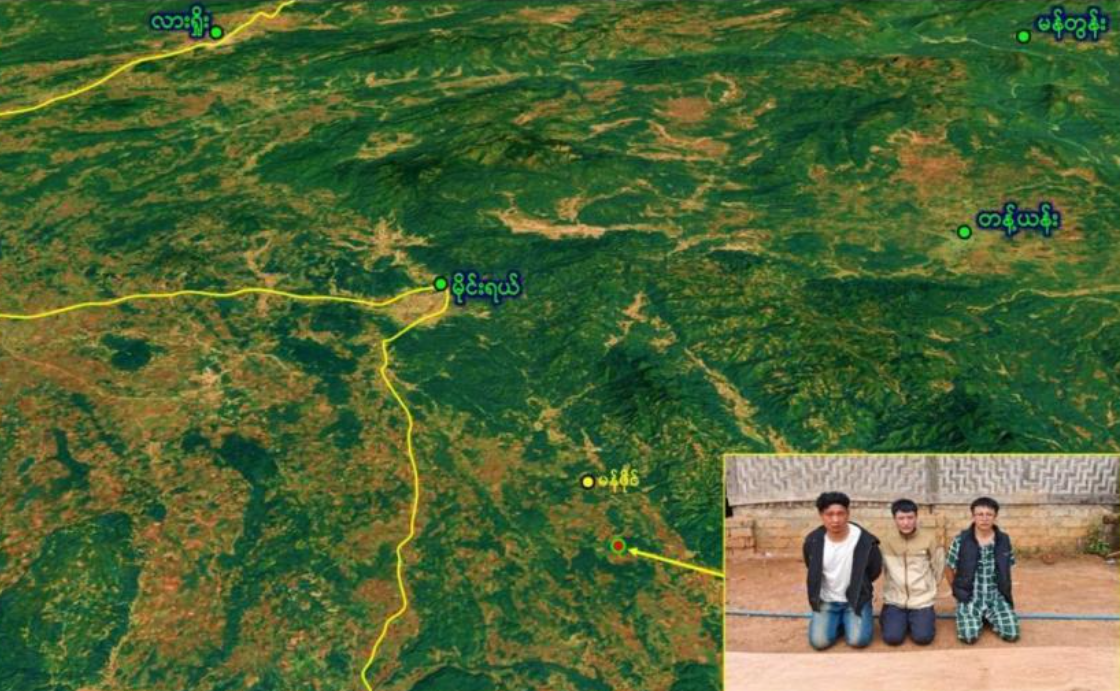
Myanmar's military forces have intensified crackdowns on cross-border criminal networks, with the latest operation targeting three Chinese nationals accused of orchestrating online gambling scams from a remote location in Mongyai Township, northern Shan State. The arrests on August 26 represent part of a broader government initiative to dismantle what has become a persistent regional problem: organised cybercrime syndicates operating from porous border regions that exploit vulnerable populations across Southeast Asia and beyond.
The three men, who allegedly crossed into Myanmar illegally, had established a makeshift operational base approximately 26 kilometres southeast of Mongyai town and roughly five kilometres south of Manphai Village. What authorities discovered during the security operation reveals the sophisticated nature of these criminal enterprises. The suspects had constructed a 50-by-20-foot corrugated iron structure with bamboo walls alongside five temporary tarpaulin shelters of varying dimensions, creating a seemingly itinerant setup designed to evade detection and rapid deployment if necessary.
The equipment seizure underscores how technologically advanced these scam operations have become. Authorities recovered 25 mobile phones, five all-in-one computers, two power stations, and critically, a Starlink satellite internet device that would have provided reliable connectivity independent of Myanmar's terrestrial telecommunications infrastructure. The recovery of ten communication radios suggests a well-organised operation with internal coordination protocols. This technological arsenal transforms what might appear to be a simple fraud ring into a sophisticated enterprise capable of managing large-scale victim networks and coordinating with accomplices elsewhere.
The discovery followed intelligence from local residents who reported suspicious activity in the area. This community-based tip-off mechanism has become crucial for Myanmar's security apparatus, which faces significant resource constraints in patrolling the vast and difficult terrain of northern Shan State. The integration of local knowledge with military security operations demonstrates how border security increasingly relies on civilian cooperation to identify and neutralise criminal infrastructure that would otherwise operate with virtual impunity.
Myanmar's government has made combating online scam gambling a national priority, recognising the corrosive impact these operations have on regional stability and social cohesion. These criminal networks typically target individuals across multiple countries, employing sophisticated psychological manipulation and false promises of financial returns. The prevalence of such operations in border regions reflects a troubling reality: weak governance in conflict-affected areas creates vacuums that organised crime fills rapidly and effectively.
The specific focus on northern Shan State is not coincidental. This region, with its complex ethnic politics, limited government presence, and proximity to Thailand, Laos, and China, has become a known haven for various illicit operations ranging from drug trafficking to human smuggling to cybercrime. The porous border with Yunnan Province in China creates natural corridors for criminal personnel and equipment movement. Chinese nationals involved in these enterprises reportedly exploit weak border security and jurisdictional ambiguities to operate with relative freedom.
The equipment seizure reveals important details about operational methodology. The Starlink device is particularly significant, as it allows these criminal operations to function independently of host nation telecommunications authorities. Starlink's global coverage means that operators can maintain encrypted communications without reliance on local internet service providers that might be subject to government monitoring. This represents a substantial challenge for law enforcement agencies attempting to intercept communications or track financial flows associated with scam gambling operations.
Authorities have indicated that the arrested individuals will face prosecution under existing Myanmar laws following completion of interrogations and formal investigations. However, the broader systemic challenge remains unresolved: the supply of recruits willing to operate these facilities and the international demand for scam gambling services that sustains the business model. Unless Myanmar can effectively disrupt the financial incentives and criminal networks that prop up these enterprises, individual raids, however successful tactically, will represent merely temporary setbacks for better-resourced international crime syndicates.
The government's stated commitment to systematically dismantle illegally constructed shelters and eliminate online scam gambling entirely suggests a recognition that this problem requires sustained, coordinated effort rather than episodic enforcement operations. However, implementation capacity remains a persistent challenge. Myanmar's military and civilian law enforcement agencies already face competing security priorities across multiple regions and must contend with resource limitations that affect operational tempo and investigative sophistication.
For Malaysia and other Southeast Asian nations, this Myanmar operation carries significant implications. Many Malaysian citizens have fallen victim to online gambling scams originating from operations in the region. The transnational nature of cybercrime means that disrupting criminal infrastructure in Myanmar directly benefits public safety across the broader region. Cross-border cooperation between Myanmar authorities and their Malaysian counterparts through ASEAN frameworks remains underdeveloped, presenting opportunities for enhanced intelligence sharing and coordinated enforcement operations.
The strategic question moving forward involves whether Myanmar can sustain sufficient political will and allocate adequate resources to transform episodic raids into comprehensive criminal network dismantlement. The current operation demonstrates tactical competence, but eliminating these operations entirely requires addressing the fundamental governance challenges, poverty, and limited economic opportunities that make border regions attractive to criminal entrepreneurs seeking to establish bases.

