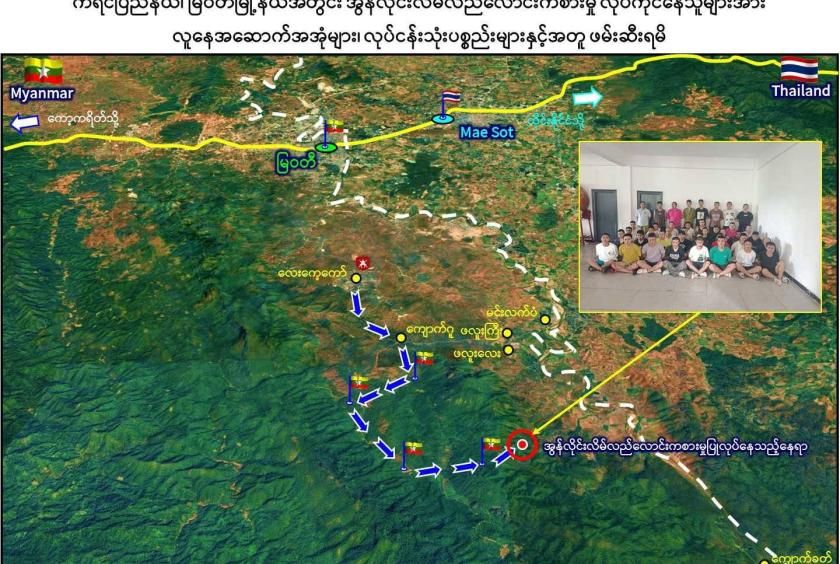
Myanmar has conducted one of its largest operations against organised cybercrime, arresting 777 suspected online fraud operators during a coordinated raid in the Kyauk Khat area of Myawaddy Township in Kayin State. The scale of the operation underscores the challenge posed by sophisticated scam networks that have become entrenched in ungoverned border zones across Southeast Asia, drawing international criminal syndicates who exploit weak enforcement and jurisdictional complexities.
The detainees comprise a diverse group reflecting the international nature of digital fraud operations in the region. Among those arrested were 631 Chinese nationals, 143 Myanmar citizens, and three Thai nationals. This composition highlights how transnational crime networks recruit operatives across borders, with foreign nationals typically occupying technical and management roles while local accomplices provide ground support and logistical assistance. The prevalence of Chinese nationals in such operations has been a persistent concern for governments throughout Southeast Asia, prompting increased bilateral pressure and law enforcement cooperation.
Military personnel recovered substantial technological infrastructure during the raid, seizing equipment that enabled the criminal enterprise to function at scale. Authorities confiscated a Starlink satellite terminal, 85 computers, and 183 mobile phones. The presence of satellite internet equipment is particularly significant, as such systems allow operators to maintain reliable connectivity from remote locations beyond conventional infrastructure, making detection and disruption considerably more difficult for law enforcement agencies.
According to official statements, security forces initiated the operation based on intelligence suggesting the establishment of illegal scam and gambling compounds within the area. The decision to mount such a comprehensive raid reflects growing governmental recognition that these networks represent not merely commercial crimes but fundamental threats to financial security and social stability. Online fraud operations particularly target vulnerable populations globally through romance scams, investment schemes, and employment fraud, causing billions of dollars in losses annually.
The raid occurred in a volatile security environment, with government forces encountering armed resistance from militia groups aligned with broader political instability. Officials reported that clashes erupted with members of the Karen National Liberation Army (KNLA) and the People's Defence Force (PDF), with authorities alleging these groups provided armed protection to scam operations in exchange for substantial payments. This allegation, if accurate, reveals a troubling nexus between organised crime and armed insurgency, where financial resources from cybercrime sustain broader paramilitary operations.
The military engagement resulted in significant casualties, with officials claiming 13 armed group members were killed during confrontations. Beyond personnel losses, authorities seized nine firearms, ammunition supplies, bunkers, and additional military-related assets, suggesting the scam compounds operated with substantial defensive fortifications. Such heavy weaponry indicates the criminals anticipated enforcement action and prepared accordingly, transforming what might otherwise be white-collar operations into quasi-military installations.
The security landscape in Myawaddy Township reflects Myanmar's broader instability since the 2021 military coup, which fractured state authority and created power vacuums exploited by criminal enterprises and armed groups alike. Border zones in Kayin State have become particularly problematic, lying beyond effective government control and offering sanctuary to transnational criminal networks. The inability to establish consistent security has transformed these areas into havens for illicit activities, from drug trafficking to human smuggling to cybercrime.
All detainees face investigation followed by prosecution under applicable Myanmar law. The government has emphasised that confiscated equipment will be processed according to legal procedures, though questions remain regarding actual prosecution rates and sentencing consistency for such crimes in Myanmar's fragmented justice system. International observers have raised concerns about due process, detention conditions, and the capacity of Myanmar courts to manage cases of this complexity.
The operation illustrates Myanmar's commitment to addressing cybercrime, yet also exposes structural limitations in combating such networks. Scam operations thrive because they require relatively modest capital investment, generate enormous profits, and operate from jurisdictions where enforcement is inconsistent. Even successful raids eliminate existing compounds but rarely dismantle underlying networks, which relocate and reconstitute elsewhere within border regions.
Myanmar authorities have pledged continued cooperation with neighbouring countries and international partners to dismantle online scam and gambling networks. This regional dimension is crucial, as most victims of these operations reside outside Myanmar, with significant percentages in Malaysia, Singapore, Thailand, and other Southeast Asian nations. Effective disruption demands coordinated intelligence sharing, mutual legal assistance, and harmonised approaches to asset seizure and prosecution.
For Malaysian and regional readers, this raid carries substantial relevance. Malaysian victims comprise a significant portion of those targeted by scam operations emanating from Myanmar's border zones, with thousands losing substantial savings to organised fraud schemes. The interdiction of operational infrastructure, while symbolically important, addresses only symptoms of deeper problems including the mobility of criminal syndicates, the difficulty of extraditing fugitives from ungoverned areas, and the relative ease with which scammers establish new operations elsewhere.
The broader challenge confronting the region involves strengthening financial intelligence mechanisms, enhancing cybercrime investigation capabilities, and building prosecutorial capacity in smaller nations where such expertise remains limited. The Myanmar operation demonstrates that enforcement is possible when resources concentrate on specific targets, but sustaining pressure across the region requires sustained commitment and funding beyond what individual nations currently allocate.

