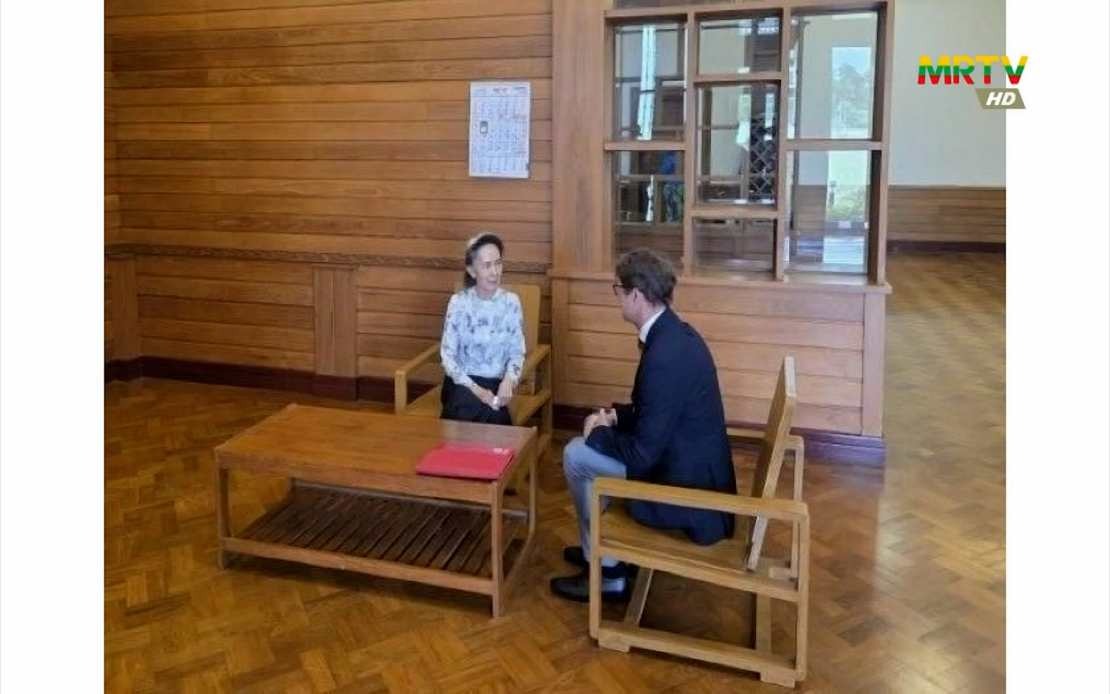
Myanmar's military-backed administration announced on Monday that Aung San Suu Kyi, the nation's ousted democratic leader, met with Arnaud de Baecque, the International Committee of the Red Cross (ICRC) representative to Myanmar, in the capital Naypyitaw. The encounter signals a marginal shift in the junta's previously opaque approach to the 81-year-old icon, who has remained beyond public view and largely inaccessible to foreign officials since the February 2021 coup that dismantled her elected government and thrust Southeast Asia's second-largest nation into profound instability.
Suu Kyi's confinement has persisted across more than three years of political turmoil, during which her exact location and health status remained shrouded in uncertainty. The Myanmar government released four photographs documenting the meeting, including images showing the former leader in traditional Burmese dress conversing with de Baecque in a minimalist, wood-paneled room equipped with basic furnishings. A fourth photograph depicts a birthday cake bearing the inscription "Happy Birthday Aunty Suu 19.6.2026," offering a rare domestic glimpse of her living quarters and suggesting recent birthday observances within her place of detention.
The authenticity and timing of these photographs remain difficult to independently verify, as Reuters could not confirm the location or precise date of the images. No evidence of earlier publication emerged before the government's release, raising questions about the administration's motivation for permitting this limited documentation at this particular moment. The timing coincides with mounting international pressure, particularly from neighbouring Southeast Asian nations, demanding verifiable proof of Suu Kyi's wellbeing and conditions of detention.
Since her arrest, Suu Kyi has endured secretive and rapid-fire trials resulting in convictions on charges spanning corruption, election fraud incitement, and state secrecy violations—accusations her supporters characterise as politically orchestrated measures to neutralise the nation's most formidable civilian politician. The junta initially imposed a 33-year sentence, subsequently reduced to 27 years, and then further trimmed by one-sixth in April, leaving approximately 18 years of imprisonment remaining according to her legal representatives. These reductions have done little to quell international concern about the legitimacy of proceedings widely viewed as lacking judicial independence.
The isolation imposed on Suu Kyi has extended to her immediate family, severely limiting communication across international borders. Her son, Kim Aris, revealed to Reuters in December that he receives only fragmentary, secondhand reports regarding his mother's health—including troubling information about cardiac, bone, and dental complications—and has maintained no direct contact for years. This family separation deepens anxieties about her vulnerability and mortality, particularly given her advanced age and the documented health challenges.
Myanmar's successive military administrations have consistently maintained that Suu Kyi enjoys robust health, yet these assurances lack independent substantiation. In late April, following a military-orchestrated election that reinstalled former junta leader Min Aung Hlaing as president, authorities indicated that Suu Kyi had been relocated to house arrest, ostensibly improving her conditions yet providing no external verification. The strategic ambiguity surrounding her status—neither confirmed prisoner nor genuinely free—reflects the regime's effort to deflect international criticism whilst retaining absolute control over her circumstances.
Regional governments have intensified diplomatic pressure on Myanmar's leadership to permit supervised access to the detained leader. During an ASEAN foreign ministers' gathering in Bangkok last month, Thailand's foreign minister Sihasak Phuangketkeow explicitly requested access to Suu Kyi "so that we can be able to verify the claims" of her wellbeing, articulating the collective regional frustration with unsubstantiated governmental assurances. The Philippines similarly petitioned Myanmar in May to authorise an ASEAN special envoy to meet with the detained leader, a request the junta rebuffed, demonstrating its reluctance to permit independent assessment of conditions.
This calculated release of imagery and access may represent a tactical concession aimed at placating ASEAN partners whilst preserving the regime's fundamental control. Permitting a brief Red Cross meeting—whilst continuing to deny access to family members, lawyers, and other international observers—allows Myanmar's leadership to project compliance with humanitarian norms whilst circumscribing genuine oversight. The ICRC's role as a neutral intermediary makes such meetings diplomatically palatable for the junta, though the organisation's ability to conduct meaningful advocacy remains constrained by its institutional commitment to confidentiality and its dependence on regime cooperation for continued operations.
The symbolic weight of Suu Kyi's continued detention cannot be overstated within Myanmar's political landscape. Daughter of General Aung San, the independence hero revered across the nation, she commanded extraordinary popular affection before the coup. During her previous 15-year house arrest under an earlier junta, she delivered galvanising speeches to masses gathered beyond the metal gates of her Yangon residence on Inya Lake, becoming a potent symbol of democratic aspiration. Her current imprisonment represents the military's determination to permanently eliminate civilian leadership challenges and entrench authoritarian governance.
For Southeast Asian observers and governance specialists, Suu Kyi's case encapsulates broader regional anxieties about democratic backsliding and military prerogatives. Myanmar's trajectory since 2021 demonstrates that even celebrated democratic transitions remain precarious, vulnerable to reversal by institutional actors commanding coercive resources. The junta's management of Suu Kyi's detention—alternating between opacity and carefully controlled disclosures—exemplifies authoritarian strategies for neutralising potential challengers whilst minimising international intervention.
The ICRC's presence in Myanmar, facilitated through this meeting, underscores the critical function humanitarian organisations perform in contexts of restricted civic space. However, such engagement carries inherent limitations; transparency regarding detainees' treatment depends ultimately on regime willingness to permit independent verification. As Myanmar consolidates its military-led governance model through manufactured electoral processes and continued civilian marginalisation, international actors face persistent dilemmas about balancing engagement with principled advocacy for fundamental rights.

