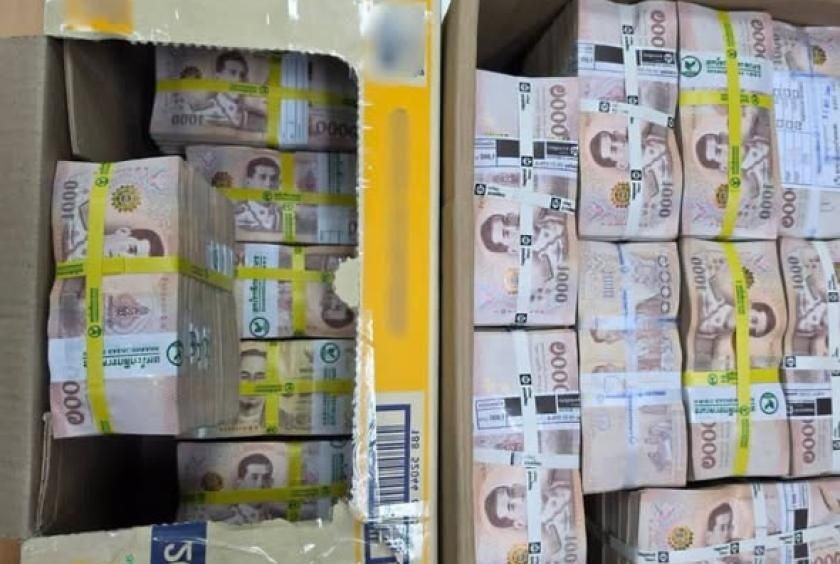
Thai customs officials have arrested a Myanmar national accused of attempting to smuggle 23 million baht across the Thailand-Myanmar border at Mae Sai, marking another significant cash seizure at one of Southeast Asia's busiest crossing points. The incident highlights persistent challenges in monitoring the movement of large sums of currency through frontier checkpoints, where smugglers continue to devise increasingly creative concealment methods to evade detection.
The 31-year-old suspect was intercepted while driving a vehicle with Myanmar licence plates across the Friendship Bridge at Mae Sai. During a routine inspection at the Thai customs checkpoint, officials discovered substantial quantities of Thai currency hidden inside what appeared to be ordinary commercial goods destined for the Myanmar market. The concealment strategy—burying banknotes within food packaging—reflects a common approach used by smugglers who bank on the lower scrutiny typically given to perishable exports and the difficulty in manually inspecting every consignment at high-volume border crossings.
According to Thai authorities, the first container revealed approximately 17 million baht in 1,000-baht denomination notes, while a second box yielded an additional 6.023 million baht. The cash had been systematically wrapped in plastic bags before being buried among cartons of dried fish and potatoes, a tactic designed to obscure the contraband during standard X-ray or visual inspections. The total seizure of 23.023 million baht represents a substantial interception that underscores the scale of currency movement problems authorities face regularly.
The alleged violation carries serious legal consequences under Thai law. Officials have charged the suspect under provisions of Thailand's Customs Act and its stringent foreign exchange control regulations, which prohibit the unauthorized export of Thai currency without proper documentation and government approval. These regulations exist to prevent capital flight, money laundering, and the financing of illicit activities, making currency smuggling a priority enforcement issue for Thai law enforcement and economic authorities.
The Mae Sai checkpoint remains a critical flashpoint for cross-border crime in the region. Situated along the primary trade corridor between Thailand and Myanmar, it processes thousands of vehicles daily, creating inevitable gaps in enforcement capacity. The volume of legitimate commerce—from agricultural products to manufactured goods—provides cover for smugglers who exploit the inherent difficulty of inspecting every shipment thoroughly. This case demonstrates that despite increased vigilance, significant quantities of contraband continue reaching the border.
For Malaysia and other ASEAN nations with porous borders, the Mae Sai incident carries cautionary implications. The methods employed by smugglers, the scale of attempted transfers, and the involvement of nationals from neighboring countries reflect patterns seen across Southeast Asia's entire frontier network. Countries across the region face comparable challenges in balancing legitimate trade facilitation with effective crime prevention, particularly as economic integration increases cross-border movement.
The investigation remains ongoing, with Thai authorities pursuing leads to identify potential accomplices and the ultimate destination of the smuggled funds. Law enforcement officials are exploring whether the suspect was part of a larger smuggling network or acting independently, a distinction with significant implications for understanding the sophistication of currency trafficking operations at the border. The detainee is being held at Mae Sai Police Station pending further questioning.
The underlying motivation for large-scale baht smuggling likely involves several factors common to regional currency trafficking. Individuals and organizations may seek to move Thai currency out of the country to avoid taxation, conceal proceeds from illegal activities, evade capital controls, or respond to exchange rate advantages in neighboring markets. Myanmar, with its relatively underdeveloped financial system and ongoing economic instability, presents both incentives and challenges for those seeking to move substantial sums across borders.
This seizure occurs against a backdrop of heightened concerns about cross-border financial crime throughout Southeast Asia. Regional authorities have increasingly coordinated efforts to combat money laundering, human trafficking, and drug smuggling, all of which often involve the movement of large cash quantities. The detection of nearly 23 million baht in a single vehicle emphasizes how much illegal currency movement may evade detection, suggesting that interdicted amounts represent only a fraction of total smuggling activity.
The incident also raises questions about the effectiveness of current screening technologies and inspection protocols at high-traffic border points. While customs officials successfully identified this attempt, the hiding method employed was relatively unsophisticated, suggesting that more elaborate concealment techniques may slip through undetected. Thailand and other regional governments continue exploring advanced detection equipment, artificial intelligence-assisted screening, and enhanced intelligence sharing to improve border security effectiveness.

