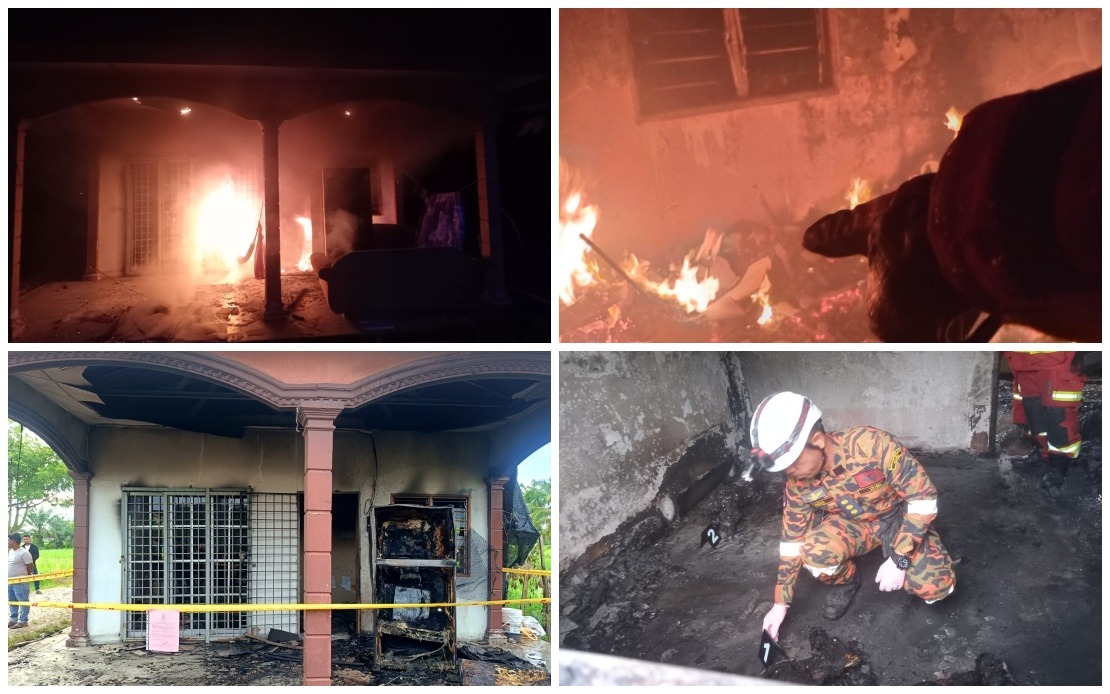
A tragic house fire in the early hours of Friday claimed the lives of three members of a Myanmar refugee family in Taman Serai Maju, Bagan Serai, Perak. The deceased comprise Mohd Yunus Nor Ali, 27, and his two young sons Muhammad Woheed Mohd Yunus, 6, and Mohamad Aheed Mohd Yunus, 3. His wife, Saniya Jahan Juma Abul Kasim, 24, also a Myanmar refugee, sustained burns to her hands and feet and was treated at hospital following the incident.
Emergency services received a distress call via the MERS 999 hotline at 5.17 am, with Perak Fire and Rescue Department (JBPM) personnel arriving at the single-storey residential property at 5.30 am. The Class A house, measuring 20 feet by 40 feet, was home to seven foreign nationals and was engulfed in flames upon arrival, with approximately 70 percent of the structure damaged. Firefighters immediately initiated a rescue operation using the RECEO methodology, which prioritises rescue, exposure, confinement, extinguishment, and overhaul.
According to Perak JBPM director Datuk Sayani Saidon, the wife was discovered outside the burning house and informed responders that her husband and two children remained trapped inside. Search and rescue efforts focused on the first room of the property, where initial signs suggested the fire had originated. All three male victims were located in this same compartment and were found to be beyond resuscitation upon recovery. Medical personnel from the Ministry of Health who attended the scene confirmed the deaths, while Mrs Kasim received preliminary medical treatment before transportation by ambulance to a medical facility.
The fire was brought under control by 6.20 am, with suppression operations concluding at 7.35 am. Royal Malaysia Police took custody of the deceased for subsequent investigation and documentation. The incident underscores the vulnerability of refugee populations living in shared accommodation, often in substandard housing conditions that may lack adequate fire safety features or emergency exits.
Initial forensic analysis by the JBPM team indicates the fire commenced in the first room, which aligns with the location where all three fatalities occurred. However, the precise origin and contributing factors remain subject to ongoing investigation. Fire investigators have been unable to determine definitively whether the blaze resulted from electrical failure, cooking-related mishap, or other environmental factors, pending detailed examination of the structural remnants and any recoverable evidence.
This tragedy highlights persistent challenges faced by Rohingya and other Myanmar refugee communities residing in Malaysia. Many such families live in economically disadvantaged circumstances, occupying older residential buildings that may not meet contemporary building safety codes or fire prevention standards mandated by local authorities. Overcrowding in shared housing arrangements further compounds safety risks, as multiple families sometimes inhabit single-storey properties designed for occupancy by fewer residents.
The loss of three lives—including two very young children—has reignited concern among humanitarian organisations and social welfare advocates regarding living conditions in refugee settlements across Perak and other Malaysian states. The Malaysian government has acknowledged Myanmar's ongoing political instability and the resulting humanitarian crisis, though providing integrated support to displaced populations remains a complex undertaking involving coordination between federal and state authorities, non-governmental organisations, and international agencies.
The circumstances surrounding this incident are particularly poignant given the ages of the young victims and the survival of their mother, who must now grapple not only with severe physical injuries but also the profound emotional trauma of losing her spouse and children. The family's vulnerability as undocumented refugees may further complicate access to comprehensive medical care or financial assistance during recovery.
Authorities in Perak have committed to completing a thorough investigation to establish definitively whether preventable factors contributed to the tragedy. The findings may inform recommendations for improved fire safety protocols in shared housing facilities occupied by migrant and refugee populations, as well as enhanced enforcement of building code compliance among landlords. The incident serves as a sobering reminder of the hidden human costs associated with regional displacement crises and the precarious existence endured by those seeking shelter beyond their national borders.

