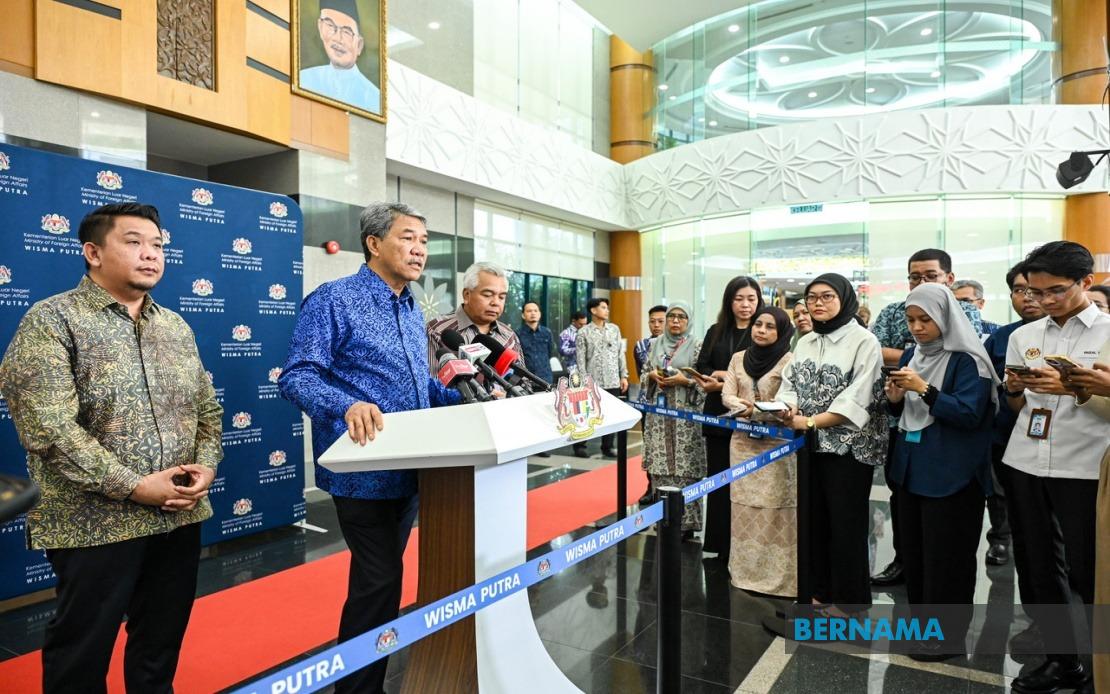
Myanmar has signalled its readiness to bring home 5,000 of its displaced citizens by sea, according to Malaysian Foreign Minister Datuk Seri Mohamad Hasan, marking a potential turning point in one of Southeast Asia's most intractable humanitarian crises. The undertaking emerged from recent discussions between Mohamad and his Myanmar counterpart Tin Maung Swe, though the minister made clear that any repatriation arrangement would need to prioritise the wellbeing and security of those being returned, neither of which can be assumed in a country still gripped by political instability and armed conflict.
Speaking at a press conference following the 59th ASEAN Day celebration in Putrajaya on Monday, Mohamad outlined the contours of what remains a highly conditional agreement. Malaysia has already verified the identities of all 5,000 individuals earmarked for return, removing one significant administrative hurdle. However, without a concrete timeline in place, uncertainty continues to shadow the initiative. The minister's emphasis on accelerating the process suggests frustration with the pace of progress, yet his simultaneous caution about safety reveals the diplomatic tightrope Malaysian officials must walk when dealing with Myanmar's military-dominated government.
The repatriation scheme addresses only a fraction of Myanmar's refugee population sheltering in Malaysia and across the region. What makes Mohamad's framing particularly significant is his deliberate effort to broaden the conversation beyond the internationally prominent Rohingya crisis. He stressed that Myanmar has displaced numerous ethnic minorities, with Chin and Karen communities among those forced to seek refuge abroad. This repositioning matters for Malaysian policymakers, as it acknowledges that the refugee burden extends far beyond a single persecuted group and reflects the complex ethno-political fractures within Myanmar itself.
The mention of safety as a paramount consideration carries weighty implications. Southeast Asia has witnessed recurring maritime disasters involving refugee boats, and memories of Rohingya vessels turned away at sea remain fresh. Any shipboard operation would require assurances about conditions, the competence of crews, and what awaits arrivals in Myanmar's ports and beyond. Whether such guarantees can be credibly extracted from a government that has been accused of orchestrating mass atrocities remains deeply uncertain. Malaysia's insistence on safeguards may therefore reflect not just humanitarian principle but also domestic political calculation—any repatriation perceived as forced or resulting in harm would invite intense criticism at home and internationally.
Moreover, the absence of a specific timeframe reveals the glacial pace at which such arrangements typically develop. Refugee repatriation, even when nominally voluntary, involves complex logistics, documentation requirements, and security screening. For Myanmar, the deeper issue is whether the conditions that drove these 5,000 people to flee have genuinely changed. The country remains convulsed by civil conflict involving various armed groups, with control fragmented across its geography. Until there is evidence of political settlement and genuine security improvements, repatriation carries inherent risks.
Mohamad's remarks also underscore ASEAN's investment in the Five-Point Consensus as the diplomatic framework for managing the Myanmar crisis. Adopted in 2021, the 5PC commits Myanmar to ceasing violence, allowing humanitarian access, establishing dialogue with opposition figures, and inviting ASEAN mediation—commitments that have been observed more in the breach than in practice. By insisting that any modifications to this framework must return to the negotiating table of all ASEAN leaders, Mohamad is asserting that regional unity and institutional integrity take precedence over ad-hoc bilateral arrangements. This reflects lingering frustration that Myanmar's leadership has not lived up to its obligations while simultaneously demonstrating ASEAN's traditional reluctance to impose sanctions or punitive measures.
For Malaysia, which hosts one of the world's largest refugee populations alongside Bangladesh, the prospect of repatriating even 5,000 people carries political weight. The country has grown increasingly impatient with the humanitarian burden, and public sentiment has shifted toward stricter immigration controls. Announcing tangible progress on refugee returns, even if modest in scale, serves multiple audiences: it placates domestic constituencies weary of providing indefinite shelter, it demonstrates to ASEAN partners that Malaysia is willing to work constructively with Myanmar, and it provides cover for maintaining Malaysia's official stance that it is not a country of permanent settlement for refugees.
Yet the arrangement also exposes the limits of ASEAN's leverage. Despite repeated expressions of concern and the rhetorical commitment to the 5PC, the bloc has been unable to arrest Myanmar's descent into conflict or secure meaningful improvements in the treatment of minorities. Myanmar's military leadership has proven resistant to external pressure, and the 5,000-person repatriation offer may represent less a genuine commitment to addressing refugee crises than a tactical gesture aimed at reducing international criticism while maintaining internal control.
Looking ahead, the success or failure of this repatriation scheme will set the tone for future initiatives. If the process unfolds transparently with verifiable safety measures and genuine voluntary participation, it could catalyse further returns and ease pressure on Malaysia and other host states. Conversely, if cases emerge of coercion, poor conditions, or returnees facing persecution, it would further delegitimise Myanmar's government and harden the positions of international actors. For Malaysian officials and ASEAN diplomats, the coming months will test whether their cautious optimism about Myanmar's intentions is justified or whether the region's refugee crisis will remain frozen for years to come.

