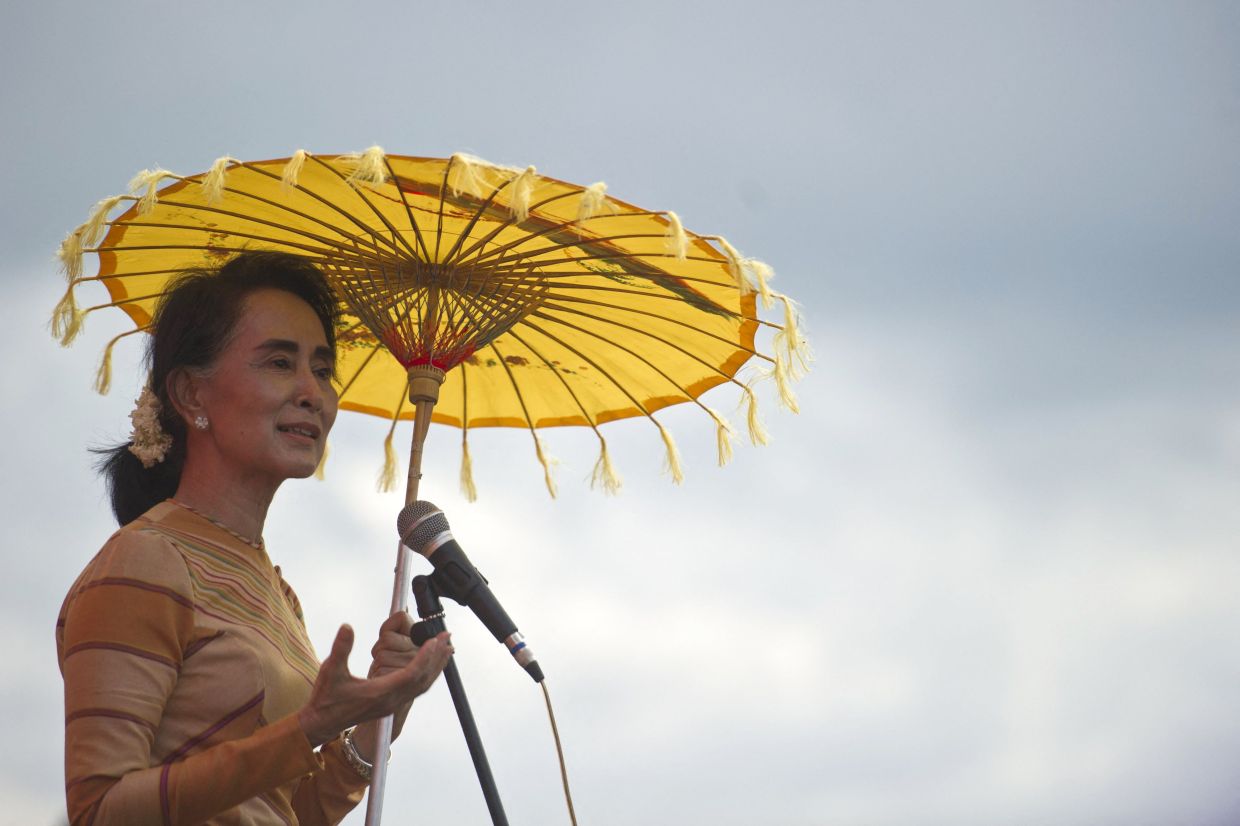
Myanmar's military administration has once again rebuffed efforts by the Association of Southeast Asian Nations to meet with Aung San Suu Kyi, the deposed civilian leader now approaching her eighty-second birthday in captivity. The June rejection by regime spokesperson Khaing Khaing Soe—insisting that Suu Kyi, as a convicted prisoner, cannot receive international visitors—underscores a troubling pattern that extends well beyond diplomatic protocol. It represents something far more consequential for the entire region: a calculated signal that the junta leadership under General Min Aung Hlaing believes itself unencumbered by Asean's mechanisms for diplomatic persuasion or multilateral accountability.
The blockade on Suu Kyi's accessibility has become a defining feature of Min Aung Hlaing's governance strategy since the February 2021 coup d'état. When Philippines Foreign Secretary Maria Theresa Lazaro, representing Asean as chair during that period, attempted to secure a meeting during her January visit to Naypyitaw, she was turned away. The June refusal marked the second such rebuff, yet it was merely the latest in a lengthening catalogue of denials. Since her detention began, Suu Kyi has been permitted to receive only a tiny handful of foreign visitors—former Thai Foreign Minister Don Pramudwinai gained access in July 2023, while Chinese Foreign Minister Wang Yi reportedly met her during an April 2025 visit. This severely restricted visitor list itself carries enormous significance, revealing precisely which international partners the junta considers trustworthy allies and which it regards as imposing unwanted scrutiny.
Exerts from regional think-tanks and Myanmar specialists offer compelling analysis of what the regime intends by maintaining this iron curtain around its most prominent political prisoner. Hunter Marston of the Lowy Institute articulated the core calculation: the junta fundamentally believes that Myanmar's strategic value to Asean—its geographic position, resources, and geopolitical weight—exceeds whatever leverage the ten-nation bloc might wield. The asymmetry of dependence cuts decidedly in favour of Naypyitaw's interests rather than Brussels-style multilateral consensus. By denying Asean representatives access to Suu Kyi, the regime demonstrates operational control over Myanmar's domestic political landscape and signals its refusal to accept any suggestion of regional supervisory authority over internal affairs.
The imprisonment of Suu Kyi, who currently serves the remainder of an eighteen-year sentence following reductions from an original thirty-three-year conviction, has become instrumentalised as both punishment and leverage. Her convictions on charges including violations of Myanmar's official secrets legislation and corruption allegations have been widely characterised by international observers as politically motivated and lacking credible evidentiary foundation. The regime's ability to keep her essentially incommunicado—with mounting reports that she was placed under house arrest in April—allows Min Aung Hlaing to maintain absolute control over the narrative of her condition while simultaneously demonstrating his power to resist external pressure. Even her adult son Kim Aris, now forty-eight years old, has been denied the opportunity to visit or communicate with his mother for five consecutive years, a restriction the regime justifies through reference to prisoner regulations that critics consider pretextual.
The broader context of Myanmar's civil strife amplifies the significance of this diplomatic stalemate. Since the coup, independent conflict monitoring organisations such as Armed Conflict Location & Event Data have documented at least one hundred thousand deaths across Myanmar, with violence endemic to multiple regions as resistance movements and ethnic armed organisations contest the junta's authority. Asean's Five-Point Consensus, adopted immediately following the coup to provide a framework for peaceful resolution, explicitly contemplates dialogue with all relevant stakeholders and humanitarian access. The inability of Asean's special envoy to meet with Suu Kyi represents a fundamental obstruction to implementing even the most basic provisions of this plan, yet the regime shows no inclination to alter course regardless of regional censure.
Min Aung Hlaing's transition from military chief to presidential office in April 2025, following his orchestration of elections dismissed internationally as fraudulent, consolidated his control without meaningfully addressing Asean's grievances. The junta leader has deliberately sidelined the Five-Point Consensus framework, viewing it as an infringement on Myanmar's sovereign prerogatives. From Naypyitaw's perspective, Asean applies inconsistent standards—the grouping, after all, has refrained from comparable interventionism regarding territorial disputes between Thailand and Cambodia, for instance. This selective attention persuades the regime that capitulating to Asean demands would establish an unwelcome precedent of external interference in Myanmar's domestic politics.
Phyo Win Latt, an independent historian of Myanmar, articulated a penetrating distinction between the junta's apparent craving for Asean recognition and its simultaneous rejection of Asean scrutiny. By prohibiting international visits to Suu Kyi, the regime signals that it will accept regional diplomatic standing only on entirely its own terms, refusing any mechanism that might imply supervisory competence over Myanmar's internal political arrangements. The incarcerated leader herself has become a focal point for this larger struggle over Myanmar's relationship to Asean institutional authority. Her confinement away from the world's gaze generates legitimate questions about what the regime believes it must conceal, questions that resonate with her son's increasingly vocal expressions of concern regarding her actual circumstances and wellbeing.
Asean's response to this defiance has been circumscribed and ultimately toothless. The grouping has maintained its ban on Min Aung Hlaing attending leaders' summits for five years, conditioning his return on meaningful progress toward implementing the peace plan. Yet this exclusion appears to cause him minimal political discomfort. The junta derives its legitimacy from control of Myanmar's territory and instruments of coercion rather than from regional diplomatic recognition. Moreover, alternative international partnerships—particularly with China—provide economic support and geopolitical validation that effectively compensate for Asean's ostracism.
Amara Thiha of the Stimson Centre observed that Min Aung Hlaing interprets Asean's peace plan demands as fundamentally unfair and hypocritical, given the organisation's passivity toward internal disputes among member states. This perception, accurate or not, hardened the regime's resistance to external pressure and reinforced its conviction that capitulation would yield no tangible benefits. The diplomatic struggle over Suu Kyi's accessibility has thus become a proxy for the larger question of whether Asean possesses meaningful enforcement mechanisms or remains primarily a consultative forum lacking teeth.
For Malaysian readers and Southeast Asia more broadly, Myanmar's defiant posture carries substantial implications. It suggests that Asean's consensus-based approach to regional governance—premised on mutual respect for sovereignty and non-interference in internal affairs—provides inadequate tools for addressing internal state collapse or humanitarian catastrophe within member boundaries. The junta's willingness to withstand regional pressure indefinitely implies that future crises may equally prove immune to Asean mediation. Additionally, Myanmar's tightening relationship with China at the expense of broader regional integration points toward geopolitical fragmentation within Southeast Asia, where great power competition potentially erodes the collective agency that smaller nations require for protecting shared interests. The continued imprisonment of Suu Kyi, maintained behind walls that even Asean cannot penetrate, exemplifies this troubling trajectory.

