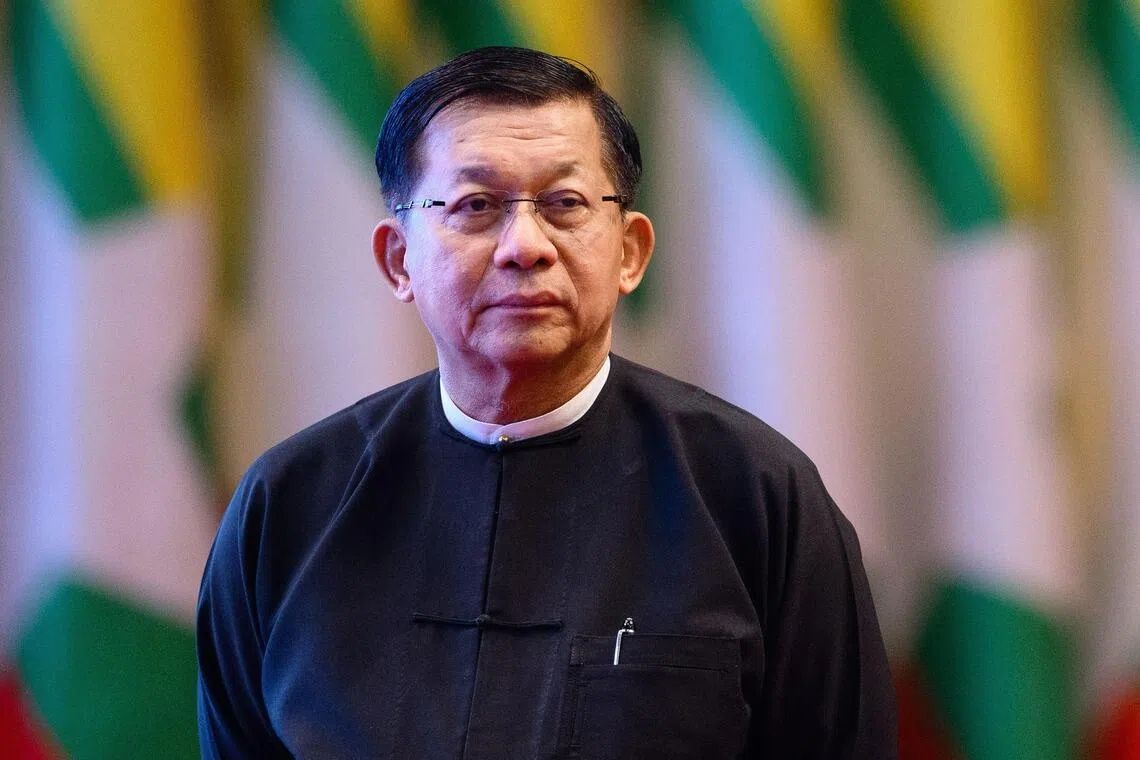
Myanmar's former military ruler Min Aung Hlaing is poised to touch down in Thailand on Thursday, embarking on what represents a carefully orchestrated attempt to rehabilitate Myanmar's standing within Southeast Asia's regional bloc. The visit marks his first journey to Thailand since shedding his military uniform to assume the civilian presidency following stage-managed elections in April—a transition that democracy advocates and Western governments have dismissed as little more than cosmetic legitimacy-laundering for an illegitimate regime.
The backdrop to this diplomatic manoeuvre remains deeply troubling. Min Aung Hlaing orchestrated the February 2021 military coup that toppled the democratically elected government of Aung San Suu Kyi, an event that unravelled into protracted civil conflict claiming an estimated 100,000 lives across all factions. The putsch triggered an unprecedented grassroots resistance movement, military defections, and the emergence of numerous armed groups challenging junta authority across the country's geography. Yet despite this catastrophic human toll and international condemnation, Min Aung Hlaing's administration has embarked on a methodical campaign to reset its regional image, beginning with state visits to India, China, and Laos.
Thailand's willingness to welcome Min Aung Hlaing reflects Bangkok's pragmatic calculation regarding the border stability and security challenges emanating from Myanmar's disorder. The kingdom has become home to millions of Burmese refugees fleeing the violence, while the porous border region has become a haven for transnational criminal networks operating cyberscams and trafficking illicit narcotics with alarming sophistication. Thailand's Foreign Minister Sihasak Phuangketkeow intends to use Thursday's visit as an opportunity to press Min Aung Hlaing on these specific concerns, particularly regarding the proliferation of scam operations targeting victims across Southeast Asia and beyond.
The protocol surrounding the visit underscores Thailand's determination to treat Myanmar's leadership as a restored partner rather than an international pariah. Min Aung Hlaing will be received by an honour guard at Government House and accorded a one-on-one meeting with Prime Minister Anutin Charnvirakul, followed by formal ceremonies including a state dinner and business forum. Officials have confirmed that labour cooperation measures will be formalised through a memorandum of understanding, signalling an intention to deepen bilateral engagement across multiple sectors.
Yet this diplomatic choreography sits uneasily alongside Myanmar's continued defiance of regional consensus mechanisms designed to address the conflict. Asean's so-called five-point consensus, established to facilitate dialogue between Myanmar's military authorities and opposition forces as a pathway toward stability, has been consistently rejected by Min Aung Hlaing's government. This paradox—simultaneously seeking acceptance within Asean's institutional framework whilst repudiating the very conflict-resolution architecture the bloc has constructed—reveals the fundamentally contradictory nature of Myanmar's rehabilitation strategy. Independent analyst David Mathieson characterises this approach as reflecting "zero-sum logics," where the regime seeks status within international structures without accepting the corresponding obligations those memberships entail.
Asean's own position towards Myanmar has undergone subtle evolution since the coup. The bloc formally excluded Myanmar's leadership from high-level summit participation, yet permitted the country's foreign minister to attend an informal gathering of regional counterparts in Thailand last month. This measured engagement represents Asean's characteristic balancing act—maintaining institutional principles whilst preserving dialogue channels with a significant member state. Thailand has positioned itself as the primary architect of this normalisation effort, viewing the restoration of Myanmar engagement as beneficial to regional stability and economic cooperation.
The timing of Min Aung Hlaing's visit carries additional significance given recent developments regarding Aung San Suu Kyi's detention. The ousted democratic leader, who has remained under house arrest since the coup, was permitted to meet a representative of the International Committee of the Red Cross on Monday—her first documented encounter with a foreign official since her removal from power. While this concession appears modest, it may signal incremental pressure from international actors on Myanmar's authorities regarding humanitarian and political considerations, though such gestures remain largely symbolic given Suu Kyi's continued confinement.
International human rights organisations and democracy advocates have strongly opposed Thailand's diplomatic opening to Min Aung Hlaing. Justice For Myanmar and similar campaign groups argue that the red-carpet reception effectively legitimises a leader credibly accused of crimes against humanity and who faces international criminal investigation. Min Aung Hlaing remains under sanctions from multiple Western democracies, and the International Criminal Court has indicated investigative interest in potential accountability mechanisms. From this perspective, Thailand's ceremonial welcome represents a capitulation to realpolitik considerations that privileges security and economic interests over universal principles of accountability and justice.
The broader implications of Myanmar's diplomatic rehabilitation campaign extend beyond bilateral Thai-Myanmar relations. Should Asean gradually normalise engagement with Min Aung Hlaing's administration—permitting high-level summit attendance and restoring Myanmar to its former institutional standing—this would represent a significant setback for democracy and human rights advocacy within Southeast Asia. The precedent would signal that internal repression, even on a catastrophic scale, need not permanently exclude a nation from regional institutional participation, particularly if that nation possesses strategic or economic importance.
For Malaysia and other Asean members observing these developments, Thailand's approach presents a consequential test case regarding the bloc's commitment to its own founding principles emphasising good governance and regional stability. Malaysian policymakers have historically expressed concern regarding Myanmar's refugee crisis and cross-border instability, making the question of how Asean collectively manages Myanmar's reintegration directly relevant to national interests. The consensus mechanism that Min Aung Hlaing rejects was precisely designed to prevent scenarios where Asean countries must choose between accepting military authoritarianism or absorbing the humanitarian consequences of regional instability.
Thursday's Bangkok encounter will likely generate minimal immediate breakthroughs, instead functioning as a symbolic affirmation of Myanmar's gradual rehabilitation within regional structures. The business forum and labour cooperation accord will be presented domestically in Myanmar as validation of international acceptance, whilst Thailand gains tangible opportunities to address security and criminal network concerns. However, the fundamental tension underlying these overtures—between Myanmar's desire for restored status and its refusal to engage meaningfully with conflict-resolution mechanisms—suggests that genuine regional stabilisation remains elusive, and the path toward inclusive peace remains blocked by zero-sum calculations that continue to exact a devastating human price.

