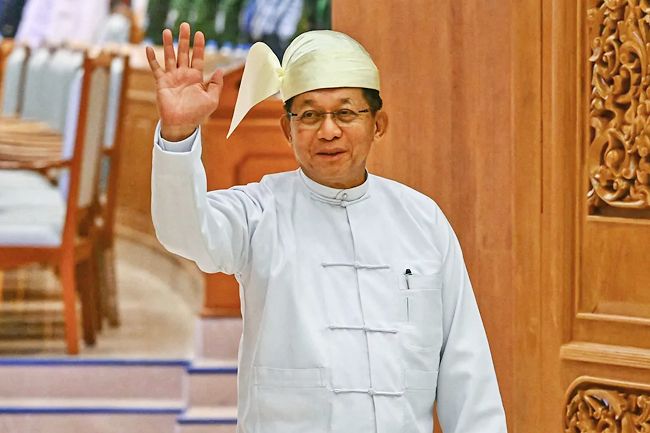
Myanmar's military leader Min Aung Hlaing is set to visit Bangkok for talks with Thai Prime Minister Anutin Charnvirakul on August 6 and 7, Thailand's foreign minister announced on Tuesday following regional diplomacy discussions in Manila. The visit represents a significant diplomatic engagement at a time when Myanmar remains largely isolated from the international community following the 2021 military coup that overthrew elected leader Aung San Suu Kyi's government.
Thailand's Foreign Minister Sihasak Phuangketkeow confirmed the scheduled bilateral meeting after what he characterised as frank and candid exchanges with fellow Southeast Asian foreign ministers over strategies to restore Myanmar's standing within the regional bloc. The discussions in Manila underscored the region's growing debate over how best to handle Myanmar's international rehabilitation, with approaches ranging from gradual engagement to more cautious stances among ASEAN member states.
Meanwhile, Myanmar remains formally suspended from ASEAN's principal gatherings despite technically retaining membership in the Association of Southeast Asian Nations. This paradoxical status reflects the deep fractures within the ten-member organisation over Myanmar policy, with member states holding sharply divergent views on whether engagement or isolation better serves regional interests and democratic principles. The junta's 2021 coup shattered Myanmar's fragile transition to democracy and triggered widespread international condemnation.
Thailand's prominent role in pushing for Myanmar's reintegration stems from its unique strategic and humanitarian position. Sharing an extensive border with Myanmar and hosting millions of refugees fleeing civil conflict, Bangkok has incentives to stabilise its neighbour and reduce the humanitarian burden on its own resources. Thailand's advocacy for a more accommodating approach towards Naypyidaw has, however, generated considerable friction within ASEAN, exposing how divergent member states' geopolitical priorities and values have become.
Sihasak outlined what he termed a "dual-track approach" to Myanmar engagement, suggesting that Bangkok intends to address immediate bilateral concerns while preserving longer-term regional reintegration objectives. He identified pressing transnational challenges including organised crime networks, scam operations, and narcotics trafficking as immediate issues requiring bilateral cooperation. These practical security concerns provide a framework for engagement that sidesteps more contentious political questions about democracy and human rights.
Crucially, Thailand's foreign minister emphasised that this pragmatic bilateral engagement does not represent an abandonment of ASEAN's five-point peace plan, the bloc's foundational framework for addressing Myanmar's crisis. This clarification appears aimed at reassuring more sceptical member states that Thailand is not unilaterally softening the organisation's position on Myanmar without broader consensus. The five-point plan, adopted in 2021, calls for dialogue cessation, humanitarian assistance, constructive engagement, and ASEAN's mediation role.
The Thai government has proposed a more nuanced framework for measuring progress in Myanmar's political trajectory. Rather than demanding immediate democratic transformation or comprehensive human rights reforms, Sihasak suggested examining incremental developments such as whether the junta permits ASEAN's special envoy to meet imprisoned former leader Suu Kyi, or whether violence diminishes along the volatile Thai-Myanmar border region. This gradualist perspective reflects Thailand's assessment that unrealistic demands could further entrench Myanmar's junta, whereas acknowledging modest improvements might create space for constructive dialogue.
Sihasak acknowledged that political change in Myanmar will not materialise swiftly, advocating instead for patient recognition of incremental progress. His reframing of what constitutes meaningful advancement suggests Thailand is attempting to build international consensus around a lower threshold for engagement success. This approach implicitly accepts that near-term democratic restoration remains unlikely while exploring whether stability and security improvements can facilitate longer-term political evolution.
Thailand has also identified the military elections that installed Min Aung Hlaing as president as a potential opening for expanded dialogue. Sihasak suggested the junta's electoral process, however restricted and internationally criticised, might paradoxically create opportunities for talks with armed ethnic groups and domestic opposition movements. This optimistic reading proposes that Myanmar's leadership could use the elections' conclusion as a pivot point toward addressing the country's multiple armed conflicts involving ethnic militias along its borders.
Border stabilisation emerges as a critical element in Thailand's strategic thinking. The prospect of Thai facilitation of dialogue between Myanmar's junta and ethnic armed organisations operating along the shared frontier could simultaneously reduce cross-border violence, refugee flows, and sanctuary provision for criminal networks. Such mediation would position Thailand as a constructive bridge-builder while advancing its immediate security interests.
Simultaneously, ASEAN members are reconsidering their institutional mechanisms for Myanmar engagement. Philippine Foreign Minister Theresa Lazaro revealed that the bloc is contemplating appointing a permanent, long-term envoy rather than relying on its current yearly rotating arrangement. This institutional reform implicitly acknowledges that Myanmar's crisis demands sustained, specialised diplomatic attention beyond what rotating ambassadorships can provide. The existing rotation system's acknowledged ineffectiveness suggests that resolving Myanmar's multifaceted political, humanitarian, and security challenges requires dedicated, experienced envoys with continuity and institutional memory.
Thailand's August summit with Min Aung Hlaing will test whether bilateral engagement can generate momentum for wider regional consensus on Myanmar. Success would require demonstrating tangible progress on transnational crime, refugee management, and border stability while maintaining space for future political dialogue. The visit also signals that despite ASEAN's public unity messaging, powerful members like Thailand are pursuing parallel tracks of engagement that reflect their particular strategic interests and geographic proximity to Myanmar's ongoing transformation.

