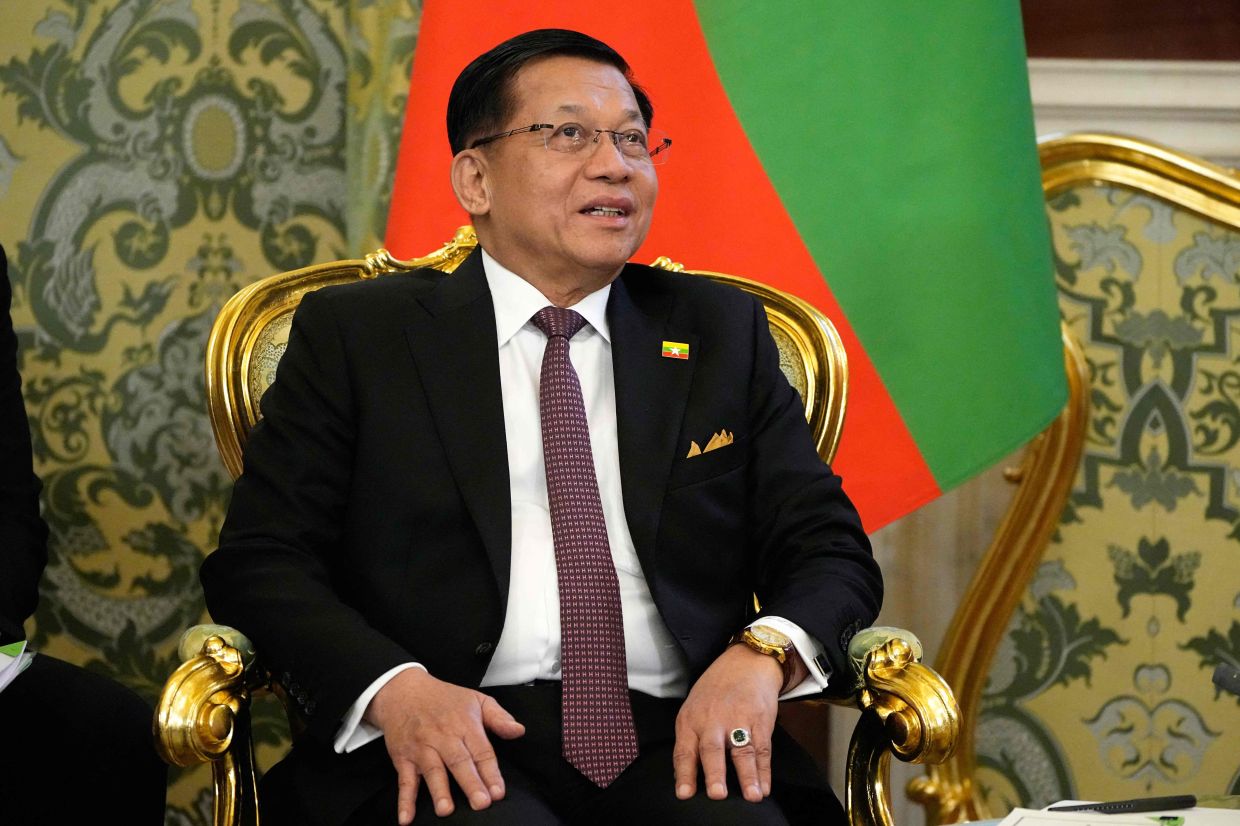
Myanmar's military leader Min Aung Hlaing is preparing an official visit to Cambodia in early September, marking another step in an extensive regional diplomatic offensive that has drawn sharp criticism from human rights organisations and democracy advocates across Southeast Asia. The announcement, confirmed by Cambodia's Senate, comes as government officials including Kuy Sophal, Minister of the Royal Palace, and Chin Ketna, permanent deputy chairman and secretary-general of the National Committee for Organising National and International Festivals, begin surveying venues to receive the Myanmar delegation.
Cambodia's Senate spokesperson Chea Thyrith characterised the visit as an opportunity to deepen ties between Phnom Penh and Naypyidaw, emphasising that cooperation between the two neighbours serves mutual interests. This framing reflects the official narrative promoted by both governments, yet it sits uncomfortably alongside growing international scrutiny of Min Aung Hlaing's repeated foreign travels since his April election as Myanmar's president.
The trajectory of Min Aung Hlaing's international engagements reveals a deliberate strategy to accumulate diplomatic recognition. Since his contested election in April, he has already completed official visits to India, China, Laos, Thailand and Russia. Each journey adds another layer to what critics characterise as an orchestrated campaign to reshape his international standing and bolster his domestic authority. The Cambodia visit represents the sixth country on this diplomatic itinerary, suggesting a methodical approach to securing bilateral endorsements across the region.
Human rights watchdogs and pro-democracy movements have consistently lambasted these tours, pointing to the substantial human rights violations documented under Min Aung Hlaing's military administration. The February 2021 coup that toppled Myanmar's democratically elected leader Aung San Suu Kyi remains the most visible symbol of military overreach, while her subsequent detention crystallised international concern about the regime's direction. Beyond this headline-grabbing action, thousands of human rights activists, political dissidents and ordinary citizens have reportedly languished in detention, subjected to arbitrary arrest and detention under military rule.
The credibility of Min Aung Hlaing's April election as president has been widely questioned by international observers and regional analysts. Conducted within a closed political environment controlled by the military, the vote was widely dismissed as a performative exercise rather than a genuine democratic exercise. This technical assumption of civilian office has not satisfied regional or international bodies, nor has it translated into broader acceptance of his government's legitimacy.
The exclusion of Myanmar from Asean summit meetings reflects the regional bloc's formal displeasure, a consequence of the military's failure to comply with the five-point consensus agreed upon in April 2021. This diplomatic isolation represents a significant cost for Myanmar's junta, and Min Aung Hlaing's foreign travels appear designed to circumvent this collective rebuke by cultivating bilateral relationships with sympathetic regional partners.
Kin Phea, president of the International Relations Institute of Cambodia, offered a more nuanced interpretation of the Cambodia visit, suggesting it represents a reciprocal effort to strengthen ties rather than a one-way legitimacy exercise. He recalled Cambodia's diplomatic initiatives when it held the Asean chairmanship in 2022, during which Phnom Penh attempted to bridge gaps and ease tensions surrounding Myanmar's political crisis. This context positions Cambodia as a nation with some experience in navigating difficult transitions and reconciliation processes.
Phea acknowledged the apparent dual purpose of the visit, describing it candidly as part of Min Aung Hlaing's broader campaign to consolidate his legitimacy and strengthen his position as president. However, he also suggested that Cambodia might contribute valuable lessons from its own historical experiences in reconciliation, nation-building and peace-processes, areas where the country has grappled with profound challenges.
Yet Phea introduced an important clarification that underscores the limitations of bilateral diplomatic gestures in addressing Myanmar's political impasse. He stressed that whether countries formally recognise the visit as a state visit remains secondary to the larger question of Myanmar's regional standing. Crucially, the restoration of Myanmar's Asean participation and the lifting of its summit exclusion depends on implementation of the five-point consensus, a multilateral agreement that transcends individual bilateral relationships.
This distinction carries substantial weight for Myanmar's trajectory and for Asean's cohesion. No single country, whether Cambodia or any other regional power that Min Aung Hlaing visits, possesses the authority to unilaterally overturn Myanmar's exclusion or grant it the diplomatic recognition it seeks. The decision rests with the collective Asean membership and their assessment of whether the junta has fulfilled its commitments under the consensus framework.
Phea's analysis suggests that while the Cambodia visit serves Min Aung Hlaing's immediate interests in accumulating bilateral goodwill, it addresses only a symptom rather than the underlying political crisis within Myanmar. Genuine progress toward Myanmar's rehabilitation within the regional order requires concrete actions by the military regime itself—not ceremonial visits or external pressure from neighbouring countries. This represents a fundamental constraint on how far regional diplomacy can advance without substantive political change in Naypyidaw.
The visit thus encapsulates a broader tension within Myanmar's regional politics: a military leadership attempting to normalise its position through calculated diplomatic engagement, while the region's institutional frameworks and many of its constituent governments maintain clear conditions for reintegration. For Malaysian observers and Southeast Asian policymakers, the Cambodia visit exemplifies the limited utility of bilateral engagement in resolving multilateral political crises, particularly when the underlying legitimacy questions remain unresolved.

