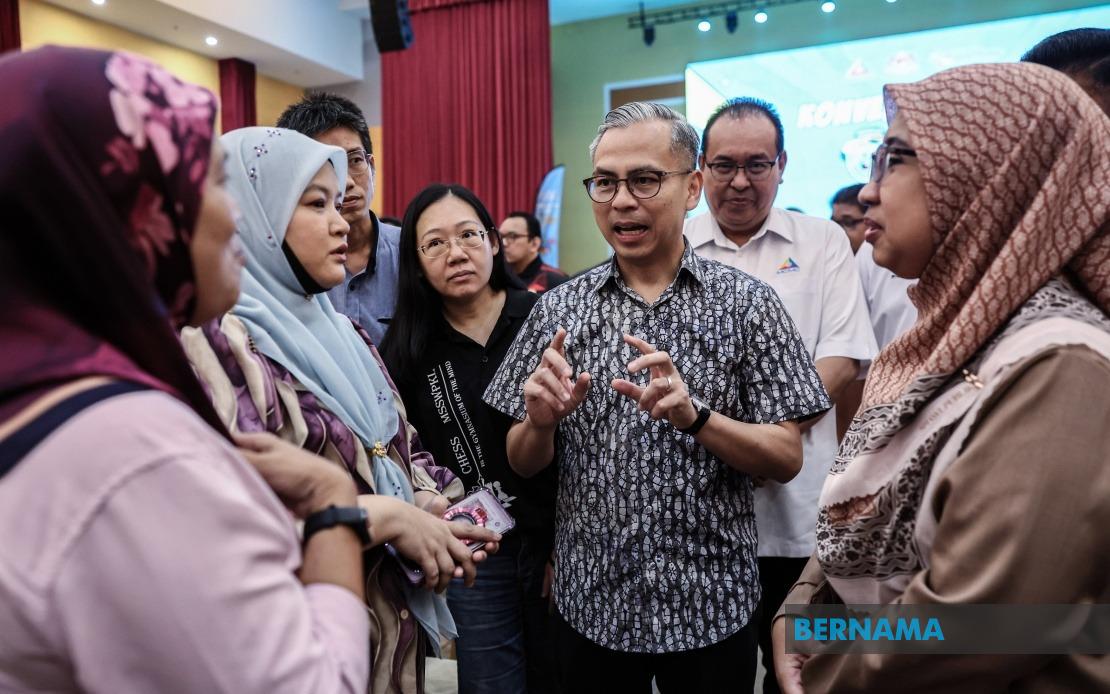
The government has moved to dispel confusion surrounding the MyKhas allocation by explicitly stating it represents a constituency-based welfare mechanism rather than a personal prerogative for Members of Parliament. Communications Minister Datuk Seri Fahmi Fadzil issued this clarification at a press conference in Kuala Lumpur on August 8, stressing that the fund exists solely to address the needs and welfare of voters within specific parliamentary constituencies. The remarks come as part of broader efforts by the MADANI Government to establish transparency around how government resources are deployed and who benefits from such allocations.
Fahmi's intervention reflects Prime Minister Datuk Seri Anwar Ibrahim's earlier position that government disbursements are intended for public benefit and cannot be treated as the exclusive domain of any single elected official. This principle represents a departure from historical governance patterns and attempts to reframe how Malaysia's political establishment understands the relationship between elected representatives and state resources. The Communications Minister emphasised that even he, in his capacity as an MP, cannot utilise MyKhas allocations for personal purposes, underscoring the universality of this restriction across the legislative branch.
The mechanism behind MyKhas has been formally embedded within Malaysia's policy framework through documentation in both the Malaysia Plan and Budget papers. These documents explicitly designate MyKhas as a special provision that falls under the Prime Minister's direct authority. This institutional embedding means that decisions regarding disbursement and allocation strategy rest with the executive office of the Prime Minister rather than with individual parliamentary representatives. The structural arrangement effectively centralises control over how and when these funds reach constituencies, creating a potential check on how MPs might otherwise leverage government resources for political advantage.
One significant aspect of MyKhas is its intended application beyond partisan boundaries. According to Fahmi, the allocation system includes provisions allowing applications from constituencies represented by opposition parties. The Implementation Coordination Unit within the Prime Minister's Department serves as the administrative pathway through which such applications are processed. This cross-partisan application mechanism suggests an attempt to distribute resources based on genuine constituency need rather than political affiliation, though implementation will ultimately determine whether this principle holds in practice.
The range of projects eligible for MyKhas funding extends across multiple sectors critical to public welfare. Anwar previously outlined that allocations can target educational facilities including conventional schools and religious institutions, places of worship such as mosques, and essential infrastructure like drainage systems. This breadth of eligible projects indicates recognition that constituency development encompasses diverse dimensions of community wellbeing rather than concentrated funding in narrowly defined areas. The flexibility also suggests policymakers believe local needs vary considerably across parliamentary constituencies.
Fahmi's repeated emphasis that the fund exists exclusively for residents and voters rather than elected representatives carries implications for how Malaysian politics may evolve. If consistently applied, this principle could reshape the relationship between individual MPs and state resources, potentially diminishing one traditional mechanism through which parliamentarians cultivate political support at the grassroots level. Many voters have historically regarded constituency allocations as a tangible benefit associated with their elected representative's position, creating incentives for supporting incumbents. Reframing these allocations as bureaucratically administered public funds rather than MP discretionary items might weaken such personal political attachments.
The timing of these clarifications suggests the government anticipated potential confusion or misuse of MyKhas allocations. By publicly and repeatedly declaring that the mechanism is not a personal entitlement, Fahmi and the Prime Minister's office appear to be establishing normative expectations before the system becomes entrenched. Such preventative communication is particularly important in a context where older governance patterns may still influence how some MPs understand their relationship to state resources. The repeated messaging indicates awareness that institutional rules alone may be insufficient without parallel efforts to reshape political culture.
For Malaysian constituencies and voters, the MyKhas framework theoretically offers advantages over traditional MP discretionary allocations. A centralised system supposedly insulates funding decisions from individual political calculations and may prioritise applications based on objective needs assessments rather than factors like electoral margins or personal relationships. However, the actual implementation of such systems often diverges from their stated principles. Whether the Prime Minister's office genuinely applies consistent, needs-based criteria or whether political considerations influence decisions remains to be demonstrated through evidence of actual fund disbursement patterns.
The clarification also addresses a governance question relevant across Southeast Asia regarding how elected officials should relate to public resources. Malaysia's approach of explicitly designating certain allocations as administrative rather than parliamentary entitlements reflects global trends toward strengthening institutional oversight of government spending. Countries grappling with governance challenges have increasingly sought to depersonalise access to state resources, recognising that concentrating disbursement authority in individual representatives can facilitate corruption or reduce equity across constituencies. By centralising MyKhas authority, Malaysia is adopting mechanisms consistent with international best practices in public finance management.
For opposition-held constituencies, the MyKhas system potentially offers some protection against resource discrimination, though this depends entirely on how effectively the Prime Minister's Department enforces equitable application. The formal inclusion of opposition areas within the allocation system suggests commitment to service delivery transcending partisan lines. However, critics might observe that true neutrality requires demonstrable evidence through tracking how much opposition-held constituencies receive relative to ruling coalition areas, adjusted for population and legitimate development needs. Transparent reporting on MyKhas disbursement patterns would substantially strengthen confidence in the system's fairness.
The broader political context informing these clarifications includes ongoing debates about governance standards in Malaysia. Concerns about misuse of government resources for political purposes remain salient in public discourse. By explicitly demarcating MyKhas as a non-discretionary MP entitlement and subjecting it to Prime Minister's office oversight, the MADANI Government signals commitment to addressing such concerns. Whether this translates into meaningful institutional change or remains primarily rhetorical will depend on whether implementation consistently matches these stated principles and whether independent oversight mechanisms can verify compliance.

