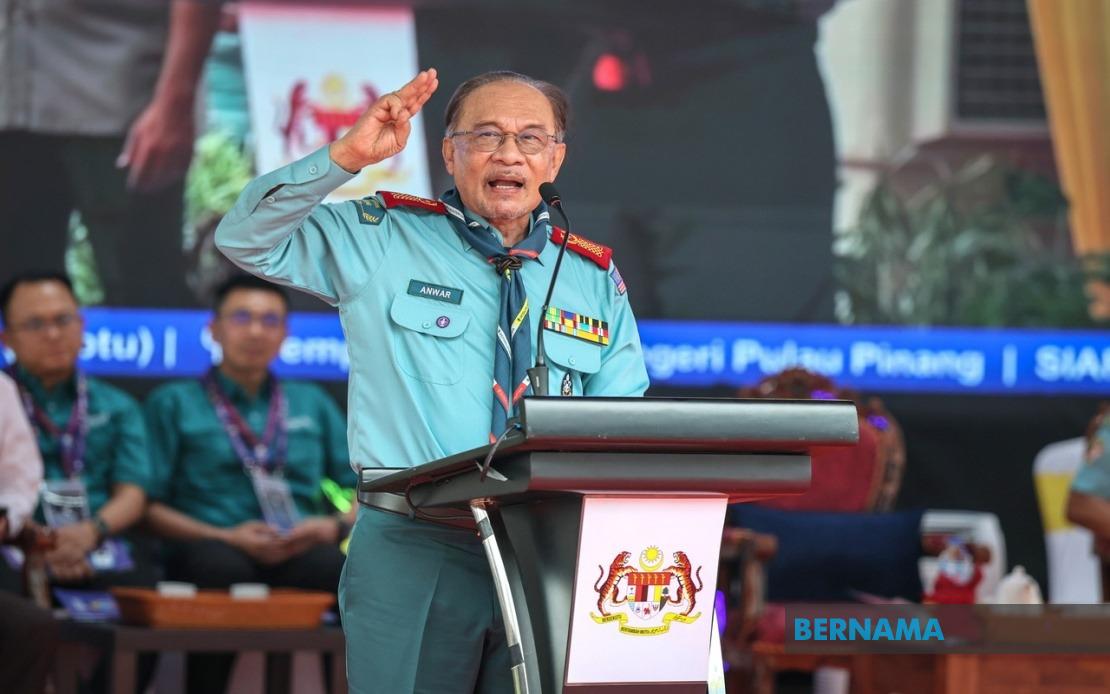
Prime Minister Datuk Seri Anwar Ibrahim has cautioned that measuring a nation's progress purely through economic expansion and technological advancement obscures a deeper truth: sustainable development depends fundamentally on cultivating a generation that combines intellectual rigour with ethical grounding and personal discipline. Speaking at the 15th Malaysian Scouts Jamboree in Batu Kawan, Penang, on August 29, Anwar articulated a vision of national development that extends beyond gross domestic product figures and innovation metrics to encompass the character formation of young Malaysians.
Anwar's remarks reflect growing concern among policymakers across Southeast Asia that rapid industrialisation and digitalisation can hollow out the civic and moral foundations upon which stable societies rest. The Prime Minister contended that educational systems must deliberately instil in students a sense of service, responsibility towards family and community, and commitment to the nation's wellbeing. He questioned the value of mere material prosperity divorced from the cultivation of conscience, suggesting that affluence without virtue produces hollow achievement. This perspective aligns with Malaysia's constitutional ideals and the foundational principles embedded in the Rukun Negara, yet represents a deliberate reassertion of those values at a moment when technological disruption threatens to displace them from public discourse.
In his address, Anwar stressed that the purpose of formal education—whether at schools, polytechnics, or universities—transcends credential acquisition. Instead, he positioned learning as a pathway to becoming individuals capable of moral discernment and motivated by genuine commitment to societal improvement rather than self-interest alone. This framing carries particular resonance for Malaysian audiences navigating an era when academic credentials proliferate whilst concerns about professional ethics and civic responsibility periodically dominate headlines. The Prime Minister's insistence on connecting knowledge to character development suggests frustration with a bifurcation increasingly visible in Malaysian professional life, where technical competence and ethical behaviour have become uncoupled.
The jamboree itself provided an apt platform for these remarks. The 15th Malaysian Scouts Jamboree, running from August 29 through September 4 at Penang State Stadium, assembled more than 5,450 scouts from Malaysia and abroad, including delegations from South Korea, Indonesia, Singapore, and Sri Lanka. By delivering his message at this youth gathering, Anwar underscored the scouting movement's historical role as a character-building institution alongside its leadership development function. The event's scale and international participation illustrate how youth formation remains a priority across the region, with neighbouring nations investing substantially in scout programmes as instruments of civic socialisation.
Anwar specifically addressed the dual challenge confronting Malaysia's young people: embracing technological change whilst maintaining anchoring values and cultural identity. As artificial intelligence, automation, and digital platforms reshape employment landscapes and social interaction patterns across Southeast Asia, the risk intensifies that younger generations become untethered from traditional sources of meaning and community cohesion. The Prime Minister's warning that technological advancement must not come at the cost of cultural rootedness speaks to anxieties visible throughout the region regarding the homogenising effects of globalisation and the erosion of distinctive national and ethnic identities. He positioned cultural preservation not as nostalgic resistance but as essential psychological and social ballast enabling individuals to navigate accelerating change without losing orientation.
The emphasis on unity in diversity resonates deeply within Malaysia's multiethnic, multireligious context. Anwar stressed that as the current generation assumes leadership roles over coming decades, their capacity to maintain social cohesion across communal lines will prove decisive for national stability and prosperity. This concern carries heightened salience given periodic incidents of communal tension and the challenge of building inclusive national narratives that acknowledge plural identities whilst fostering shared citizenship. By positioning youth as custodians of unity, the Prime Minister implicitly assigned them responsibility for transcending the communal fragmentation that occasionally disrupts Malaysian public life.
Anwar's invocation of the 2026 National Day celebrations and his exhortation that young people cultivate patriotic sentiment reveals the government's broader objective: channelling youthful energy and idealism towards national projects rather than allowing it to dissipate or redirect toward fragmentation. The prospect of upcoming national commemorations serves as a focal point for mobilising collective sentiment and reinforcing bonds of citizenship. Southeast Asian governments generally recognise that young people who lack positive identification with their national project become vulnerable to alternative ideologies or privatised concerns disconnected from civic life.
The selection of Penang as host for this year's jamboree carries symbolic weight. The state's hosting of the inaugural Malaysian Scouts Jamboree in Teluk Bahang during 1966—the year following Malaysia's formation—connects the scouting movement explicitly to the nation's foundational period. The 60-year interval between those events marks the evolution of Malaysian society through post-independence consolidation, industrial development, and now digital transformation. By returning to Penang after six decades, the jamboree implicitly affirms continuity with founding principles whilst acknowledging the profound changes through which the nation has traversed. Chow Kon Yeow, Penang's Chief Minister, and Datuk Prof Dr Mohd Zin Bidin, Chief Scout, lent official endorsement to this temporal and spatial framing.
The attendance of regional and international scouts underscores the transnational dimensions of youth development challenges. Indonesia, Singapore, and Sri Lanka all face comparable pressures to balance rapid modernisation with cultural preservation and civic formation. The jamboree creates space for young people across borders to share experiences and mutual support in navigating these tensions. For Malaysia specifically, the gathering demonstrates the nation's capacity to host significant youth events and positions Malaysian scouts as participants in a regional and global community dedicated to character development and service.
Anwar's message ultimately articulates a philosophy of development that challenges conventional metrics focused narrowly on economic output. He implicitly critiqued models of progress that treat young people primarily as future workers or consumers rather than as moral agents whose formation deserves intentional investment. This perspective requires schools, families, civil society organisations, and government bodies to maintain sustained attention to ethical and civic education even as resources increasingly flow toward STEM disciplines and vocational training aligned with labour market demands. The challenge facing Malaysian policymakers involves translating the Prime Minister's rhetorical commitment to youth character formation into concrete institutional practices and resource allocation decisions that demonstrate that commitment beyond ceremonial occasions.

