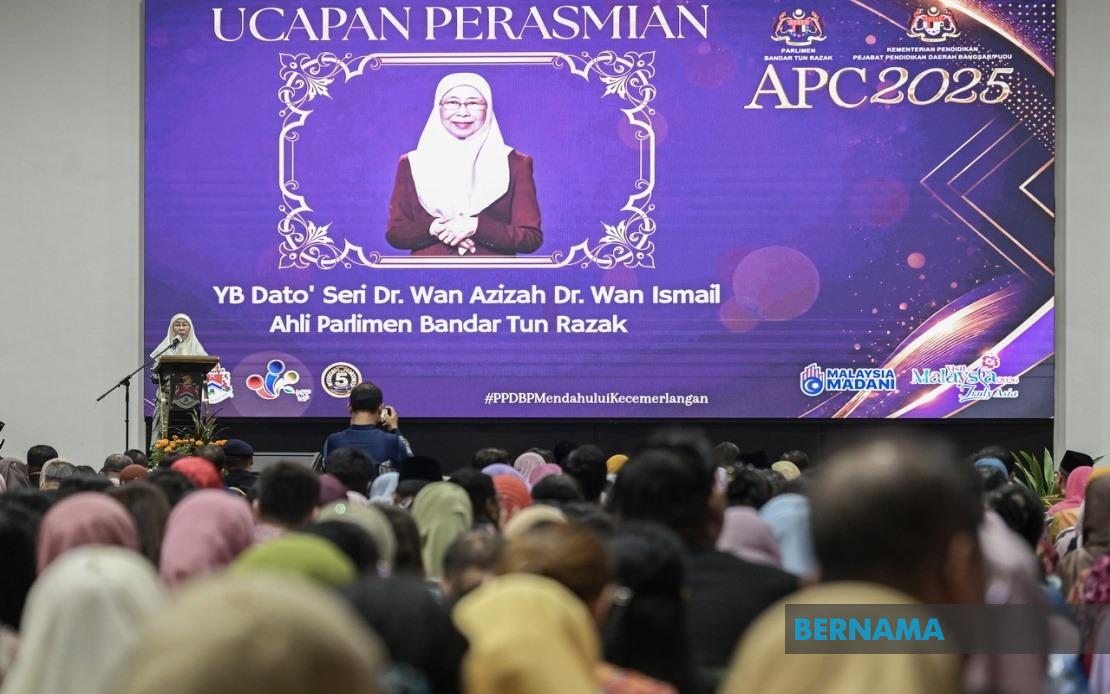
A nation's fortitude extends far beyond financial prosperity or technological prowess. Rather, genuine strength is forged through cultivating citizens who possess knowledge coupled with ethical principles and compassion, according to Datuk Seri Dr Wan Azizah Wan Ismail, wife of the Prime Minister and Member of Parliament for Bandar Tun Razak. She articulated this vision while presiding over the 2025 Excellent Service Award ceremony organised by the Bangsar/Pudu District Education Office at the Kuala Lumpur City Hall Training Institute, drawing together roughly 1,000 participants to celebrate educational excellence.
Dr Wan Azizah's remarks centred on the understated yet transformative responsibilities shouldered by educators in contemporary society. Within school environments, where children invest considerable hours especially in urban centres where parental availability is constrained by employment demands, teachers function as primary architects of character development. This reality becomes increasingly significant as families grapple with balancing work and childrearing, often relying on institutions to supplement household guidance in shaping young minds during formative years.
The Prime Minister's wife articulated a vision of education that transcends the conventional transmission of academic content. She underscored that schooling encompasses a broader mandate: cultivating individuals distinguished by integrity, refined conduct, and genuine concern for others. This holistic approach recognises that memorisation and examination performance represent only partial measures of educational success. True educational accomplishment manifests when graduates navigate society as principled actors capable of ethical decision-making and social responsibility.
Teachers emerge as custodians of the nation's most valuable resource in this framework. Rather than mere deliverers of curriculum, educators function as character architects, wielding influence that extends beyond classroom walls into the broader fabric of national development. Their daily interactions with students, the values they model, and the ethical standards they uphold collectively determine the calibre of citizenship the nation cultivates across generations.
Dr Wan Azizah emphasised that this educational philosophy becomes particularly urgent in an era characterised by artificial intelligence proliferation and unprecedented information accessibility. As digital technologies reshape communication landscapes and algorithmic systems filter content, the capacity to discern truth from misinformation has become a survival skill for democratic societies. Values-based education and analytical reasoning provide essential frameworks enabling young people to navigate these complex information ecosystems with discernment rather than passive credulity.
The ceremony itself honoured 746 educators and school administrators drawn from 143 institutions across the Bangsar/Pudu district, recognising their sustained dedication to institutional excellence and improved learning outcomes. This large-scale recognition programme represents a deliberate strategy to validate teaching contributions often underappreciated in public discourse, where education debates frequently centre on policy implementation rather than individual educator commitment. By celebrating exemplary performance and consistency throughout the year, the recognition mechanism signals institutional commitment to professionalising the teaching workforce.
The event's magnitude and composition underscored educational infrastructure investment in Malaysia's most urbanised federal territory. Kuala Lumpur's concentration of schools, students, and educators reflects the capital's demographic dynamics, where rapid urbanisation has created distinct educational challenges compared to other Malaysian regions. Urban schools typically serve diverse socioeconomic backgrounds, requiring educators to calibrate instruction to heterogeneous student populations whilst maintaining academic rigour and character development simultaneously.
Dr Wan Azizah's advocacy for values-based education resonates within Malaysia's broader national development framework. The nation has historically emphasised moral and spiritual development alongside intellectual growth, reflected in curricular structures emphasising patriotism, interfaith understanding, and social responsibility. However, practical implementation often faces resource constraints, competing curricular demands, and inconsistent teacher preparation in values pedagogy. Her public endorsement reinforces political commitment to rebalancing educational priorities towards character formation.
The presence of Datuk Azman Abidin, the Prime Minister's Political Secretary, and Megat Affandi Ismail, the Kuala Lumpur Federal Territory Education Department director, reflected high-level institutional support for the ceremony. Such attendance signals that teacher recognition and values-based education represent priority considerations within federal government structures, potentially influencing resource allocation and policy formulation affecting educational service delivery across Malaysia.
For Malaysian educators navigating mounting pressures—including curriculum evolution, technological integration, and shifting parental expectations—such recognition ceremonies provide meaningful affirmation of professional significance. Teaching in Malaysia's urbanised centres presents particular challenges as educators simultaneously manage academic expectations, character guidance, and increasing social complexities. Public acknowledgement of these contributions, especially by prominent national figures, validates the profession's essential role in national development.
The 2025 awards programme ultimately embodies a deliberate strategic positioning within Malaysia's educational landscape. By celebrating teaching excellence and reaffirming the nation's commitment to character-centred education, the initiative addresses recurrent anxieties about whether contemporary schooling adequately prepares students for responsible citizenship. Dr Wan Azizah's remarks anchored this recognition within a coherent vision of education transcending credential acquisition towards cultivating nationally productive, ethically grounded citizens capable of navigating complex social environments with integrity and compassion.

