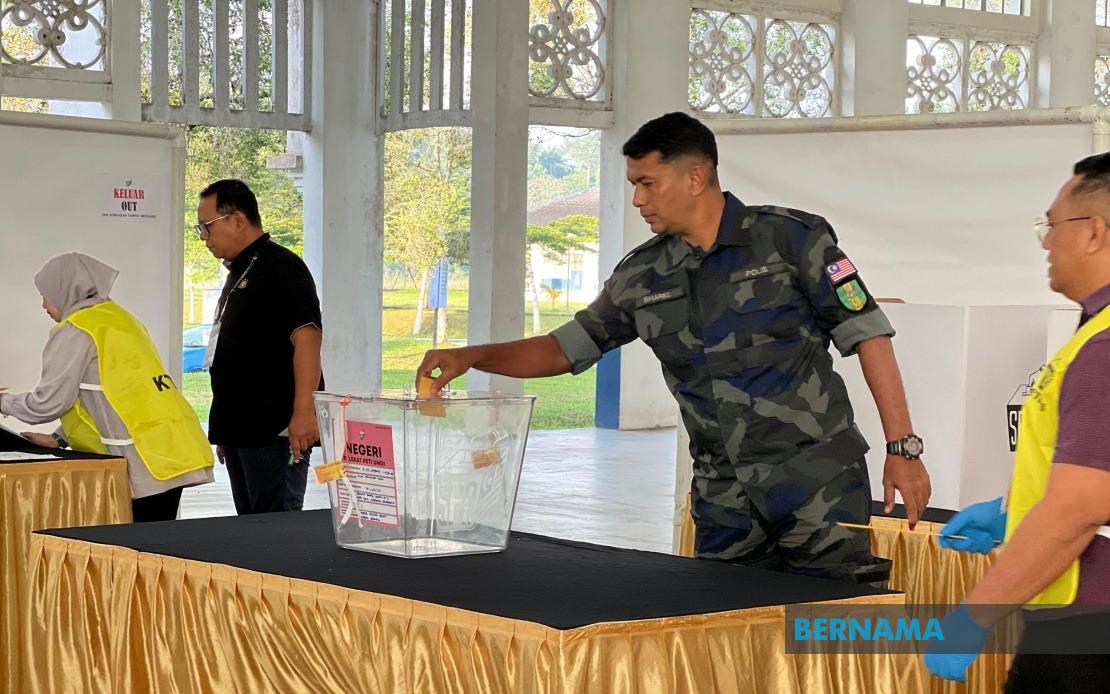
Nearly 25,000 military and police personnel, together with their families, cast their votes in the 16th Johor state election on July 7, exercising their franchise at 64 specially designated polling centres distributed throughout the state. This early voting exercise represents a carefully coordinated operation designed to accommodate the unique scheduling needs of security forces who may be deployed or otherwise unavailable during the standard polling day scheduled for July 11.
The early voter contingent comprised two distinct groups. The Malaysian Armed Forces contributed 12,041 eligible voters, including active service members and their spouses, while the Royal Malaysia Police and General Operations Force added 12,710 personnel and their families to the rolls. This breakdown underscores the substantial size of Malaysia's security apparatus and the logistical complexity involved in ensuring their electoral participation, a constitutional right that must be accommodated despite their operational commitments to the nation.
Within the police contingent, organisers distinguished between those voting in person and those participating through postal ballots. Of the total police early voters, 12,067 individuals cast their ballots at physical polling locations on July 7, while a smaller subset of 643 had already submitted postal votes, reflecting the flexibility built into the electoral system for those with extraordinary scheduling constraints. This two-tier voting mechanism demonstrates how election commissions balance accessibility with security when dealing with personnel whose duties may preclude conventional polling day attendance.
The logistics of managing early voting across such geographically dispersed and functionally distinct groups required meticulous planning. Authorities opened 53 dedicated police polling centres and 11 military polling centres simultaneously at 8 am, creating a coordinated voting environment that spanned the entire state. Rather than closing simultaneously, these centres adopted a staggered closure schedule between noon and 6 pm, tailored to local circumstances. This pragmatic approach meant that smaller polling stations could efficiently conclude their operations once all registered voters had participated, reducing unnecessary administrative overhead.
The variation in voter populations at individual centres reflected Johor's diverse geography and security deployment patterns. Some stations served remarkably compact electorates: Tenang Police Station in the Tenang constituency recorded only six registered early voters, while Bukit Besar Police Station in Pasir Raja accommodated just eleven. These minimal numbers allowed such facilities to close by noon, having completed their voting operations with efficiency. Conversely, larger administrative hubs such as Muar District Police Headquarters, Kahang Police Station in the Kahang constituency, and Johor Bahru Utara headquarters remained operational throughout the full six-hour window, anticipating higher turnout volumes.
Maintaining security and order throughout this distributed voting operation required substantial police mobilisation. Authorities deployed 3,565 personnel across the state, a contingent comprising 647 officers, 2,806 rank-and-file officers, and 112 civilian administrative staff. These personnel assumed diverse responsibilities extending well beyond simple ballot management. Their duties encompassed physical security of polling centres, secure transportation of ballot boxes between locations, traffic direction and crowd management, ongoing crime prevention patrols to maintain general public order, staffing of centralised operations rooms for real-time coordination, surveillance of strategically important locations, and enforcement of electoral regulations to prevent irregularities. This comprehensive security architecture reflects the seriousness with which authorities approach electoral integrity.
A critical procedural safeguard distinguished early voting from ordinary polling operations. All ballot boxes completed on July 7 remained sealed and stored at designated police stations, remaining unopened and unexamined until after the conclusion of ordinary polling scheduled for Saturday, July 11. This sequestration prevents any possibility that early voting results could influence subsequent voter behaviour or generate premature political narratives. The delayed counting process ensures that all ballots are processed simultaneously under uniform conditions, maintaining the principle that all voters' preferences carry equal weight regardless of when they cast their ballots.
The broader election context demonstrates why such comprehensive early voting arrangements merit the administrative investment they require. The 16th Johor state election features genuine competition, with 172 candidates contesting 56 state assembly seats across the state. This substantial candidate pool indicates meaningful contest and engagement across multiple constituencies. The general election will involve 2.7 million registered voters, representing a significant cross-section of Johor's population. For Malaysian readers accustomed to viewing state elections as secondary to federal politics, Johor's size and economic importance make these contests genuinely consequential for state-level governance, resource allocation, and policy direction.
For the security forces themselves, these early voting arrangements acknowledge a fundamental democratic principle: that those who serve the nation in uniform retain full and equal rights to participate in the political process that determines the nation's direction. By providing accessible voting mechanisms adapted to military and police operational schedules, authorities recognise that security personnel cannot be excluded from democratic participation simply because their duties may conflict with conventional polling days. This inclusive approach strengthens democratic legitimacy by ensuring that the armed forces and police maintain a genuine stake in electoral outcomes.
The coordination required to execute early voting across multiple agencies and distributed locations illustrates the operational sophistication that modern elections demand, even at the state level. Election management in Malaysia involves not merely the holding of ballots, but the orchestration of security, logistics, personnel coordination, and procedural integrity across complex administrative structures. The 24,751 early voters represent merely the visible component of this elaborate machinery. Behind the scenes, election officials, security coordinators, and administrative staff invested significant planning effort to translate the constitutional right to vote into practical reality for citizens whose professional obligations might otherwise have prevented participation.

