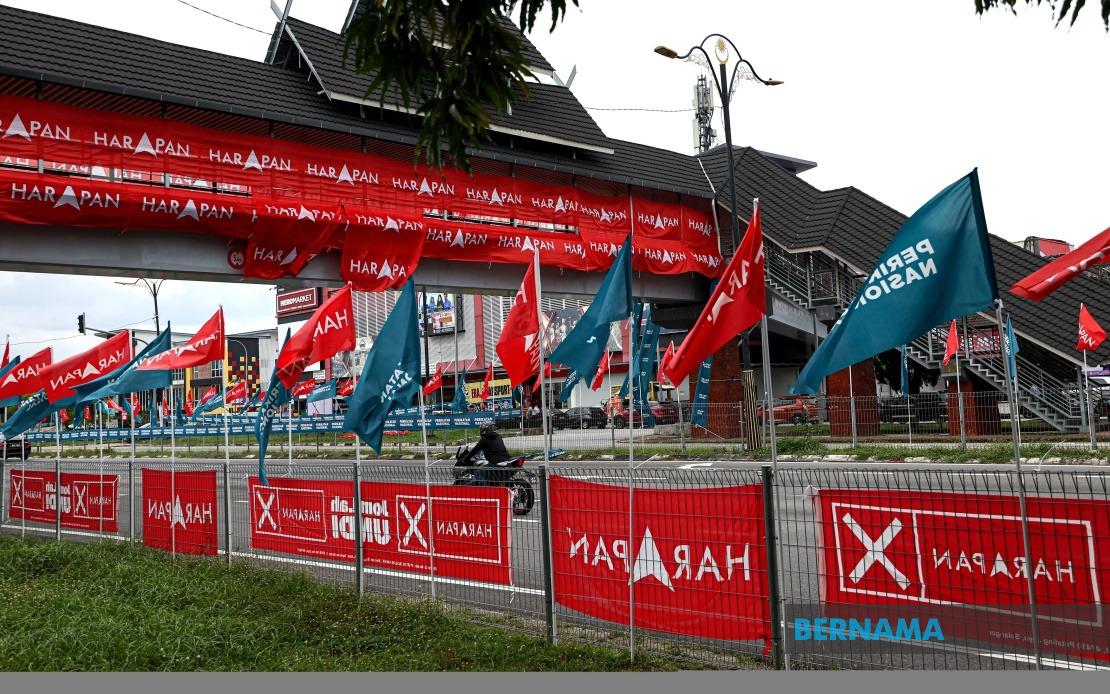
The opening phase of Negeri Sembilan's 16th state election has unfolded at a measured pace, with major political coalitions holding back their full arsenal of campaign machinery as the first seven days draw to a close. While preliminary skirmishes between competing parties are underway, observers note that the characteristic intensity associated with Malaysian electoral contests has yet to materialise, suggesting a calculated approach by both Pakatan Harapan and Barisan Nasional as they gauge voter sentiment and test their respective ground organisations.
The traditional hallmark of Malaysian election campaigns—the saturated visual presence of party flags, banners, and symbols across the landscape—has appeared subdued by historical standards. Rather than a comprehensive blanket of political messaging, campaign materials have been strategically concentrated at specific gathering points, including community halls, village corridors, and elevated junction points that attract foot traffic. This selective placement reflects a transition in campaign methodology, moving away from mass display tactics towards more precision-targeted visibility strategies designed to maximise impact where voters congregate and organise.
Both leading coalitions are leaning heavily on grassroots methodologies that demand sustained human engagement rather than broadcast messaging. Candidates and party workers have devoted considerable effort to direct outreach, including residential visits, attendance at religious congregations, and public appearances in local markets and gathering spaces. These face-to-face interactions are being augmented by digital campaign work, with parties leveraging social media networks to amplify messages and build supporter communities online, recognising that contemporary Malaysian voters increasingly make electoral decisions informed by both physical encounters and digital information sources.
Pakatan Harapan's leadership has signalled commitment through executive-level participation, with Prime Minister Datuk Seri Anwar Ibrahim making two separate visits to the state during the campaign's inaugural week. Simultaneously, the Barisan Nasional coalition has deployed its own top-tier support, with Deputy Prime Minister Datuk Seri Dr Ahmad Zahid Hamidi conducting three separate campaign visits across Negeri Sembilan. These leadership interventions serve multiple purposes: reinforcing candidate visibility, energising party volunteers, and projecting coalition confidence to regional media and observers.
Menteri Besar Datuk Seri Aminuddin Harun, contesting the Linggi state assembly seat under the Pakatan Harapan banner, characterised the coalition's opening-week strategy as deliberately focused on intimate voter consultations at the community level rather than large-scale public events. He acknowledged that while Pakatan Harapan plans to intensify engagement during the subsequent campaign phase, projecting precise seat-win predictions remains premature given the electoral variables still in play and the campaign's nascent stage. This measured communication stance suggests an effort to avoid inflated expectations that could undermine party morale if unfulfilled.
Barisan Nasional's approach similarly emphasises consolidation and operationalisation across its contested constituencies. Deputy BN chairman and incumbent Rantau Assemblyman Datuk Seri Mohamad Hasan, who also serves as Foreign Minister, called for sustained momentum in ground activities, instructing campaign workers to prioritise voter contact and maximise exposure across their respective districts. The emphasis on operational excellence and consistency indicates a recognition that election victories often hinge on superior machinery execution rather than singular headline-generating events, particularly in state-level contests where local issues often outweigh national narratives.
Perikatan Nasional, the newer entrant to this particular electoral contest, confronts the structural challenge of building campaign momentum from a lower baseline of organisational establishment in Negeri Sembilan. With eleven candidates fielded across the 36 available seats, PN operates as a secondary force competing for voter attention against the more established and better-resourced coalitions, though the party's strategic positioning and policy differentiation may resonate with specific voter demographics seeking an alternative to traditional BN-PH competition.
Academic analysis of the emerging campaign trajectory comes from Dr Mujibu Abd Muis, a Political Science lecturer at Universiti Teknologi MARA's Seremban campus, who observes that the first week has clarified the essential contours of competition. The contest appears primarily structured as a Pakatan Harapan-Barisan Nasional duel, with Perikatan Nasional still engaged in initial consciousness-raising among the electorate. Notably, Pakatan Harapan's strategic deployment of granular, targeted micro-campaigning contrasts with broader broadcast approaches, suggesting the coalition is concentrating resources on winnable constituencies and persuadable voter segments rather than attempting comprehensive persuasion across all constituencies simultaneously.
Dr Mujibu identifies an important shift in Malaysian voter behaviour emerging from contemporary campaign dynamics. Rather than relying principally on formal political oratory or party messaging disseminated through traditional media, voters increasingly assess candidates through direct personal visibility and demonstrated community engagement. This behavioural change reflects broader trends in Malaysian political culture, where local problem-solving capacity and accessible leadership have become more electorally significant than hierarchical party positioning or ideological rhetoric. The implication for political parties is clear: ground presence and constituent interaction have become non-negotiable campaign requirements.
The final campaigning week, spanning from late July through early August, historically represents the decisive period when wavering and undecided voters crystallise their electoral choices. As campaign intensity rises and party messages sharpen into clearer policy and personality contrasts, these fence-sitters typically converge toward one or another coalition. The second and third campaign weeks will therefore determine whether early groundwork translates into election victory, making the approaching period fundamentally more consequential than the opening week's organisational establishment phase.
The electoral field itself encompasses 103 candidates distributed across 36 state assembly seats, with Pakatan Harapan fielding the maximum possible slate of 36 candidates, positioning the coalition to contest every available seat. Barisan Nasional offers 25 candidates, while Bersatu and Perikatan Nasional together field 35 candidates, with supplementary participation from smaller entities including Berjasa, ASLI, PSM, and independent candidates. This fragmented electoral landscape means that seat outcomes may hinge on relatively modest vote margins, particularly where multiple parties divide opposition to the incumbent, making ground-level campaign effectiveness genuinely consequential.
With early polling scheduled for 28 July and the general polling day established for 1 August, the campaign countdown has entered its penultimate phase. The approaching week will clarify whether preliminary momentum translates into sustained competitive advantage, whether undecided voters gravitate toward incumbents or challengers, and which coalition's ground machinery proves more effective at converting voter contact into actual ballots cast. For Malaysia's broader political trajectory and regional observers tracking democratic competition across Southeast Asia, the Negeri Sembilan result will provide important indicators regarding voter sentiment and organisational effectiveness at a crucial juncture in the nation's political development.

