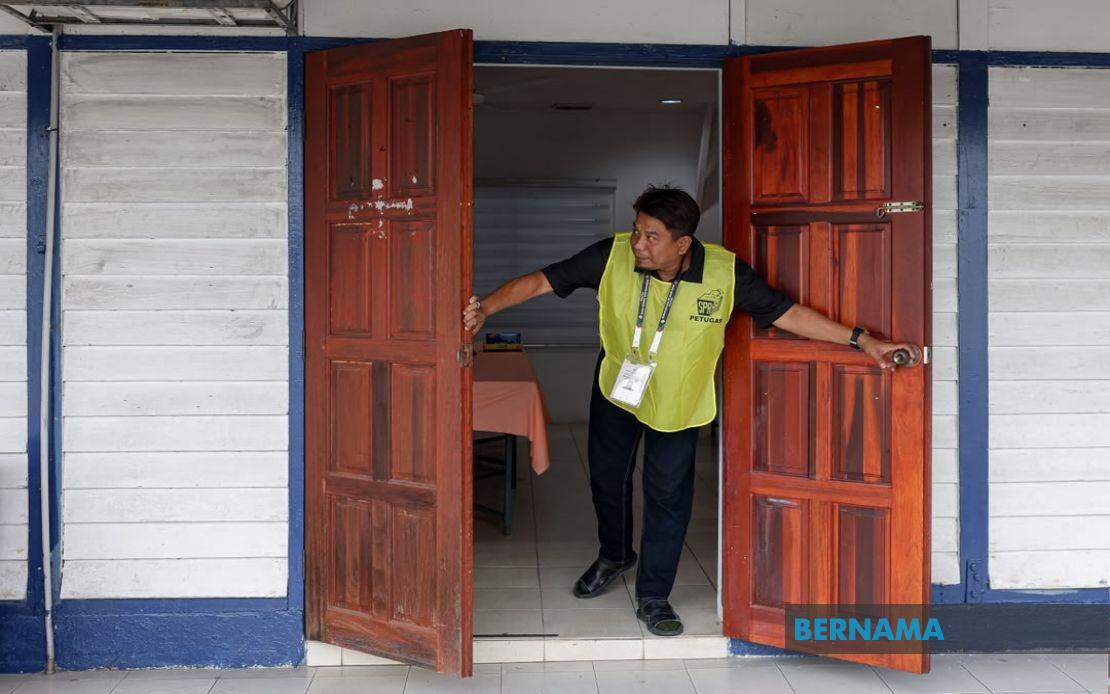
The first phase of polling for Negeri Sembilan's state election drew to a close on Sunday when the final early voting centre shut its doors at 5 pm, marking the end of a dedicated voting window reserved exclusively for members of Malaysia's security forces and their immediate families. The exercise, conducted across 38 dedicated polling stations throughout the state, had commenced in the early morning hours and proceeded systematically throughout the day, with centres closing in waves as their assigned constituencies completed their voting responsibilities.
The Election Commission orchestrated a carefully managed schedule that allowed security personnel—soldiers, police officers, and their spouses—to cast ballots before the general election scheduled for Saturday. This tiered approach, wherein some centres concluded operations at midday while others remained open until the final evening deadline, reflected the Commission's strategy to accommodate varying voter densities across different regions of Negeri Sembilan. By mid-afternoon, the bulk of voters had already completed their civic duty, with staggered closing times reflecting both logistical efficiency and the geographical distribution of eligible participants.
Election Commission chairman Datuk Seri Ramlan Harun disclosed that participation figures had substantially exceeded initial expectations. By 3 pm, preliminary tallies indicated that 14,651 eligible voters had already cast their ballots—a figure representing 88.97 per cent of all early voters who had been scheduled to participate. This composition broke down into 9,827 military personnel and their spouses alongside 4,824 police officers and their family members, collectively demonstrating robust engagement with the electoral process among these traditionally disciplined constituencies.
The overall early voting cohort comprised 22,339 registered voters, of whom approximately 73.7 per cent exercised their right to vote in person at the designated centres. This figure encompassed 11,293 military servicemembers and their spouses together with 5,174 police officers and their spouses. The remainder of eligible early voters—roughly 5,872 individuals—utilised postal voting arrangements, a provision designed to accommodate those whose duties or circumstances prevented physical attendance at polling locations.
Datuk Seri Ramlan had publicly indicated that the Commission had established a turnout benchmark of 90 per cent for the early voting phase. The final recorded participation rate of 88.97 per cent represented near-total fulfilment of this ambitious target, suggesting exceptionally high civic consciousness among the security forces and their families. Such elevated engagement levels typically correlate with disciplined voter mobilisation and strong institutional encouragement for participation.
The 16th Negeri Sembilan State Election represents a significant democratic exercise for the state, with 103 candidates contesting for representation across 36 state assembly seats. This candidate-to-seat ratio indicates a reasonably competitive electoral environment with approximately 2.86 candidates per available position. The competition reflects broader patterns of political engagement in Malaysia's state-level contests, where multiple parties and independents vie for voter attention and legislative representation.
General polling, which will determine the ultimate composition of the Negeri Sembilan state assembly, is slated for the following Saturday and involves a substantially larger electorate. The general voting roll encompasses 889,490 registered voters—a figure dwarfing the 22,339 early voters and underlining the representative significance of the Saturday balloting. This mass participation phase will ultimately determine which parties secure control of state government and which candidates succeed in their bids for assembly membership.
The deployment of 38 separate early voting centres across Negeri Sembilan reflects the geographic dispersal of military and police installations throughout the state. This infrastructure investment demonstrates the Election Commission's commitment to maximising accessibility for security force personnel, recognising that such voters often face operational constraints that make standard polling day participation challenging. The staggered closing schedule further exemplified this responsiveness, allowing flexibility for centres with lighter footfall while maintaining momentum at busier locations.
From a broader electoral perspective, the strong turnout among security forces carries symbolic importance for Malaysia's democratic processes. Military and police participation rates often serve as barometers of institutional confidence in electoral systems and faith in the legitimacy of electoral outcomes. High engagement suggests that security force personnel view the state election as a meaningful exercise rather than a perfunctory requirement, potentially reflecting broader institutional health and inter-agency cooperation on electoral matters.
The transition from early voting to general polling represents a critical juncture in Negeri Sembilan's electoral calendar. The security forces' ballots have been cast and secured; attention now turns toward Saturday's mass participation event. The Election Commission's demonstrated capacity to manage the complex logistical requirements of early voting—managing multiple centres, voter verification systems, ballot security, and staggered closures—will be tested anew on a vastly larger scale when nearly 890,000 voters converge on regular polling stations throughout the state. The success of early voting operations provides some assurance of institutional readiness for this imminent challenge.
For Malaysian observers tracking state-level electoral dynamics, Negeri Sembilan's polling exercise offers instructive lessons about voter mobilisation, institutional efficiency, and the capacity of security force communities to engage with democratic processes. The near-90 per cent early voting turnout suggests patterns that may inform how future electoral exercises are designed and conducted, particularly regarding provisions for voters with service obligations that complicate standard polling day participation. As Malaysia continues evolving its electoral administration, such data points contribute valuable evidence about what engagement rates are achievable under optimised conditions.

