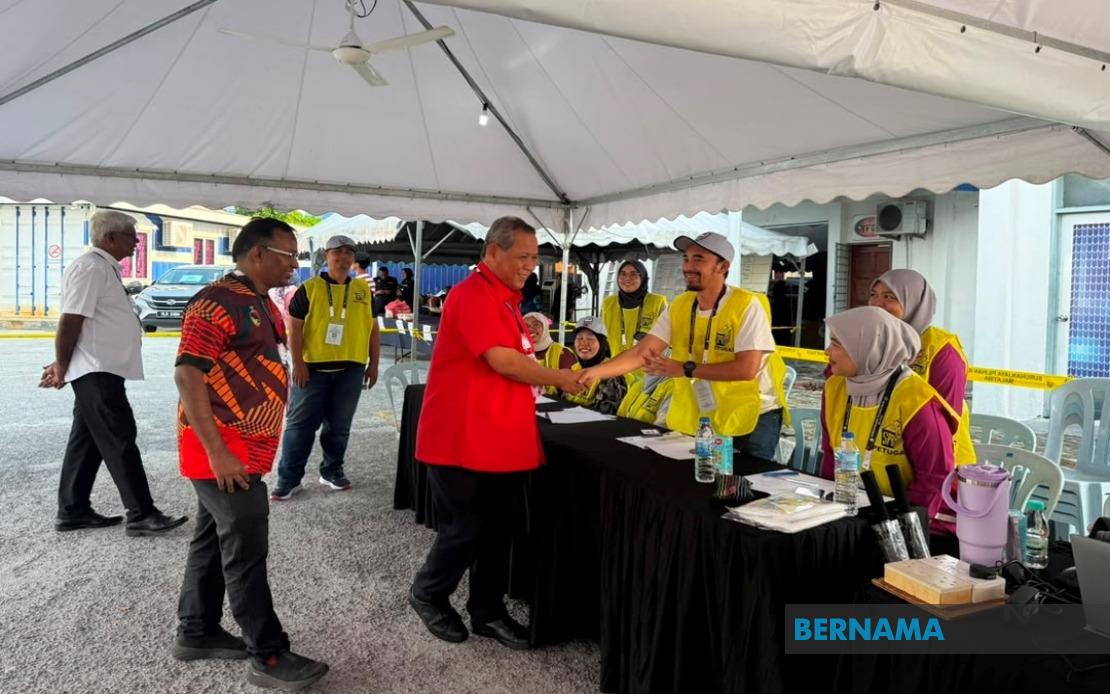
The Negeri Sembilan State Election reached a pivotal moment on July 28 as candidates from competing coalitions fanned out across the state to observe the early voting process, which proceeded without significant incident. The deployment of high-profile contenders to polling centres reflected the competitive intensity surrounding the contest, while their presence also served as a confidence-building exercise for election stakeholders.
In Port Dickson, Menteri Besar Datuk Seri Aminuddin Harun, the Pakatan Harapan candidate for the Linggi seat, arrived at the Port Dickson District Police Headquarters at 9 am to monitor early voting operations. His visit underscored the importance of the early voting mechanism in Malaysia's electoral system, which allows essential service personnel such as police officers to cast their ballots before general polling day. Aminuddin took time to interact with police officers and personnel who were exercising their right to vote during their working hours, acknowledging both their participation and their commitment to maintaining democratic processes.
The Menteri Besar's remarks to reporters highlighted a broader satisfaction with voting procedures on the day. He expressed appreciation for the early turnout of voters, framing their participation as a demonstration of civic responsibility. His commendation of the police force's role in facilitating the democratic process reflected the critical interdependence between law enforcement agencies and the election commission in ensuring that polling operations remain orderly and accessible to all eligible voters, regardless of their occupational demands.
Meanwhile, the Barisan Nasional coalition also maintained a visible presence at polling centres throughout the state. In Jelebu, Datuk Seri Jalaluddin Alias, the BN candidate for the Pertang seat, visited the Jelebu District Police Headquarters at approximately 8 am to observe early voting proceedings. His inspection of the polling centre, combined with informal interactions with those present, mirrored the broader strategy employed by candidates across both major coalitions to demonstrate their engagement with the electoral process and their confidence in its administration.
The early voting mechanism represents a significant accommodation within Malaysia's electoral framework, recognising that certain categories of citizens—particularly those in security services—require flexibility in voting arrangements due to their operational commitments. The smooth execution of early voting on July 28 suggested that polling authorities had adequately prepared for the influx of police personnel and other eligible early voters, with proper queuing systems, verification procedures, and ballot distribution in place.
For Malaysian voters and regional observers, the successful administration of early voting carries implications beyond the immediate state contest. It demonstrates the Election Commission's capacity to manage multiple voting phases simultaneously while maintaining transparency and accessibility. The presence of candidates at polling centres, observing procedures firsthand, contributes to public confidence in electoral integrity—a factor of considerable importance in Malaysia's competitive political landscape, where perceptions of fairness directly influence voter participation and acceptance of results.
The coordination required to enable early voting while maintaining security and voting secrecy involves multiple government agencies working in concert. Police participation as voters, combined with their operational role in securing polling areas, requires careful scheduling and logistics. The apparent smoothness of proceedings on July 28 reflected careful planning by the Election Commission and its partner agencies, though the ultimate test of the electoral process would come with the conclusion of general polling day and the verification of overall results.
From a Southeast Asian perspective, Malaysia's experience with multi-phase voting and accommodation for occupational groups demonstrates institutional maturity in electoral management. Several regional democracies have experimented with similar mechanisms, and the practical execution of such arrangements in Malaysia offers relevant lessons regarding operational feasibility and voter accessibility. The Negeri Sembilan election served, in this sense, as a real-time case study in adaptive electoral administration.
The visibility of major candidates at polling centres also underscores the personalised dimension of state-level contests in Malaysia. Unlike federal elections, which can feel distant to many voters, state elections often feature more direct engagement between candidates and constituents. Candidates' presence at voting facilities, offering observations and comments, reinforces their accessibility and maintains momentum during the critical pre-polling period. This engagement strategy reflects the intensely competitive nature of Negeri Sembilan politics, where margins of victory in previous contests have often been narrow.
As early voting concluded and the electoral process moved toward general polling day, the Negeri Sembilan election demonstrated that despite Malaysia's complex institutional arrangements and multi-level governance structures, fundamental electoral mechanisms continue to function effectively. The ability to accommodate diverse voter requirements while maintaining procedural integrity remains a cornerstone of Malaysia's democratic system, even amid intense partisan competition between Pakatan Harapan and Barisan Nasional.

