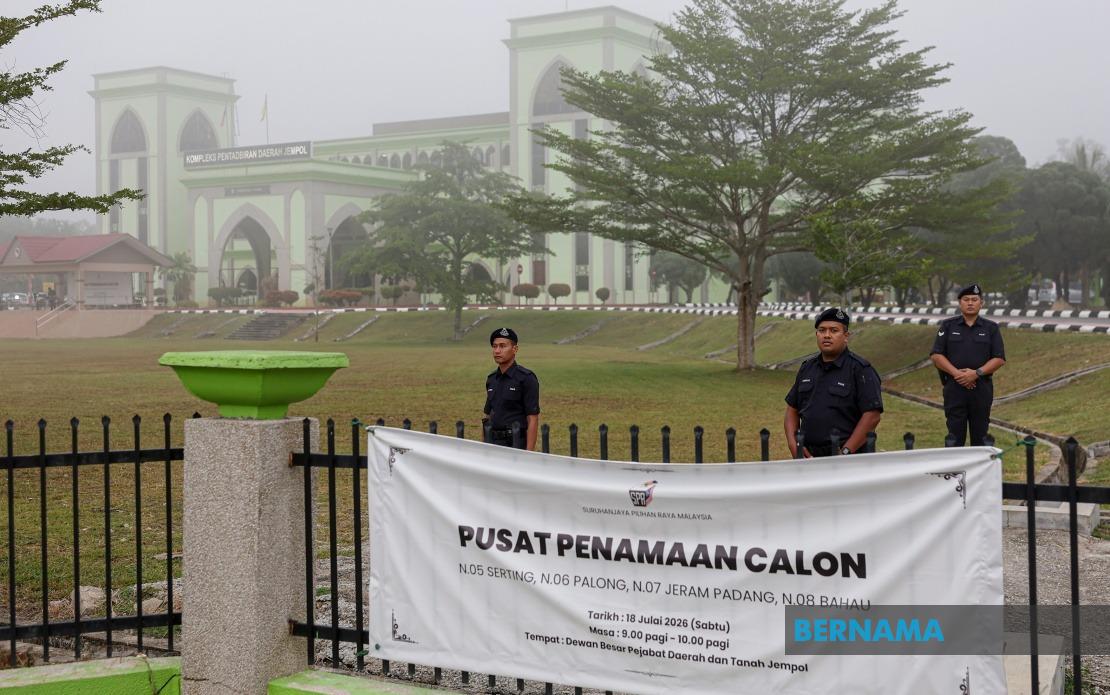
The 16th Negeri Sembilan state election formally commenced its nomination phase today as all eight candidate registration centres across the state activated simultaneously at 9 am. The one-hour window for candidate submissions concluded at 10 am, after which returning officers began processing submissions and announcing the final list of eligible contenders. This regulatory moment marks the official beginning of what will become a closely watched contest in the peninsular state, potentially reshaping the regional political landscape ahead of the August 1 polling day.
Election authorities have mapped out a compressed but structured timeline for the entire electoral process. Once candidates receive official confirmation, a 14-day campaign period begins immediately and extends until 11.59 pm on July 31, giving political parties and independent candidates less than a fortnight to mobilise voters and articulate their platforms. The Election Commission scheduled early voting for July 28, accommodating military personnel, police officers and their spouses who are entitled to cast ballots in advance. This staggered voting arrangement reflects the commission's effort to balance democratic participation with operational feasibility.
Security preparations underscore the state's commitment to orderly elections. Negeri Sembilan police chief Datuk Alzafny Ahmad confirmed deployment of 2,393 police personnel stationed across all eight nomination centres, tasked with maintaining peace and preventing disruptions throughout the registration process. This substantial security presence reflects standard precautions for conducting nominations without incident, though it also signals authorities' recognition of the political sensitivities surrounding state-level contests in Malaysia, where competition between major coalitions remains intense.
The electoral roll reveals Negeri Sembilan's participation base as fundamentally robust. As of June 4, 2026, the state contains 889,490 registered voters eligible to participate in this election. This total comprises 867,151 ordinary citizens entitled to vote on polling day, alongside 16,884 military personnel and their spouses and 5,455 police officers designated as early voters. The composition of the electoral roll demonstrates how electoral mathematics in Malaysian state contests intersect with security sector interests, a factor that can influence outcomes in closely contested races.
The state election was triggered by the official dissolution of the Negeri Sembilan State Legislative Assembly on June 5, following formal consent from Tuanku Muhriz Tuanku Munawir, the Yang Dipertuan Besar of Negeri Sembilan. This constitutional procedure reflects Malaysia's Westminster-influenced framework, wherein state rulers retain ceremonial but significant powers over the dissolution of legislatures. The decision to call fresh elections suggests either expiration of the previous assembly's term or strategic timing by the ruling coalition to seek renewed mandate during perceived periods of political advantage.
The previous electoral contest in 2023 established the competitive terrain that today's nominations will contest. Pakatan Harapan captured 17 of the 36 state seats, translating into a comfortable governing majority. Barisan Nasional secured 14 seats, maintaining its position as the principal opposition force, while Perikatan Nasional achieved five seats, establishing itself as a tertiary political player in the state assembly. These results demonstrate that Negeri Sembilan represents neither a one-party state nor a genuinely competitive two-horse race but rather a three-way contest with asymmetric weight distributed toward the incumbent coalition.
Today's nomination process occurs against broader national political currents that shape state-level calculations. The interplay between federal and state politics in Malaysia means that Negeri Sembilan's election carries implications beyond the state's borders. Strong showings by any coalition can generate momentum for national narratives, while disappointing results may prompt internal reckonings within larger political structures. For Pakatan Harapan, defending the 17-seat majority achieved in 2023 matters for sustaining its narrative of national relevance and renewed electoral viability. For Barisan Nasional, improved performance could suggest recovery potential in peninsular states where the coalition has faced recent setbacks.
Weather conditions proved cooperative for nomination proceedings. Meteorological observations across all seven districts indicated favourable atmospheric conditions, eliminating operational complications that could have disrupted the smooth functioning of registration centres. While weather rarely becomes a political issue in Malaysian elections, its benign presence today allowed nomination activities to proceed without logistical friction, permitting smooth flow of candidates through submission procedures.
The nomination day itself represents a critical filtering mechanism within Malaysia's electoral architecture. Returning officers now evaluate submitted nominations against statutory requirements, potentially disqualifying candidates who fail to meet constitutional or procedural standards. This gatekeeping function means that the names announced after 10 am represent only those candidates who survived official scrutiny, a process that occasionally generates controversy when marginal cases spark debate about administrative interpretation of electoral law. In Negeri Sembilan's case, the relatively routine nature of today's proceedings suggests no extraordinary disputes over candidate eligibility have emerged.
The 36-seat configuration of the Negeri Sembilan legislature distributes electoral competition across constituencies that reflect varying demographic and geographic profiles. Urban areas around Seremban present different competitive dynamics than rural districts, influencing how parties allocate resources and messaging during the compressed 14-day campaign. The eventual candidate slate announced today will reflect party assessments of which individuals possess the best prospects of capturing specific constituencies, incorporating evaluations of incumbent performance, local ground organisation, and demographic shifts within electoral boundaries.
For Malaysian political observers, Negeri Sembilan's 2026 state election carries significance as a mid-term verdict on the Pakatan Harapan-led coalition's governance at state level. Two years into the previous government's mandate, voters will assess whether incumbent performance has justified continued confidence or whether challengers have mounted sufficiently persuasive alternative visions. The degree to which national political narratives penetrate state voting behaviour remains contested among analysts, but few dispute that state elections offer valuable signalling function regarding shifting electoral sentiments across key demographic groups.
Campaign dynamics over the coming fortnight will substantially determine the election's trajectory. The 14-day window compresses political messaging into a concentrated period, favouring well-organised campaigns with established ground networks and substantial financial resources. Smaller parties and independent candidates face steeper challenges in achieving visibility within such compressed timeframes, potentially advantaging the three major electoral forces that demonstrated capacity to mobilise voters in the 2023 contest. How effectively each coalition translates nomination numbers into actual electoral victory will depend substantially on campaign execution, candidate quality, and ultimately voter responsiveness to competing policy prescriptions and leadership appeals.

