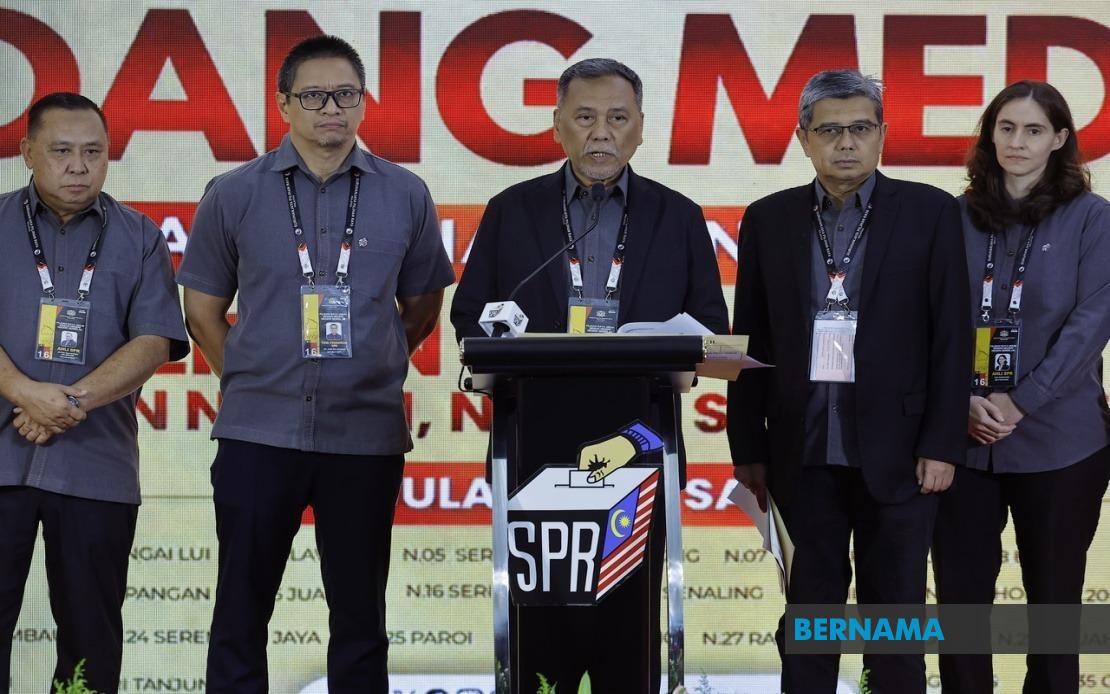
The Election Commission confirmed on July 18 that 103 candidates have been verified as eligible to contest in Negeri Sembilan's 16th state election, setting the stage for a spirited competitive campaign across one of Malaysia's more evenly balanced political landscapes. The comprehensive verification process concluded after the nomination deadline passed at 10 am, with all submissions processed at eight centres throughout the state. The diversity of the candidate field underscores the democratic nature of the contest, with representation spanning established coalitions and smaller political movements.
Pakatan Harapan has emerged as the frontrunner numerically, fielding a full slate of 36 candidates across all constituencies. This comprehensive approach reflects the coalition's ambitions to reclaim or consolidate control in the state, where political fortunes have shifted substantially in recent years. The Barisan Nasional, historically dominant in Negeri Sembilan, is fielding 25 candidates, representing a more selective strategy that concentrates resources on winnable seats rather than attempting universal coverage. This difference in approach suggests distinct campaign philosophies, with PH pursuing an all-encompassing presence while BN prioritises strategic positioning.
The fragmentation of the non-PH, non-BN space reveals another dimension of contemporary Malaysian politics. Bersatu has fielded 24 candidates, making it a significant contender that could prove decisive in split-vote scenarios. The party's substantial nomination reflects its continuing relevance following the political upheavals of recent years. Perikatan Nasional, the coalition structure that includes Bersatu alongside other parties, has contributed 11 additional candidates to the mix. Smaller parties and independent candidates round out the field, including Berjasa, the Malaysian Orang Asli Party, and the Socialist Party of Malaysia each putting forward a single nominee, along with four independent contenders. This constellation of choices provides voters with an unusually wide ideological and representational spectrum.
The distribution of contests across the 36 seats reveals a fragmented political landscape where clear head-to-head battles will be the exception rather than the rule. Twenty-one constituencies will feature three-cornered fights, meaning that victory margins could be determined by relatively modest vote pluralities rather than majority support. Only eleven seats are configured for straight one-on-one contests, indicating that the vast majority of constituencies will involve splitting the anti-incumbent or pro-incumbent vote. Two seats, Nilai and Sri Tanjung, have drawn five-cornered contests, adding further complexity to the tactical and strategic calculations voters must make. Jeram Padang and Rahang will see four-candidate races, intensifying the potential for fragmented results. This configuration suggests that ground campaigns, community engagement, and voter mobilisation efficiency will matter considerably.
The candidate demographics provide insight into the inclusivity and generational composition of the various parties. Election Commission Chairman Datuk Seri Ramlan Harun revealed that 94 male candidates and nine female candidates are contesting the election, reflecting ongoing gender disparities in political representation at the state level. The candidate age range spans from 23 to 70 years old, indicating attempts by various parties to balance experienced legislators with younger faces intended to signal renewal and forward-thinking governance. The youngest candidate, a 23-year-old representing Bersatu in Sri Tanjung, embodies one type of renewal strategy, while the oldest, a 70-year-old PH candidate competing in Gemencheh, represents continuity and established political experience.
The electoral body comprises nearly 890,000 registered voters, a substantial and diverse electorate reflecting Negeri Sembilan's status as a moderately populated state. The voter breakdown encompasses 867,151 ordinary citizens, alongside 16,884 military personnel and their spouses, and 5,455 police officers. This composition means that security force personnel represent a meaningful bloc, approximately 2.5 percent of the total electorate, concentrated in specific constituencies where military or police establishments are located. The substantial ordinary voter majority ensures that civilian political preferences will ultimately determine the outcome, though security force voting patterns could prove decisive in closely contested marginal seats.
The election timeline provides candidates and parties with a compressed campaign window. The Election Commission has scheduled early voting for July 28, enabling military personnel, police officers, and other eligible voters to cast ballots before polling day. The official election date of August 1 marks the culmination of campaign activities and the point at which the electorate will render its verdict. This timeframe is typical for Malaysian state elections and provides approximately two weeks between nomination closure and polling day, a period in which parties must mobilise supporters, conduct media campaigns, organise grassroots activities, and address emerging campaign issues.
The dissolution of the Negeri Sembilan state assembly on June 5 initiated this election cycle, following constitutional procedures that enable a sitting government to seek a fresh electoral mandate. The decision to call elections carries strategic implications for the incumbent administration, as governments typically dissolve assemblies when they perceive favourable political conditions. The timing relative to the various party standings and public sentiment at the time of dissolution would have factored into the decision to seek a fresh mandate.
For Malaysian and Southeast Asian observers, this election matters beyond Negeri Sembilan's borders. State-level contests serve as bellwethers for national political trends, providing early indicators of voter sentiment regarding federal government performance and the relative standing of major political coalitions. The results will offer insights into Pakatan Harapan's capacity to retain and expand control in state governments, Barisan Nasional's prospects for recovery following its 2018 federal election loss, and the emerging role of Bersatu as a kingmaker capable of influencing coalition mathematics. The prevalence of three-cornered and multi-candidate races suggests that seat distribution may diverge significantly from vote share, making the actual results unpredictable and dependent on tactical voting patterns and organisational efficiency.
The candidate field's composition across the major coalitions and parties will test the effectiveness of various political organisations in identifying winnable candidates and building campaign machinery. Pakatan Harapan's decision to field candidates in all seats demonstrates confidence but also exposes it to potential losses in traditionally non-aligned constituencies. Barisan Nasional's more selective approach may prove more efficient if it correctly identifies its strongholds but could cede momentum if it appears to be retreating. Bersatu's substantial presence ensures that it will exercise meaningful influence over the outcome, particularly in constituencies where its vote could determine whether PH or BN wins the seat. The August 1 polling date will provide the definitive answer to these strategic calculations and reveal how Negeri Sembilan voters prioritise their choices across this unusually fragmented competitive landscape.

