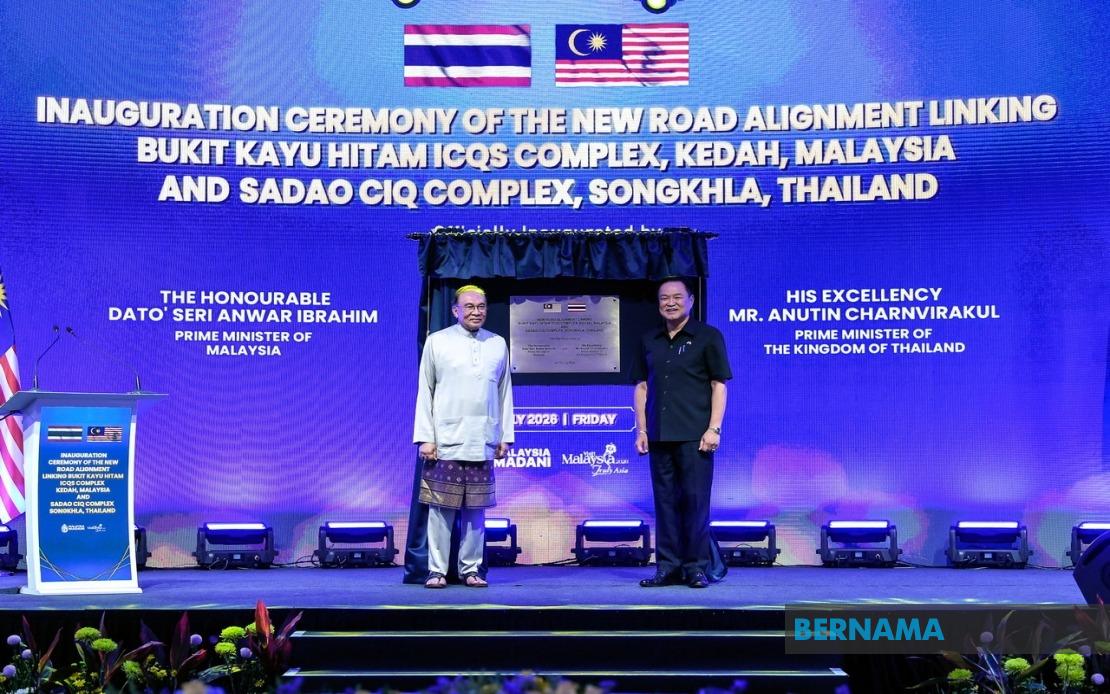
Prime Minister Datuk Seri Anwar Ibrahim has unveiled a strategic infrastructure project designed to reshape economic dynamics across the Malaysia-Thailand border, describing the newly aligned road connecting Bukit Kayu Hitam in Kedah to the Sadao complex in Thailand as a transformative venture with far-reaching implications for both nations. Speaking at the official launch in Bukit Kayu Hitam on July 10, Anwar characterised the initiative as a watershed moment in bilateral relations, one that transcends conventional diplomatic engagement to establish tangible mechanisms for sustained prosperity in border communities.
The road alignment itself represents more than merely improved physical connectivity. By streamlining the passage between the Bukit Kayu Hitam Immigration, Customs, Quarantine and Security (ICQS) Complex and the Sadao Customs, Immigration and Quarantine (CIQ) Complex, the infrastructure project aims to reduce friction in cross-border transactions, thereby facilitating smoother movement of goods, services, and people. For Malaysian traders and entrepreneurs operating in northern Peninsular Malaysia, this development promises tangible operational benefits through reduced transit times and administrative bottlenecks that have historically constrained commercial activity in the region.
Central to Anwar's vision is the establishment of a special economic border zone encompassing northern Malaysia and southern Thailand. This framework differs fundamentally from ad-hoc bilateral agreements by creating institutionalised structures for coordinated economic development. States including Perlis, Kedah, Kelantan, Perak, and Penang stand to benefit from expanded commercial opportunities and investment flows that such a zone would generate. The approach reflects recognition that border regions, often economically marginalised compared to metropolitan centres, possess untapped potential when provided with appropriate institutional frameworks and infrastructure support.
The bilateral trade ambition underpinning this initiative is substantial. Malaysia and Thailand have set a target of USD30 billion in bilateral trade by 2027, a figure that underscores the commercial significance both governments attach to deepened economic integration. Current trade patterns suggest considerable room for expansion, particularly in manufacturing, agricultural products, and services sectors where complementarities between the economies remain underutilised. Enhanced border connectivity directly supports achievement of this target by reducing transaction costs and enabling businesses to operate more efficiently across the frontier.
Anwar's emphasis on resolving longstanding administrative impediments signals pragmatic governance. Outstanding issues spanning customs procedures, immigration protocols, fisheries management, and trade regulations have accumulated over decades, creating cumulative friction that imposes real costs on businesses and communities. The commitment to expedite resolution of these matters, jointly articulated with Thailand's Prime Minister Anutin Charnvirakul, suggests both governments recognise that incremental bureaucratic improvements can yield significant economic dividends. By prioritising practical problem-solving over protracted negotiations, the two nations demonstrate capacity for results-oriented engagement.
The participation of Anutin Charnvirakul in the border launch ceremony carries symbolic weight extending beyond ceremonial protocols. A Thai Prime Minister's willingness to visit Bukit Kayu Hitam signals institutional commitment from Bangkok's leadership to advancing regional development outside Thailand's major urban centres. Such engagement validates local communities' concerns and aspirations, fostering political goodwill essential for successful implementation of complex cross-border initiatives. For Malaysian stakeholders in border states, Anutin's presence demonstrates that bilateral cooperation enjoys high-level commitment in Thailand, enhancing confidence in project sustainability beyond electoral cycles or leadership transitions.
The special economic zone concept requires careful calibration to succeed in the Southeast Asian context. Such zones function optimally when underpinned by clear regulatory frameworks, transparent governance structures, and genuine commitment from both governments to protect investor interests and enforce agreements. Malaysia's experience with existing economic zones, combined with Thailand's substantial manufacturing sector, suggests complementary capabilities exist. However, success depends on moving beyond formal announcements to establish operational mechanisms including joint customs administration, harmonised standards, and dispute resolution processes that command confidence from business communities on both sides.
For Malaysian workers and entrepreneurs in northern states, enhanced border connectivity presents both opportunities and adjustment challenges. Increased competition from Thai businesses operating within the zone could pressure some sectors, particularly low-margin trading activities and basic services. Simultaneously, expanded market access offers significant growth prospects for manufacturing, logistics, and specialised services sectors where Malaysian firms possess competitive advantages. Regional economic development policies should therefore balance liberalisation benefits with targeted support for workers and businesses requiring transition assistance as border economies restructure.
The infrastructure investment required for such integration extends beyond the road alignment itself. Supporting development of port facilities, telecommunications infrastructure, and logistics hubs would amplify the benefits of improved road connectivity. Malaysia's position as Southeast Asia's most developed economy suggests appropriate technology and expertise availability for these complementary investments. Joint planning mechanisms between Malaysian and Thai authorities would optimise infrastructure deployment across both jurisdictions, ensuring maximum economic impact.
The geopolitical context merits consideration as well. Enhanced Malaysia-Thailand economic integration strengthens regional stability through deepened interdependence and shared prosperity interests. As both nations navigate evolving regional dynamics, economic cooperation rooted in border region development provides concrete foundation for broader diplomatic and strategic alignment. The initiative also demonstrates ASEAN principles of regional integration extending beyond national capitals to encompass peripheral communities whose welfare constitutes genuine measure of development success.
Implementation timelines and accountability mechanisms remain critical for translating Anwar and Anutin's commitments into tangible outcomes. Clear benchmarks for resolving regulatory impediments, measurable targets for trade growth, and transparent reporting mechanisms would enhance project credibility. Given Malaysia's experience administering complex border arrangements and Thailand's substantial administrative capacity, establishing joint working groups with explicit mandates and timeframes appears essential for maintaining momentum beyond the launch ceremony.
The broader significance of this initiative extends beyond bilateral Malaysia-Thailand relations. Successful development of the Bukit Kayu Hitam-Sadao economic zone could establish a replicable model for other ASEAN border regions, demonstrating how strategic infrastructure investment combined with regulatory harmonisation can transform peripheral areas into engines of regional growth. This carries particular relevance for smaller ASEAN members whose border regions often lag in development despite geographic proximity to dynamic neighbouring economies. Malaysia's leadership in pioneering this approach positions the nation as regional innovator in inclusive development strategies.

