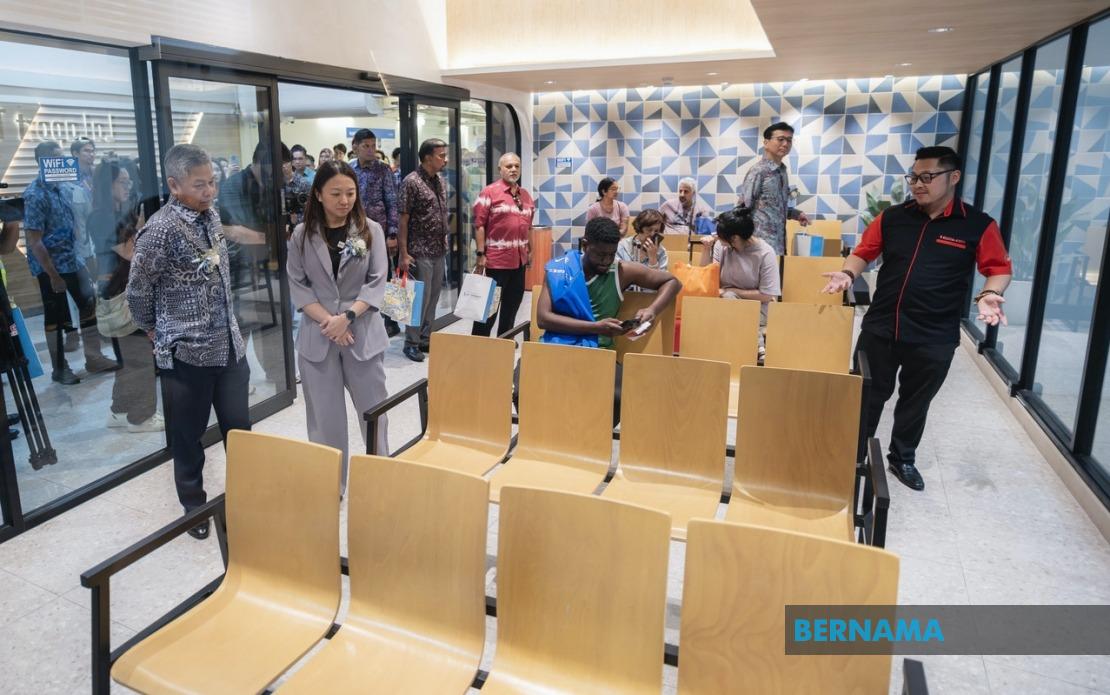
Kuala Lumpur's urban transport landscape has expanded with the official launch of the LaLaport Transportation Hub (LTH), an ambitious integrated facility designed to streamline passenger movement across the city centre. The hub, positioned adjacent to the Hang Tuah LRT and Monorail interchange, represents a significant advancement in Malaysia's approach to multi-modal transport connectivity, with projections suggesting it will accommodate up to 10,000 daily travellers once operational capacity is reached.
Hannah Yeoh, Minister in the Prime Minister's Department (Federal Territories), unveiled the facility with particular emphasis on its role in addressing Kuala Lumpur's mounting transportation pressures. The city currently experiences approximately 1.2 million people entering and departing daily, alongside roughly 5.5 million journeys recorded within a 24-hour period. These figures underscore the mounting strain on existing infrastructure and justify substantial investment in facilities that consolidate multiple transport modes under one roof. The LaLaport hub responds directly to this challenge by offering passengers seamless transitions between rail networks, express buses, e-hailing platforms, conventional taxis, and shared mobility options through covered pedestrian pathways that shield users from weather conditions—a critical consideration in Malaysia's tropical climate.
The terminal's strategic positioning within the city centre carries broader implications for regional connectivity. Beyond serving local commuters, the hub has been positioned as a critical gateway for intercity travellers between Kuala Lumpur and Singapore. Approximately 30 bus operators are anticipated to utilise the facility as their primary transit point, particularly for cross-border services. This regional dimension elevates the project beyond local significance, potentially reshaping how passengers throughout Southeast Asia experience intercity bus travel. The availability of 24-hour express services to Singapore combined with airport shuttle connections to both Kuala Lumpur International Airport terminals one and two positions the hub as a comprehensive mobility solution for both business and leisure travellers.
Operational specifications demonstrate careful infrastructure planning. The facility occupies the LG1 level of the East Atrium and incorporates 11 dedicated bus parking bays alongside a fully air-conditioned waiting area equipped with staffed service counters and self-service kiosks. Real-time passenger information displays provide dynamic bus schedule updates, addressing a persistent gap in Malaysian public transport information systems. These features collectively represent incremental improvements that cumulatively enhance user experience—reducing uncertainty around departure times, providing weather-protected spaces, and ensuring clear operational guidance. The operator, Asia Success Resource Sdn Bhd, projects handling approximately 150 bus trips daily through the facility.
Compplementary services extend the hub's functionality beyond traditional bus terminals. The Boleh-Boleh Ride on-demand van shuttle service provides flexible connectivity to key city centre destinations, catering to passengers whose journey endpoints lie beyond walking distance from major transit nodes. This last-mile connectivity challenge remains inadequately addressed in many Malaysian cities, and the hub's integration of such services represents recognition of how modern transport systems must seamlessly connect micro-mobility with macro-transport infrastructure.
Government reforms have created the administrative environment enabling such developments. Dewan Bandaraya Kuala Lumpur (DBKL) recently transitioned from annual renewal licences to three-year operating permits for transport terminals, a policy shift intended to provide operators with greater stability and long-term planning certainty. This extended licensing period potentially incentivises further investment in facility upgrades and service expansions. Simultaneously, DBKL is deploying approximately 10,000 operational closed-circuit television cameras throughout the city, addressing safety and security concerns that historically constrain public transport usage—particularly during evening hours and amongst female passengers.
International collaboration has facilitated the project's development. Japanese Ambassador to Malaysia Noriyuki Shikata attended the launch, contextualising the hub within broader Malaysia-Japan cooperation frameworks. He highlighted the initiative as exemplifying both nations' commitment to sustainable urban development, connecting the specific infrastructure project to wider strategic partnerships. This diplomatic framing reflects Japan's established expertise in transit-oriented development and urban planning, areas where Malaysian authorities increasingly seek international knowledge exchange. The ambassador also referenced Prime Minister Datuk Seri Anwar Ibrahim's recent Japan visit as reaffirming bilateral commitments across energy security and other domains, positioning the transport hub within a larger diplomatic narrative.
The hub's significance for Malaysian travellers extends beyond immediate convenience. The facility's integration of rail, bus, and e-hailing services creates ecosystem effects that potentially reduce private vehicle dependency. As Kuala Lumpur grapples with chronic traffic congestion and associated air quality degradation, facilities that make public transport seamlessly accessible and comfortable offer meaningful progress toward sustainability objectives. The project demonstrates how infrastructure investment can align with both immediate mobility needs and longer-term environmental ambitions.
Kuala Lumpur Mayor Datuk Seri Fadlun Mak Ujud's presence at the launch, alongside Land Public Transport Agency (APAD) deputy director Azrin Borhan, signified institutional commitment spanning multiple administrative layers. This multi-level government participation suggests the hub represents not isolated infrastructure development but rather integrated urban planning reflecting coordinated policy direction across federal territories administration, municipal government, and transport regulation agencies.
The LaLaport hub's operational trajectory will provide important empirical insights for Malaysian planners. Performance metrics around actual passenger volumes, service reliability, and user satisfaction will inform decisions regarding similar integrated terminal developments in other Malaysian cities. If the facility successfully captures projected volumes and generates positive user feedback, it could catalyse replication across other urban centres—potentially establishing integrated transport hubs as standard infrastructure in Malaysia's growing metropolitan areas.
Looking ahead, the hub's success will partly depend on complementary investments ensuring effective connections between the terminal and broader public transport networks. Reliable feeder bus services, convenient walking infrastructure, and pedestrian-friendly urban design around the Hang Tuah interchange all influence whether the facility achieves its potential. Additionally, continued service quality and competitive pricing by participating bus operators will determine whether the hub effectively attracts passengers from private vehicles—the ultimate measure of its contribution to urban sustainability objectives.

