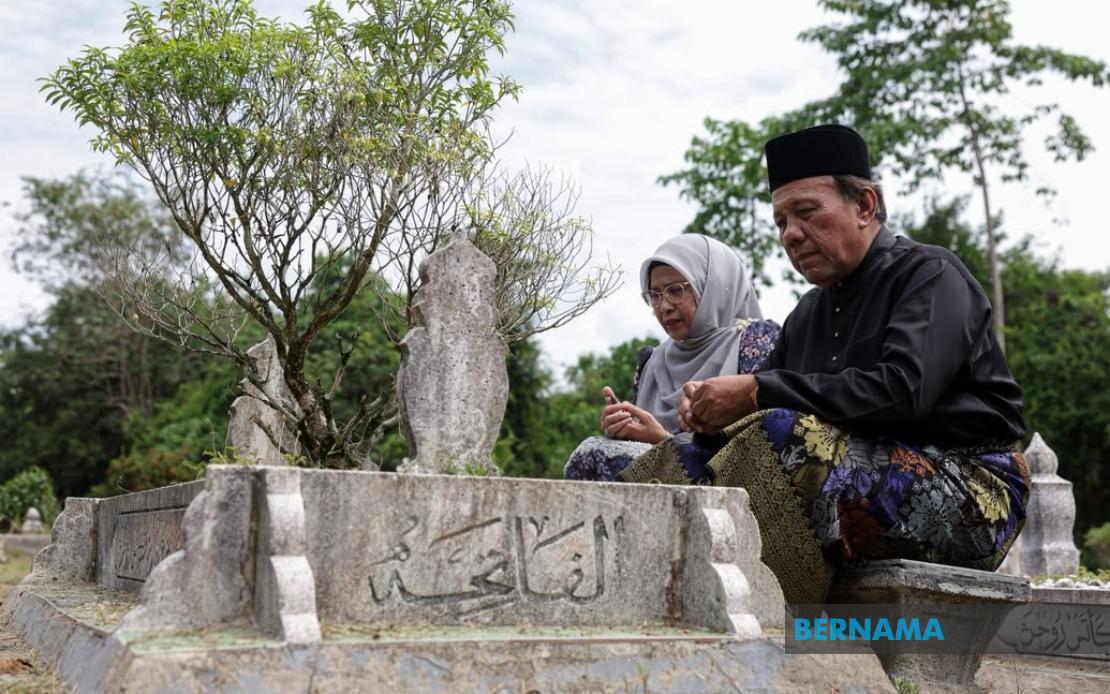
Datuk Ismail Lasim marked the beginning of his tenure as Menteri Besar of Negeri Sembilan with a personal pilgrimage to the Tebing Tinggi Muslim cemetery in Kuala Pilah, where he and his wife Datin Noraishah Othman paid their respects at the graves of his late parents. The visit took place on August 2, just hours after Ismail had completed the formal swearing-in ceremony before the Yang di-Pertuan Besar of Negeri Sembilan, Tuanku Muhriz Tuanku Munawir, at Istana Besar Seri Menanti. Dressed in traditional black Malay attire befitting the solemnity of the occasion, the newly installed leader observed a moment of quiet reflection at the cemetery, a gesture that underscored his deep connection to his family heritage at a pivotal moment in his political career.
The decision to visit the graves immediately after taking office carries symbolic weight in Malay-Muslim culture, where paying respects to deceased parents is considered a fundamental act of filial piety. For Ismail, whose victory in the Juasseh state seat during the 16th Negeri Sembilan state election provided him the platform to assume the highest executive position in the state, this cemetery visit appeared to serve as both a personal acknowledgment of those who came before him and a spiritual grounding ahead of the responsibilities that now rest upon his shoulders.
Ismail's parents held particular significance in his life. His father, the late Lasim Yaman, lived to the age of 97 before passing away on March 5, 2020, while his mother, the late Bedah Othman, had died several years earlier on September 16, 2014. The extended period between his mother's death and his assumption of office meant that his father had witnessed his son's political ascent over several years, though Lasim Yaman did not live to see this final achievement. By visiting their resting place so promptly upon taking the oath, Ismail demonstrated a continuity of respect and remembrance that many in Malaysian society would recognise as an important personal and cultural practice.
The electoral mandate that propelled Ismail to the menteri besar position was substantial and gave his administration considerable room for manoeuvre in state governance. The August 1 election results delivered Barisan Nasional a commanding 18 state seats, while its coalition partner Perikatan Nasional secured seven seats, together commanding a two-thirds supermajority in the 36-seat Negeri Sembilan state assembly. This commanding victory meant that Ismail and his cabinet would not face the precarious single-digit majorities that have plagued other state governments in Malaysia in recent years, allowing for potentially more stable policymaking and legislative initiatives.
The composition of the new state government, bringing together Barisan Nasional and Perikatan Nasional, reflected broader coalitional dynamics that have reshaped Malaysian politics following the 2022 general election and subsequent state-level contests. Negeri Sembilan's result demonstrated that voters in the state were willing to consolidate their support behind the governing coalitions, rejecting fragmentation and offering a clear instruction to the state administration to proceed with its agenda. The two-thirds majority is particularly significant as it enables the coalition to pass constitutional amendments at the state level and gives it substantial flexibility in allocating state resources and implementing major policy initiatives.
For Negeri Sembilan specifically, the election outcome marked a stabilisation of political governance after several years of shifting alliances and periodic tensions between coalition partners. The state, which relies heavily on agriculture, manufacturing, and increasingly on tourism and service sectors, faces numerous challenges including rural development, urban management in Seremban, and economic diversification away from traditional industries. With a stable coalition government holding a supermajority, there is potential for longer-term planning and implementation of developmental strategies that might have been constrained under more fractious political circumstances.
Ismail's selection as Menteri Besar represented a choice that aligned with both Barisan Nasional's preference for experienced administrators and the coalition's broader strategy in Negeri Sembilan. His victory in the Juasseh seat, a traditional stronghold, suggested strong personal support in his home territory and connection to the grassroots politics of the state. The swearing-in ceremony before Tuanku Muhriz Tuanku Munawir followed constitutional protocols that underscore the ceremonial and institutional foundations of monarchical democracy in Malaysia, where the Yang di-Pertuan Besar plays a crucial role in the appointment and dismissal of the chief executive officer of the state government.
The immediate cemetery visit also invited reflection on how Malaysian political leaders navigate the intersection of personal values, cultural practice, and public duty. In a context where political careers are often scrutinised for their moral and ethical dimensions, such displays of family piety and respect for ancestors resonate with significant segments of Malaysian society who view these practices as indicators of character and grounding. Media coverage of such moments, therefore, often extends beyond mere reportage to function as implicit commentary on the leader's suitability for office and alignment with societal values.
Looking forward, Ismail's administration will inherit a state that has experienced considerable economic activity in recent years, including infrastructure development and industrial expansion, yet which faces ongoing questions about equitable distribution of growth benefits to rural communities and adequate provision of public services. The two-thirds majority provides the political space to pursue ambitious agendas without constant concern about legislative obstruction, yet it also carries an implicit mandate from voters for demonstrable delivery and responsible stewardship of state resources. The early symbolic act of paying respects at his parents' graves may thus be read as a personal commitment to honour the foundation of family values and responsibility that he now extends to his governance of the state and its people.

