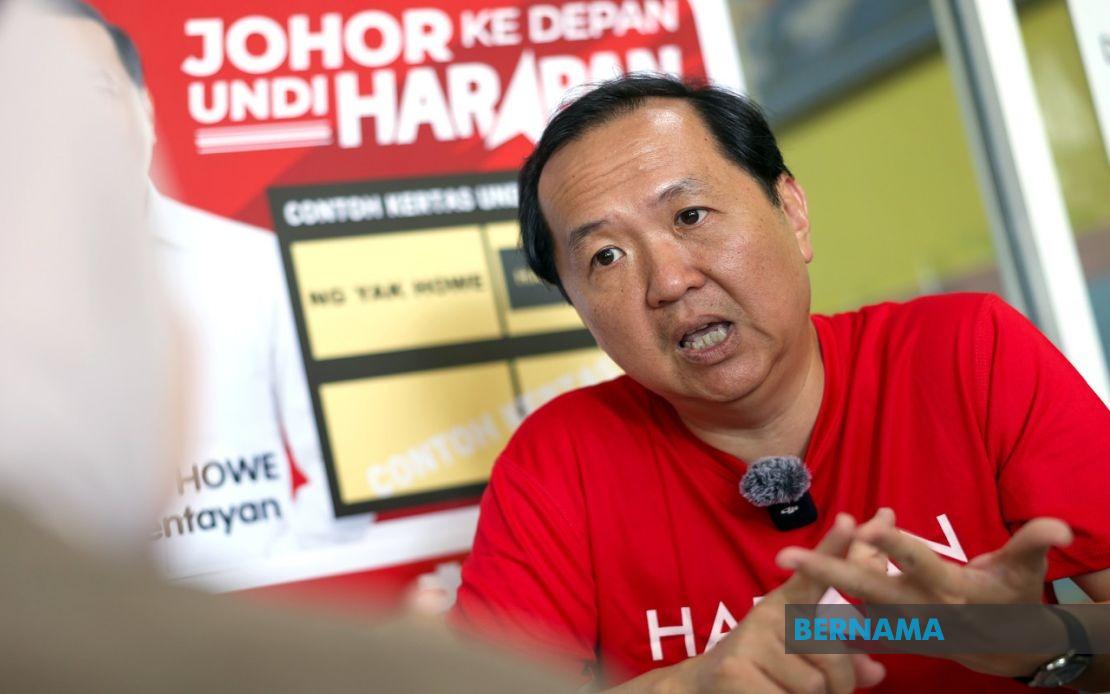
As Johor voters prepare for the state election on July 11, incumbent Bentayan assemblyman Ng Yak Howe is casting urban renewal as his signature campaign issue, targeting the visible decay of Muar's historic town centre where shuttered shophouses and vacant offices stand as monuments to decades of demographic drift. The Pakatan Harapan candidate's emphasis on the town's revitalisation reflects a challenge faced by many older commercial districts across Malaysia, where suburban expansion and the rise of shopping malls have hollowed out traditional business hubs. Ng's focus suggests that local-level concerns about community vitality and economic opportunity remain potent electoral concerns in Johor, even as state-level politics dominates national discourse.
The Bentayan constituency, which encompasses more than half of Muar's town centre proper, encapsulates the problem plainly. During business hours, the area pulses with commercial activity as traders and office workers conduct their daily routines. Yet as evening falls and the workforce disperses to residential areas on the urban fringe, the town centre transforms into a hollow shell, its streets and shopfronts abandoned until dawn breaks again. This boom-and-bust daily cycle reflects a structural issue: younger families and established businesses have progressively relocated outward in search of modern infrastructure, ample parking, and the amenities that suburban developments promise. The incumbent sees reversing this trend as integral to his bid for a third term representing the 34,205 registered voters in Bentayan.
Ng's approach combines pragmatism with modest intervention. Working alongside Bakri Member of Parliament Tan Hong Pin, he has championed merchant assistance schemes including cash vouchers and lucky draw promotions designed to lure consumers back into town centre shops. These initiatives, familiar to Malaysians through similar programmes nationwide, operate on the logic that targeted purchasing power can catalyse broader recovery. The two parliamentarians have framed such measures not as subsidies but as instruments to address the approximately 18 per cent vacancy rate that characterises the town centre's retail and office landscape. By channelling government support toward existing proprietors, the strategy attempts to stabilise the commercial base while demand gradually rebuilds.
Ng's political credentials rest on substantial experience. A former quality assurance engineer with more than a decade in private industry, he has invested over 25 years in political engagement and currently serves on the Johor Democratic Action Party committee. His background in technical fields suggests an orientation toward systematic problem-solving, though urban revival projects often prove more complex than single-sector initiatives. The incumbent's decision to highlight economic revitalisation rather than abstract policy platforms indicates his reading of voter priorities in a constituency where daily commerce and streetscape conditions form the texture of constituent experience.
His challenger in what has become a straight two-candidate contest is Barisan Nasional's Chua Lee Huat, setting up a direct contest for the Bentayan seat. The binary configuration eliminates third-party competition and may focus voter choice sharply on candidates' records and visions. For Ng, his incumbency carries both advantage and liability: he can point to initiatives undertaken over two terms, yet bears responsibility for any continued deterioration. Chua will likely position himself as offering fresh perspective and untapped connections to federal resources, particularly given BN's control of both national government and several key state institutions. The outcome may hinge substantially on how Bentayan residents weigh Ng's proven engagement against appetite for alternative leadership.
The broader Johor electoral context provides crucial backdrop. With 172 candidates contesting across 16 state seats, the election will determine control of a state assembly historically pivotal to national politics. Johor's demographic and economic weight—as Malaysia's most developed state outside the federal territories and a launchpad for national leaders—means that state-level races often preview national political sentiment. While Bentayan represents a localised battleground, the election campaign offers voters opportunity to assess which coalition and which individuals can address the lived experience of towns, suburbs, and rural communities. In this regard, Ng's focus on town centre decay addresses a tangible irritant familiar to Malaysian urbanites beyond Muar.
The campaign also reflects evolving tensions within Malaysian federalism. State assemblypersons occupy a tier of government often overlooked in national media coverage, yet they shape decisions on local commerce, public space, and community development. Ng's pitch essentially argues that sustained local attention—the kind an incumbent with established relationships can provide—matters more than promises of broader policy shifts. This grounds electoral choice in the quotidian, moving conversation away from abstract political allegiances and toward the material condition of the constituency. Whether this strategy resonates with voters will become apparent on polling day.
Early voting is scheduled for July 7, providing flexibility for those unavailable on the main polling date. The relatively high voter registration of 34,205 in Bentayan suggests substantial engagement with the democratic process, though participation rates will ultimately determine turnout. As election week approaches, Ng will continue intensive ground engagement, seeking to consolidate support among traders invested in town centre recovery and residents nostalgic for Muar's former commercial vitality. The election represents not merely a personal contest between two candidates but a referendum on how constituencies should revitalise themselves in an era of dispersed settlement patterns and transformed shopping habits.

