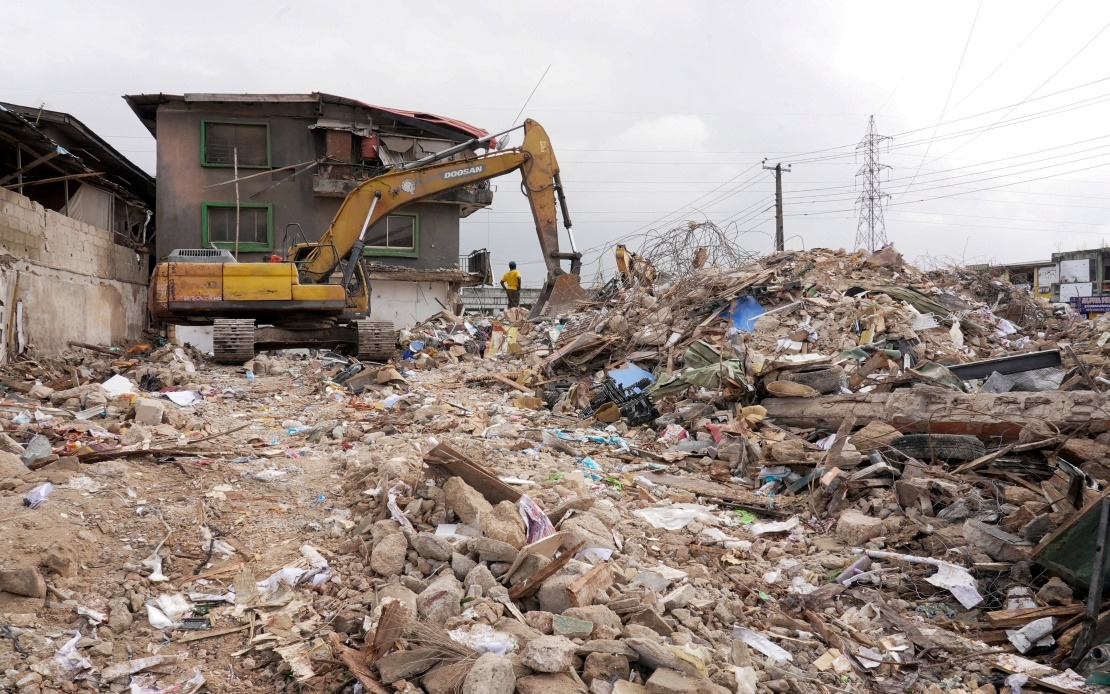
A devastating structural failure in Lagos, Nigeria's commercial heartland has claimed nine lives, with rescue crews managing to pull 27 survivors from the ruins of a three-storey shopping complex that gave way unexpectedly on Thursday morning. The incident occurred in Alakija, a rapidly expanding residential and commercial hub positioned along the Lagos-Badagry Expressway, one of the state's major arterial routes connecting the megacity to surrounding regions.
Emergency responders mobilised swiftly following the Thursday morning collapse, with multiple agencies coordinating an intensive search-and-rescue operation that persisted through the night and into Friday. Olufemi Oke-Osanyintolu, the permanent secretary of the Lagos State Emergency Management Agency, confirmed to international media that teams operated continuously to extract trapped individuals from beneath tonnes of concrete, steel, and debris. The scale of the rescue effort underscored both the urgency of the situation and the complexity of locating survivors within the unstable wreckage.
The individuals extracted from the rubble sustained injuries ranging from minor to severe. Medical personnel transported all survivors to nearby hospitals for immediate treatment and assessment, with healthcare facilities in the Alakija area and central Lagos mobilised to accommodate the influx of casualties. The exact condition of survivors remained undisclosed, though the significant variation in injury severity suggested that proximity to structural failure points and luck played determining roles in survival outcomes.
Preliminary investigations into those trapped within the complex revealed that the majority were shop owners conducting regular commercial activities at the time of collapse, alongside numerous customers engaged in routine shopping. Several residents from neighbourhoods adjacent to the building also became trapped beneath the rubble, broadening the demographic scope of the incident beyond those directly engaged with the commercial premises. This pattern reflects the dense, mixed-use urban development characteristic of growing satellite communities around Lagos.
The China Civil Engineering Construction Corporation, currently executing a railway infrastructure development project in the locality, contributed personnel and equipment to the rescue operation. This involvement highlighted how major construction enterprises operating in the region maintain emergency response capabilities that can be mobilised during crises affecting surrounding communities. The railway project itself underscores Lagos state's ongoing infrastructure expansion agenda.
Authorities announced the conclusion of rescue operations early Friday, indicating that all individuals believed trapped had been located and evacuated. This declaration, while providing closure to the immediate emergency response phase, simultaneously shifted focus toward understanding how a relatively modern three-storey commercial structure failed so catastrophically. The authorities initiated a formal investigation to establish the precise cause of the collapse.
The fundamental cause remains officially undetermined, with investigators facing the challenge of examining destabilised remains to identify contributing factors. Preliminary findings and expert commentary will likely point to established patterns visible across Nigeria's construction sector, where buildings of varying ages suffer structural failures under circumstances that could theoretically be prevented through rigorous compliance with established safety protocols.
Building collapses represent a recurring tragedy across Nigeria, occurring with sufficient frequency to constitute an ongoing public safety concern rather than isolated anomaly. Expert analysis consistently identifies three primary culprits: the deterioration of aging structures that have exceeded their design lifespan without adequate maintenance or reinforcement, systematic violation of building codes and safety regulations during construction and occupancy, and the widespread deployment of substandard or counterfeit construction materials in projects prioritising cost reduction over structural integrity.
The Lagos incident occurs within a broader regional context where rapid urbanisation in West Africa's largest city has created competing pressures between demand for affordable commercial and residential space and the implementation of rigorous building standards. Property developers facing intense competition and cost pressures sometimes circumvent regulatory frameworks, whilst enforcement agencies struggle with capacity constraints in monitoring the thousands of construction projects occurring simultaneously across the sprawling metropolitan area.
For Malaysia's property and construction sectors, the Lagos collapse offers a cautionary illustration of consequences that unfold when building standards erode. While Malaysian building codes remain comparatively stringent and enforcement mechanisms substantially more robust than in Nigeria, the incident reminds policymakers and developers of the perpetual need for vigilance. Southeast Asian nations experiencing rapid urbanisation should examine Lagos's experience as evidence of how inadequate oversight and corner-cutting can generate not merely financial losses but devastating loss of life.
The rescue operation's relative success in extracting 27 individuals alive, despite the building's complete failure, suggests that response capabilities in Lagos have improved significantly compared to previous decades when similar incidents occurred with minimal rescue intervention. This incremental progress, whilst welcome, cannot substitute for preventing collapses through rigorous regulatory compliance and regular structural inspection regimes. The investigation's findings will likely generate recommendations for tightened oversight, though implementation across Lagos's sprawling informal development zones remains perpetually challenging.
As investigation proceeds, grieving families and injured survivors face immediate practical and emotional challenges. The incident will prompt renewed discussion within Nigeria regarding construction sector reform, though converting such discussion into meaningful regulatory strengthening and enforcement has historically proven difficult. For Lagos residents and businesses, the collapse serves as a stark reminder of infrastructure vulnerability within the city's rapidly expanding peripheral areas, where growth often outpaces institutional capacity for safety oversight.

